
Headless and composable commerce trends 2026: adopt, pilot or ignore

Contents
Headless commerce trends only deserve budget when they change a contract in your stack: the engine, the OMS, search, the CMS or the frontend. In 2026 four of them have current evidence behind them, and each one touches a different layer.
Others, including generic MACH enthusiasm and unsourced speed claims, should not move a roadmap. The right call depends on your catalog complexity, channel mix and how many vendor contracts your team already tracks.
Headless commerce trends in 2026: The short answer
Headless commerce in 2026 changes in four places:
- Agent-facing protocols such as Google's Universal Commerce Protocol and the Agentic Commerce Protocol add a new sales channel.
- Composable commerce suites replace best-of-breed vendor sprawl.
- The order management system becomes the integration hub for unified commerce.
- Interaction to Next Paint drives frontend work on hydrated storefronts.
Headless separates the storefront from the commerce engine through APIs, and composable commerce assembles that engine from interchangeable services.
Agent protocols are the newest and least settled, so we recommend exposing a clean catalog feed and an idempotent order API before committing to any one standard.
Suites fit teams tired of tracking a dozen API contracts, while best-of-breed still fits teams with strong platform engineering. An order management system pays off once sales channels multiply. INP work pays off first on pages with heavy client-side personalization and tag managers.
A team with one storefront and a stable catalog can skip most of this list. For the market itself, analyst estimates for 2026 range from US$2.13 billion to US$2.41 billion, with forecast growth of roughly 21-23% a year; the statistics section compares the sources.
Is headless commerce worth it in 2026?
Headless commerce is worth it in 2026 when two or more storefronts or channels consume one catalog and your team can own frontend operations. Otherwise, stay on a packaged platform.
The rule maps to four common situations:
| Situation | Our call |
|---|---|
| One storefront, one region, marketing-led changes | Stay packaged |
| Web, app, B2B portal, or agent checkout reading one catalog, with a frontend team | Go headless on an API-first engine such as commercetools |
| Several channels, no capacity to run vendor integrations | Composable commerce suites with pre-integrated components |
| One channel, strong frontend team | Shopify Plus, with Hydrogen if you need custom rendering |
Headless moves rendering, caching, preview, and release management onto your team. With one storefront, that overhead buys little.
With several channels reading one catalog and one pricing model, an API-first engine such as commercetools lets each channel call the same APIs, which avoids per-channel catalog copies and duplicated merchandising work.
Because those channels share one backend, many teams also decouple order and inventory updates through event-driven architecture for headless commerce, so each channel reacts to the same events instead of polling shared APIs.
Teams that meet only half the rule have two middle options. Composable commerce suites bundle search, CMS, and order management under one contract. Commerce Components by Shopify, aimed at enterprise retailers, lets a merchant adopt Shopify's checkout and other components inside a stack it already runs, without a full replatform.
Run cost tends to decide these cases more than licence fees, because frontend engineers and integration upkeep recur every year. The composable commerce cost breakdown models that in full. If you are mapping channels to a target architecture, our headless commerce development and API-first commerce services cover that scoping.
Can AI agents become a storefront channel?
AI agents can become a storefront channel in 2026, but the checkout half is still unsettled. Google's Universal Commerce Protocol (UCP) now runs checkout inside Google's surfaces, while OpenAI moved ChatGPT's Instant Checkout out of product listings in March 2026 (Digital Commerce 360, 2026). We recommend making your catalog and order APIs agent-ready and piloting one surface before any architectural change.
Three protocols and one tooling pattern now define how an agent finds, prices and buys a product:
| Standard | Announced | Led by | What it standardizes | Status in October 2026 |
|---|---|---|---|---|
| Agentic Commerce Protocol (ACP) | Sept 29, 2025 (Stripe) | OpenAI and Stripe | Checkout sessions between agent and merchant, with Shared Payment Tokens scoped to one merchant and one order total | Instant Checkout moved from ChatGPT listings to merchants' ChatGPT apps; OpenAI keeps ACP as shopping infrastructure |
| Agent Payments Protocol (AP2) | Sept 16, 2025 (Google Cloud) | Google, with payments partners | Signed mandates proving the user authorized an agent-initiated payment | Open specification; UCP is built to work with it |
| Universal Commerce Protocol (UCP) | January 2026, at NRF | Google, co-developed with Shopify, Etsy, Wayfair, Target and Walmart | Discovery, checkout and order lifecycle across agent surfaces; merchants publish capabilities at /.well-known/ucp | Direct checkout for "hundreds of thousands of brands and retailers" across Google (Google, 2026) |
| Model Context Protocol (MCP) servers for commerce | MCP released Nov 2024 | Platform vendors such as Shopify and commercetools | Catalog, cart and order operations exposed as tools any MCP client can call | commercetools Managed MCP Servers generally available since July 16, 2026 (commercetools docs) |
The protocols differ in scope, but they converge on one demand. Your commerce backend must answer machine callers with the same accuracy a human checkout gets. For headless stacks this is mostly an API-contract problem, which is where API-first commerce work pays off.
What the stack must expose
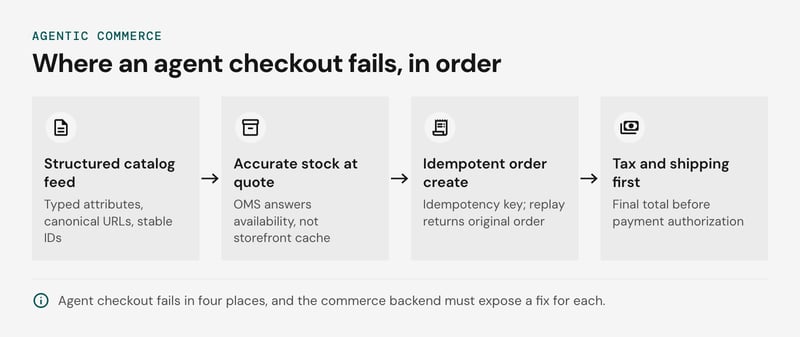
An agent checkout fails in four places, in roughly this order:
- A structured catalog feed. Agents need typed attributes (GTIN, variant options, dimensions, return policy), canonical product URLs, and stable IDs. Descriptions written for page layout are not enough, so audit attribute completeness before you touch any protocol endpoint.
- Stock that is accurate at quote time. The order management system, not the storefront cache, must answer availability. An agent that quotes a price and then fails at completion cannot show the shopper a fallback, so reserve inventory when the session is created.
- Idempotent order creation. Agents retry on timeouts. Require an idempotency key on create-order and complete-checkout calls, and return the original order on a replay. Without it, one flaky network call becomes two shipments.
- Tax and shipping computed before payment authorization. The agent must present a final total in the checkout session update step. Run tax and rate-shopping calls ahead of the authorization request, because a total that changes after the shopper approves breaks the mandate or token the payment relies on.
Agents retry on timeouts and act on whatever they read last, so three of those points map to failures a human shopper would rarely trigger:
| Failure mode | Cause | Early sign | What to expose |
|---|---|---|---|
| Duplicate orders | Agent retries a timed-out create-order call | Two orders against one payment intent | Idempotency key bound to the checkout session; the OMS returns the original order on replay |
| Price drift | Quote expires before payment authorization | Authorized amount differs from the quoted total | Quote ID with expiry timestamp and price version; explicit rejection on mismatch |
| Stale stock | Agent reads cached availability | Orders accepted, then cancelled at fulfillment | Reservation with a short TTL, released on abandonment |
Build in that order. Duplicate orders cost refunds and trust, quote expiry is a contained change in pricing logic, and reservations need OMS and warehouse integration.
Derive the idempotency key from the checkout session, because a key generated per request turns every retry into a new order. Stripe's API already accepts idempotency keys on payment calls, so the gap usually sits in the order-create endpoint of your own engine.
A read-only catalog MCP server needs none of this, which makes it the cheapest first step.
Where this breaks down
The protocols are about a year old and still changing. ChatGPT's in-chat checkout lasted about five months in its first form, and each agent surface has its own merchant onboarding and market coverage. We found no public, independently audited data on agent-originated order volume, so any revenue forecast for this channel is a guess.
Our verdict is to pilot. Pick one category and one market, expose it through the surface your customers already use, and tag every order with its channel in the OMS. Track refund and order-error rates against web checkout before widening scope, and keep each protocol behind your own adapter so a change on the agent side does not reach your order logic.
Composable commerce trends 2026: Is packaged composability winning?
Packaged composability is replacing best-of-breed sprawl for teams without platform engineering capacity, while best-of-breed holds where one differentiating capability justifies owning its integration.
Composable commerce suites such as VTEX, SAP Commerce Cloud and Commerce Components by Shopify sell modular capabilities under one vendor contract and one release train.
When Shopify launched Commerce Components in January 2023, it described them as the same infrastructure that powers over 10% of US ecommerce, a figure for Shopify's whole platform. The pitch is the suite argument in one line: modular parts from one vendor, with one release train.
The gain is fewer contracts to track. Assume a stack with six vendors: commerce engine, search, CMS, OMS, payments and promotions. That is six deprecation schedules, six webhook payload formats and six auth setups. A suite collapses most of them into one or two.
The trade-offs side by side (the six-vendor count is our illustrative assumption):
| Composable commerce suite | Best-of-breed | |
|---|---|---|
| API versions and contracts to track | One or two vendor schedules | One per vendor, six in the example above |
| Roadmap control | Vendor sets the pace; a weak module means waiting or bypassing it | You pick and swap each component |
| Capacity required | An integration owner | A platform team owning contract tests, upgrades and observability |
The price of a suite is roadmap lock-in. When its search or promotion engine lags, you either wait or bolt on a replacement and maintain that seam anyway. Shopify's Hydrogen framework and Oxygen hosting show where vendors are heading: the backend vendor now ships the headless frontend and its runtime as well.
Best-of-breed pays off only when a platform team owns contract tests, version upgrades and cross-vendor monitoring. Without that team, each integration drifts at the speed of its vendor's release cycle.
Our view: take the suite as the default and keep best-of-breed for the one or two capabilities that differentiate you, typically search (Algolia) and content (Contentful or Storyblok). SAP Commerce Cloud shops with deep ERP ties and VTEX adopters are the clearest fit; our pragmatic composability write-up on VTEX covers that route. Define those seams as stable contracts first; our API-first commerce services start there.
The case for finishing what you start is also in the data. In the MACH Alliance's 2026 survey of 600 enterprise technology decision-makers, 78% of organizations with fully implemented, scaled MACH technology reported clear evidence of ROI on AI investments, against 13% of organizations in early planning (MACH Alliance, 2026). It is a self-reported correlation from an industry body, not proof of cause.
Still, it points the same way as our verdict: a half-integrated best-of-breed stack gets the cost of composability without the benefit, and a suite is the shorter path to "fully implemented".
Consolidation also shifts total cost from engineering hours to licence fees, a split the composable commerce cost breakdown quantifies.
Why is the OMS becoming the hub of unified commerce?
An order management system becomes the hub of unified commerce when it alone owns inventory reservation, sourcing and return state across web, store and marketplace channels.
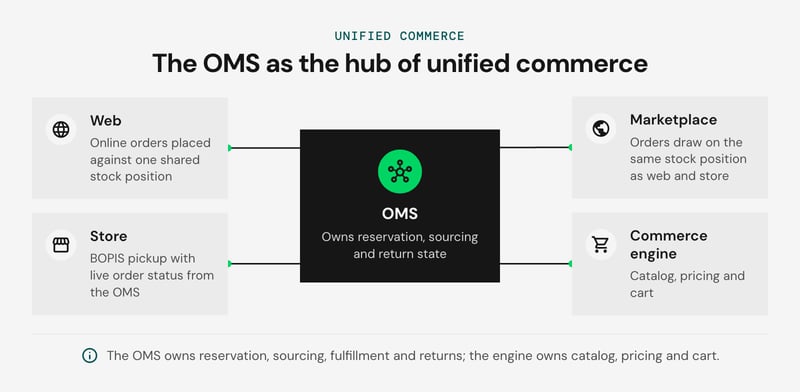
That ownership lets a shopper research online and buy in store (ROPO), or buy online and pick up in store (BOPIS), against one stock position.
Adding an OMS after a headless launch tends to produce three failures:
- Duplicated inventory logic. The commerce engine (commercetools inventory entries and supply channels, or Medusa's Inventory and Stock Location modules) keeps reserving stock while the OMS calculates available-to-promise. Early sign: the PDP and checkout show different availability for the same SKU.
- Broken webhook ordering. Webhook delivery is typically at-least-once and unordered, so an order.updated event can arrive before order.created. Early sign: orders stuck in a state the OMS already moved past. Dedupe on event ID and apply an update only if its resource version is newer.
- Returns split across systems. The refund runs in the commerce engine or PSP, the restock runs in the OMS or WMS, and store returns touch neither. Early sign: finance reconciliation gaps that nobody can attribute to one system.
Our recommendation is to settle the boundary before the storefront launches. The OMS owns reservation, sourcing, fulfillment state and returns. The commerce engine owns catalog, pricing and cart. If you are retrofitting, move reservation first and returns last, because returns touch the most systems.
This does not apply to every merchant. A single-warehouse business with no stores and low order volume can stay on the native order module in commercetools or Medusa. Multi-node sourcing and BOPIS are the point at which a dedicated OMS pays for itself, and API-first commerce architecture work should settle that boundary before the first integration is built.
Do edge rendering and INP still matter for headless storefronts?
Edge rendering and Interaction to Next Paint (INP) both still matter for headless storefronts, but edge rendering improves load speed while INP is set by browser main-thread work.
According to web.dev, INP replaced First Input Delay as a Core Web Vital on March 12, 2024, and a good score is 200 milliseconds or less at the 75th percentile of page loads. Any "LCP and FID" framing is out of date, because FID no longer counts toward the Core Web Vitals assessment.
INP samples every interaction in a visit, so a fast first click no longer hides a heavy page. Edge rendering lowers time to first byte and helps Largest Contentful Paint, but it does nothing for a long task that blocks the main thread after hydration.
Three sources cause most INP regressions on headless builds:
- Client-side personalization: recommendation and A/B scripts that rewrite the DOM after hydration.
- Tag managers: third-party tags that queue long tasks behind user input.
- Large React trees: hydrating the whole product page, including mega menu and review widgets, when only the buy box is interactive.
The usual fixes are Server Components or islands for static regions, deferred tags, and moving segment decisions into edge middleware that serves a cached variant per segment.
The freshness cost of that speed depends on the data:
| Data | Approach | What you give up |
|---|---|---|
| Catalog copy, images, navigation | ISR or static prerender, revalidated on a catalog webhook | Staleness until the webhook fires |
| Price | Cached shell with price in a dynamic partial prerender region, or a short edge TTL with stale-while-revalidate | Promotions lag by the TTL, so the cart must reprice |
| Stock | Banded availability (in stock, low, out) cached briefly, exact reservation by the OMS at add-to-cart | Occasional add-to-cart rejection |
| Personalized blocks | Edge middleware picks a cached per-segment variant | Fewer segments, no per-user HTML |
We recommend caching everything except price and stock aggressively, and treating those two as short-TTL or dynamic regions. On Shopify, Hydrogen's cache strategies (CacheShort, CacheLong, CacheNone) running on Oxygen's edge runtime give you this split for Storefront API queries. Use a short window with stale-while-revalidate for price-bearing queries.
Two limits apply. Account-specific B2B pricing defeats shared edge caching, so render those prices dynamically behind authentication. A slow commerce API origin also erases the edge gain on every cache miss, so check the origin before buying more edge compute.
Headless CMS trends 2026: Visual editing and frontend ownership cost
Headless CMS visual editing cuts the developer tickets marketers raise for page changes, but it moves cost into draft mode, preview environments and preview API upkeep, and the frontend team owns all three.
Contentful and Storyblok both ship in-context editors, and Strapi offers a preview feature for self-hosted setups. In each case the editor loads your production components in an iframe. Every component therefore has to render unpublished content and respond to the editor's click-to-edit annotations.
The trade-off, line by line:
| Cost area | Leaves the backlog | Lands on the frontend team |
|---|---|---|
| Page assembly | Marketers compose landing pages from approved blocks | Block library, schema versioning, deprecation of old blocks |
| Review | Editors see changes in context | Draft mode route, preview authentication, a preview environment per branch |
| Commerce data | Previews show real products | Uncached price and stock calls from preview traffic |
| Editor integration | None | Bridge or live-preview SDK upgrades, field annotations on each component |
Draft mode also interacts with the performance work from the previous section. In Next.js, Draft Mode renders at request time and bypasses the static cache, so a fast preview says nothing about production INP or edge cache behavior. Check performance on published pages only.
Schema coupling is where this tends to break. Renaming a CMS field can break every preview that references it, and editors notice before your monitoring does.
Our view: adopt visual editing, with a preview budget. Ring-fence frontend capacity for preview upkeep from day one, and count it in the business case. If marketing publishes only a handful of templated pages a month, a Git-based content workflow costs less than any visual editor.
What should we change this year? Verdicts by trend
Adopt Interaction to Next Paint fixes, OMS-centered integration and vendor consolidation this year, and pilot agentic commerce. Watch AI search, and do not start a B2B composable migration because of a trend.
The verdicts, with the layer each one changes and a first step:
| Trend | Evidence | Verdict | Layer changed | First step |
|---|---|---|---|---|
| Agentic commerce (UCP, ACP, AP2, MCP servers) | ACP and AP2 announced Sept 2025; UCP Jan 2026; ChatGPT checkout moved to apps Mar 2026 | Pilot | Catalog feed, checkout, payments | Make the catalog feed and order API agent-ready, then pilot one surface. Check whether your platform ships an MCP server (commercetools does). |
| Frontend performance | INP replaced FID as a Core Web Vital in Mar 2024 (web.dev) | Adopt | Storefront rendering, edge | Pull field INP per template from CrUX, then fix the worst template's long tasks and third-party scripts. |
| OMS as integration hub | Netguru assessment | Adopt | Orders, inventory | Route every channel, agents included, through one OMS with idempotent order APIs. See API-first commerce. |
| Headless CMS visual editing | Contentful and Storyblok documentation | Adopt | CMS, preview environments | Budget draft mode and preview API upkeep before rollout. |
| Suite consolidation | MACH Alliance 2026 survey; Netguru assessment | Adopt | Vendor contracts | Map overlapping vendors and retire one. See pragmatic composability. |
| AI search and merchandising | Vendor claims only | Watch | Search, ranking | Test one category inside your existing search vendor, such as Algolia. No rebuild; see headless search vs traditional search APIs. |
| B2B composable | No stack-level change needed | Ignore | Buyer portal, pricing | Revisit when quotes or punchout reach the roadmap. |
These verdicts assume a stack that is already headless and a team that owns its storefront. If you are still replatforming, consolidation and the OMS decision come first. ACP, AP2 and UCP are young and already overlap, so keep the integration behind your own adapter.
Headless commerce statistics for 2026
Analyst estimates of the headless commerce market size disagree because each publisher draws the scope differently. Some count only software licenses, others fold in implementation services, and some include composable commerce suites that sell more than a storefront API.
The estimates side by side, labelled with the publisher whose page we linked and the year of the figure:
| Source and year | Estimate | Scope to check | What it means for a stack decision |
|---|---|---|---|
| Grand View Research, 2025 | Global headless content management system software market valued at USD 1.8 billion in 2025, projected to reach USD 6.2 billion by 2033 (Grand View Research, 2025) | Software only, or services included | Sizes the content layer. Use it for CMS vendor discussions, not commerce budgets. |
| Coherent Market Insights, 2026 | The global headless commerce market is estimated at US$2.13 billion in 2026 and expected to reach US$7.24 billion by 2033, growing at a CAGR of 22.6% (Coherent Market Insights, 2026) | Regional split, enterprise vs mid-market | Lowest 2026 commerce figure here. Check whether it excludes services. |
| Mordor Intelligence, 2026 | The headless commerce platform market is USD 2.41 billion in 2026 and projected to reach USD 6.17 billion by 2031, a 20.69% CAGR (Mordor Intelligence, 2026) | Forecast horizon and base year | Ends in 2031, so compare it with other reports only for the same year. |
| MACH Alliance, 2026 | 78% of organizations with fully scaled MACH technology report clear ROI on AI investments, against 13% in early planning (MACH Alliance, 2026) | Survey of 600 enterprise technology decision-makers, self-reported | An outcome signal from an industry body. It says nothing about spend or market size. |
What the spread tells you
Our own arithmetic on the published figures shows two gaps. For 2026, the two commerce estimates differ by about 13% (US$2.13 billion against US$2.41 billion).
The stated growth rates also need checking. Taking the Coherent endpoints (US$2.13 billion in 2026, US$7.24 billion in 2033), we calculate about 19% a year, below the 22.6% quoted. The base year or rounding may explain it. Mordor's endpoints do reconcile with its 20.69%.
How to use the figures
These conditions cover most stack conversations:
- Making the case that the category is growing: cite two or more sources with their years. The stated growth rates cluster between roughly 21% and 23%.
- Sizing a replatforming budget or vendor shortlist: use none of them. Market totals say nothing about your catalog complexity, your OMS integration load, or the total cost of your own build, which the cost breakdown covers. The business impact of headless commerce depends on those variables.
- Answering "is everyone doing this?": there is no reliable adoption percentage; quote the MACH Alliance outcome figures and label them self-reported.
- Before quoting any number: confirm scope (software or services), base year, and forecast horizon.
FAQ: Headless commerce in 2026
What are the main headless commerce trends for 2026?
What is the difference between headless and composable commerce?
How big is the headless commerce market in 2026?
What is the Agentic Commerce Protocol?
Where to start
Start with your order management system: list the order, inventory, and returns data every channel, including AI agents, will read and write before you choose a storefront framework or a protocol. On a commercetools stack, that list decides how much order orchestration stays in the platform and how much moves to the OMS.
For vendor shortlists, read our headless commerce platform comparison; for shifts outside the stack, see the wider ecommerce trends. We recommend a short architecture review before any build, and our headless commerce team can run it with you: tell us about your stack and we will scope the review around the trends that apply to it.


