

Enterprise Software Development Company

Enterprise software development services: custom platforms, system integrations and legacy modernization from an ISO 27001 certified team. Rated 4.9 out of 5 by our clients.

Trusted by

Estimate your project

What an enterprise software partner builds for you

Six service lines cover most enterprise software development work, from a new platform to the systems around it.

Custom enterprise platforms

Custom application development for internal portals, customer platforms, and workflow tools, shaped around your user roles and built on an API-first architecture, so new channels and apps connect later without rework.

Legacy system modernization

Aging systems are replaced or re-platformed in stages, with old and new running side by side until each module is proven. Migration and rollback plans come before any cutover.

ERP and CRM integration

Your ERP and CRM connect to the new software through documented APIs. Data mapping and ownership of each record are agreed before the first line of integration code.

Cloud and platform engineering

Environments on AWS, Google Cloud, or Microsoft cloud, defined as infrastructure as code, with automated delivery pipelines and monitoring handed over to your operations team.

Data and AI

Data pipelines, reporting layers, and AI features go in where they fix a defined business problem.

Product design

Research, UX, and UI for dense, role-based interfaces, tested with real users before build and delivered against WCAG 2.2.

Enterprise software development backed by real delivery

17+

Years in the market

Building web, mobile and AI products since 2008.

3,500+

Projects delivered

From MVPs to enterprise platforms.

900+

Clients worldwide

Product teams in 50+ countries.

4.9/5

Average client rating

How our clients rate their work with Netguru.

Medical document repository: 10+ sources in one system for 44 hospitals

A medical software company needed patient documentation from many hospital systems in one place, built to the standards hospitals require.

Netguru built the backend in Python and Django, compliant with XDS and HL7, and integrated more than ten documentation sources. The system now runs in 44 hospitals in Poland.

  • 44

    Hospitals

  • 10+

    Documentation sources

  • 4

    Months to the first release

Read case study
Medical document repository case study

How an enterprise project runs, step by step

Each stage ends with a gate your procurement and IT leadership can review before the next one starts.

  1. Discovery and architecture

    We map user roles, systems, constraints, and risks during a paid discovery phase, which turns cost drivers into an estimate. You receive a target architecture, a prioritized roadmap, and a costed plan.
  2. Prototype

    Designers and engineers test the riskiest flows and integrations with real users and real data samples. You receive a clickable prototype and a go or no-go decision point.
  3. Build in increments

    Sprint-based delivery with automated tests, peer review, and a demo at the end of every sprint. You receive working software on a staging environment and a release-ready backlog.
  4. Integration and security review

    We test connections to ERP and CRM systems, run a review against OWASP Top 10, and check data handling. You receive a test report, a findings log, and sign-off criteria.
  5. Launch

    Phased rollout with a migration plan, monitoring, and a rollback path agreed with your IT team. You receive runbooks, documentation, and trained internal owners.
  6. Run and evolve

    Support and further releases follow the terms in your service level agreement, with regular reviews of backlog and performance. You receive a clear owner for every incident and every roadmap item.

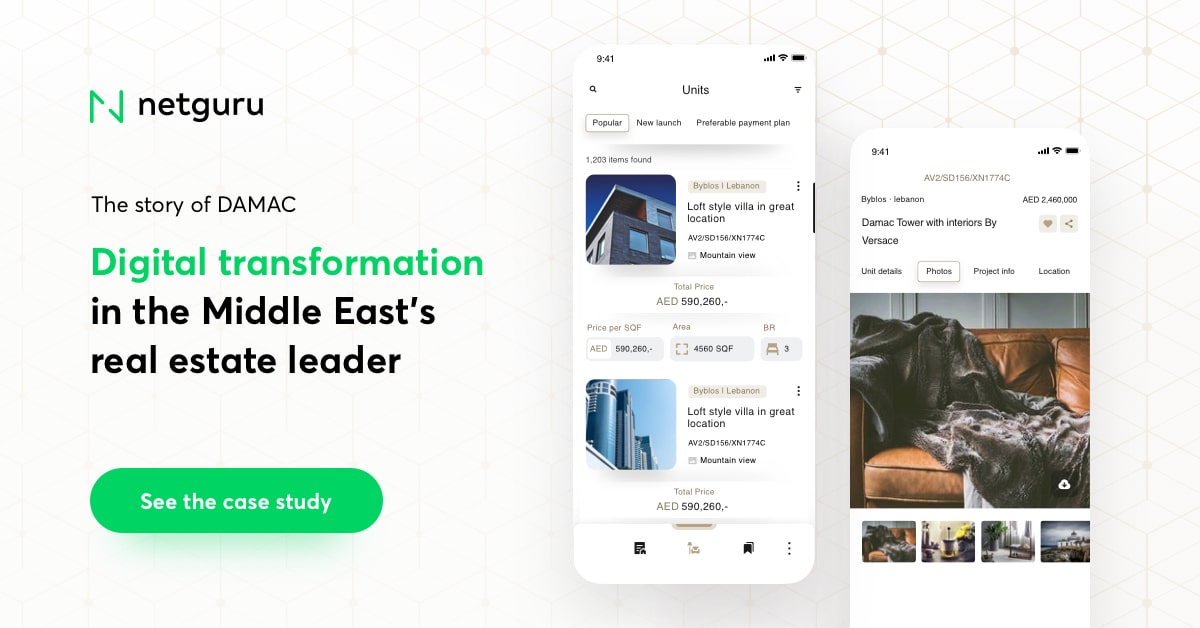
DAMAC: one app for the agents of a 40,000-unit property portfolio

DAMAC Properties, which has delivered about 25,000 luxury homes, wanted everything its sales agents need in one place.

Netguru built the iOS and Android app that brings offers, property details, sizes, locations and specifications together for the agents.

  • 25,000

    Homes delivered

  • 40,000

    Units in the portfolio

  • 17

    Years in the market

Read case study
DAMAC case study

The engineering standards behind the work

What we do on every enterprise project, named so you can hold us to it.

Code quality and testing

Unit, integration, and end-to-end tests run in the pipeline on every pull request, and peer review gates each merge.

Performance at scale

Load tests against targets agreed with you run before launch, and monitoring with alerting stays on afterwards.

Accessibility

Interfaces are designed and tested against WCAG 2.2, so internal tools and customer portals work for every user.

Security and compliance

Reviews against OWASP Top 10, GDPR-aligned data handling, and ISO 27001 certified processes cover the full delivery cycle.

Integration and API design

An API-first architecture with versioned, documented contracts keeps your ERP, CRM and internal systems connected as each one changes.

AI where it fits

AI features and AI-assisted engineering are used when they fix a defined problem and pass the same review as any other code.

What our clients say

Rated 4.9 out of 5 by our clients.

Cooperation with Netguru allowed us to efficiently deliver our vision – the team brought valuable competencies in system architecture, backend development and cloud solutions that supported our business goals.

Paweł Grabowski

Head of Digital B2B at Żabka Future, Zabka

The Netguru team has gone above and beyond any expectations of what a strong and reliable partner can be.

Hima Mandali

CTO, Solaris SE

Let me put it this way: we have built a grand and impressive building. But without Netguru's insights, we would be stuck on the ground-floor forever.

Artur Kryzan

Team Leader and CX Manager, Volkswagen

How to evaluate an enterprise software development company

A scorecard for comparing partners before a multi-year commitment.

Security certifications

Ask for ISO/IEC 27001 certification or a SOC 2 Type II report, and how access to your data is controlled. Netguru is ISO 27001 certified.

Domain experience and references

References from companies of your size and industry show whether the team has met similar compliance and integration demands.

ERP and CRM integration track record

Most enterprise projects depend on integrations, so ask which systems the team has connected and how it tested them.

Architecture ownership

Your team should own the architecture decisions and documentation, so the system does not depend on one vendor.

IP ownership and exit terms

The contract should give you the code and IP, and set out a handover plan if you change partners.

SLA and total cost of ownership

Compare the service level agreement for support and the total cost of ownership over several years, not only the build price.

How you can work with us

Three ways to start. Each one comes with the same delivery standards and a named delivery lead.

Fixed-scope project

A defined scope, timeline and budget, agreed after a paid discovery phase. It suits a first release or a well-specified module.

Dedicated team

A cross-functional team of engineers, an architect, QA and a delivery lead that owns a roadmap with you sprint by sprint, under time and materials.

Team extension

Senior engineers and architects who join your in-house team, follow your process and tools, and are matched to the skills your roadmap needs.

Enterprise software development: your questions answered

What does an enterprise software development company deliver?

An enterprise software development company designs, builds, integrates, and runs custom software for large organizations with many users, connected systems, and compliance duties. Typical work covers custom platforms, legacy system modernization, ERP and CRM integration, cloud engineering, data and AI features, and product design.

It differs from a general web agency by owning architecture, security, and long-term support. It differs from a vendor such as SAP by building around your processes. Our guide to covers the scope in more detail.

How much does enterprise software development cost?

Cost depends on the scope and number of user roles, the number and age of integrations, design depth, compliance and security needs, and team shape and engagement model. We do not publish price ranges because they would mislead. A discovery phase turns these drivers into an estimate you can take to procurement.

Ask what a quote excludes. Common exclusions are third-party licences, cloud hosting, data migration outside the agreed scope, change requests, and your own staff time.

Fixed price, time-and-materials, or dedicated team: which engagement model should we choose?

We usually recommend a fixed-scope project once discovery has defined the work, because it gives you cost predictability. A time-and-materials contract fits work where requirements will change as you learn. A dedicated team model fits a product that will run and grow for years.

Team extension suits organizations that already have strong management and need extra engineers. Many of our enterprise clients start with discovery, then move to a dedicated team.

How long does enterprise software development take?

Timeline depends on scope, the number of integrations, how many releases you plan, compliance reviews, and how fast your side can make decisions and provide access to systems. Modernization usually runs longer than a greenfield build because old and new systems must coexist.

We do not quote week counts before discovery. The discovery phase produces a roadmap with milestones and stage-gates you can plan against.

How do you choose an enterprise software development partner?

Use a checklist and ask every shortlisted firm for evidence on each point:

  • Case studies in your sector and with systems like yours.
  • Security certification: ask for SOC 2 and ISO/IEC 27001 evidence. We hold ISO 27001.
  • Code ownership and IP assignment written into the contract.
  • A statement of work with clear acceptance criteria.
  • Support terms, including a service level agreement.
  • A named team with a plan for continuity.
  • Reference calls with past enterprise clients.

Should we build, buy, or configure enterprise software?

We recommend buying or configuring a platform such as SAP or Salesforce when your process is standard and the platform covers it. Build custom software when the process gives you an advantage or no product fits.

Most enterprises end up with a mix. We design custom parts with an API-first architecture, so they connect cleanly to the platforms you already run.

Talk to our enterprise software expert

Tell us about your product, and we will talk through scope, the right team and the engagement model.

Barbara Rybicka

Commercial Director

Click for the details