
Site Reliability Engineering Best Practices: Turning SRE into a Business Advantage

Contents
Site reliability engineering best practices have evolved from technical procedures into measurable business assets. Organizations implementing an SRE-driven strategy with proactive monitoring and automated routine tasks report a notable 30% reduction in incident-related customer complaints within the first year. These results demonstrate why reliability engineering matters to both technical teams and business leaders.
What is site reliability engineering? Created by Google, the SRE model allows developers to focus on feature velocity and innovation while system operators concentrate on consistency and reliability. SRE practices maintain system stability and minimize outages in complex cloud environments, striking a balance between feature development and operational reliability. The approach centers on preventing and mitigating incidents to ensure systems remain available and performant, making site reliability a core business asset rather than just a technical concern.
This article examines how organizations can leverage best practices in reliability into tangible business advantages by establishing well-defined service level objectives (SLOs), fostering cross-functional collaboration, and implementing product-focused reliability enhancements. As reliability practitioners often note, "If you can't measure it, you can't improve it".
Key Takeaways
Organizations implementing SRE practices achieve remarkable business results, with up to 30% reduction in customer complaints and 35% improvement in uptime within the first year.
- Balance innovation with stability through error budgets and SLOs that quantify acceptable unreliability while enabling rapid feature development.
- Implement the four golden signals of monitoring: latency, traffic, errors, and saturation to achieve comprehensive system observability.
- Reduce operational toil by 50% through automation and self-healing systems, freeing engineering time for innovation and value creation.
- Foster psychological safety with blameless postmortems to encourage honest incident analysis and prevent repeat failures.
- Transform operations into a value center by treating reliability as a strategic business advantage rather than just a technical concern.
SRE success requires both technical excellence and cultural transformation. Organizations that embrace cross-functional collaboration, shared ownership, and data-driven decision-making position themselves for sustainable growth while maintaining a competitive advantage through consistently reliable services.
Understanding SRE as a Business Enabler
Modern enterprises increasingly view Site Reliability Engineering (SRE) as a critical business enabler, not merely a technical function. According to the Global SRE Pulse 2022 report, 19% of organizations have implemented SRE across their entire operations, while another 55% utilize it for specific teams, products, or services. This widespread adoption reflects how SRE has evolved from a specialized Google practice into an essential component of enterprise IT strategy.
What is site reliability engineering in modern enterprises
Site reliability engineering fundamentally applies software engineering principles to solve operations problems. Instead of viewing operations and development as separate domains, SRE creates a bridge between them to ensure system reliability without sacrificing innovation. SRE teams focus on availability, latency, performance, and capacity planning through the use of automation and engineering solutions.
What makes SRE valuable to modern enterprises? The core value proposition comes from its ability to balance two seemingly contradictory business needs: stability and agility. As Google's SRE documentation states, "At the end of the day, our job is to keep agility and stability in balance in the system". This balance enables organizations to innovate quickly without compromising service quality.
For business leaders, SRE represents a significant shift in how operational roles are perceived. Traditionally, IT operations were treated as unavoidable expenses, whereas SRE positions operations as a value creation center. SRE teams demonstrate this value through measurable improvements in system reliability, scalability, and performance—factors directly linked to customer satisfaction and business outcomes.
SRE vs DevOps: Aligning speed with stability
Although SRE and DevOps share common goals, they approach them in different ways. DevOps emphasizes cultural change and collaboration across the software lifecycle, whereas SRE provides specific engineering practices to implement that philosophy. As Google's SRE book explains, "If DevOps is the 'what,' SRE is the 'how'".
The primary difference between these approaches lies in their focus. DevOps manages the end-to-end product lifecycle from development to deployment and maintenance. SRE focuses on delivering and maintaining a stable production environment. When organizations employ both, DevOps typically handles what teams build, while SRE determines how they build it.
SRE contributes to speed without sacrificing stability through several key mechanisms:
- Error budgets that quantify acceptable levels of unreliability
- Automation that reduces manual toil and human error
- Service Level Objectives (SLOs) that align reliability goals with business priorities
This framework enables organizations to make data-driven decisions about when to accelerate feature development versus when to prioritize improving reliability.
Site reliability engineering services and their scope
The scope of SRE services extends beyond traditional IT operations. Site reliability engineers typically divide their time between solving customer problems (managing escalations and incidents) and automating operations tasks. This balanced approach ensures immediate issues are addressed alongside long-term improvements.
SRE services typically encompass:
- Production system monitoring and observability
- Release and change management engineering
- Emergency response protocols and incident management
- Complex problem solving and capacity planning
- System scaling and load balancing
Moreover, SRE teams establish and maintain service level indicators (SLIs), objectives (SLOs), and error budgets that translate technical metrics into business outcomes. These measurements establish a common language between technical and business stakeholders, facilitating more informed decision-making regarding reliability investments.
As enterprises continue digital transformation initiatives, SRE becomes increasingly crucial for maintaining competitive advantage. The structured approach to reliability enables businesses to scale operations efficiently, reduce operational costs through automation, and enhance customer experiences by providing more reliable services.
Core SRE Practices That Drive Business Value
Core SRE practices deliver measurable business advantages through enhanced system reliability, reduced operational costs, and improved customer experiences. Organizations that effectively deploy SRE methodologies have reported up to 35% improvement in uptime and a 44% decrease in operational expenses. These practices form the foundation of a successful SRE strategy.
SRE monitoring best practices for observability
What does effective monitoring actually look like? Google's SRE teams emphasize that monitoring should address two fundamental questions: what's broken and why. This straightforward approach ensures teams can quickly identify and resolve issues before they impact users.
The four golden signals of monitoring provide a comprehensive framework for observability:
- Latency: Measure of response time for requests
- Traffic: Measure of demand on the system
- Errors: Rate of failed requests
- Saturation: How constrained the system is under current load
If teams can only track four metrics of their user-facing systems, these four signals should take priority. Monitoring systems should avoid "magic" solutions that attempt to automatically detect causality or learn thresholds. Instead, monitoring should remain simple and comprehensible to everyone on the team.
Many organizations combine white-box monitoring (internal system metrics) with strategic black-box monitoring (external testing). This hybrid approach creates complete visibility across service components. Data freshness is equally critical—monitoring data more than four to five minutes stale might significantly delay incident response.
Defining SLIs, SLOs, and error budgets
Service level management provides a structured framework for measuring and ensuring reliability. This framework consists of three interconnected components:
- Service Level Indicators (SLIs): Quantifiable measures of service quality from the customer perspective, typically represented as the ratio of successful events to total events
- Service Level Objectives (SLOs): Target values for SLIs over a specific time period
- Error Budgets: The acceptable amount of unreliability (100% minus the SLO target)
Well-implemented SLOs serve as a powerful tool for determining what engineering work to prioritize. When choosing between automating rollbacks or migrating to a replicated data store, teams can calculate the estimated impact on their error budget to determine which approach delivers the greater customer benefit.
Well-defined SLOs require approval from all stakeholders, including product managers who confirm the thresholds meet user expectations and developers who commit to reducing risk when error budgets are exhausted. This collaborative process ensures that reliability targets align with business goals.
Contrary to intuition, 100% reliability is not an appropriate SLO target. Setting a 100% target would prevent teams from updating or improving services, as changes are the primary source of outages. Realistic SLOs below 100% create the flexibility needed for innovation while maintaining customer satisfaction.
Reducing toil through automation and self-healing systems
Toil—manual, repetitive work with no enduring value—consumes valuable engineering time that could otherwise be invested in innovation. Google's SRE organization limits operational work (toil) to no more than 50% of each SRE's time. The remaining time should focus on engineering projects that either reduce future toil or add service features.
Leading organizations implement self-healing capabilities to automatically resolve issues without human intervention. These systems can detect failures and trigger corrective actions, reducing downtime. Self-healing mechanisms include:
- Automated failover for compute resources, databases, and storage
- Checkpoints for long-running transactions
- Automated remedial workflows triggered by monitoring alerts
Netflix's Chaos Automation Platform exemplifies this approach, proactively identifying resilience gaps before users notice problems. This system has prevented over 200 outages in a single year. Microsoft Azure has achieved a 65% reduction in alerting noise and a 90% auto-resolution rate for common incidents.
The business impact of reducing toil extends beyond technical improvements. Teams report higher morale, decreased burnout, and enhanced productivity when freed from repetitive tasks. Self-healing systems dramatically reduce Mean Time To Resolution (MTTR), with AI-driven solutions responding in seconds rather than minutes.
Successful SRE implementation requires an integrated operating model bringing together application, operations, and infrastructure functions. This holistic approach enables organizations to reimagine traditional IT service management processes and build platforms with complete end-to-end self-service capabilities.
Evaluating SRE Maturity with the Horizon Map
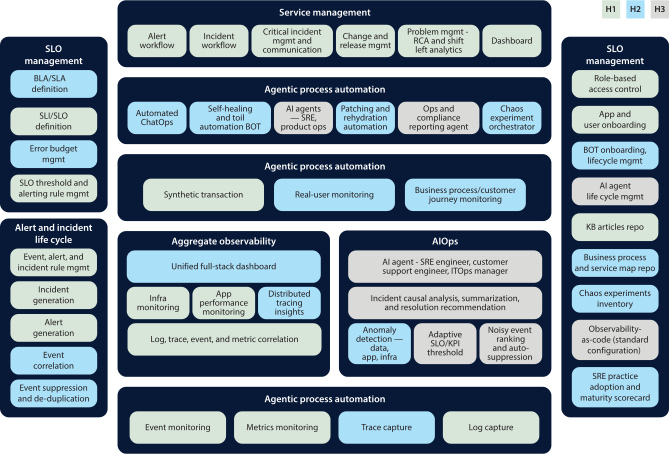
Image Source: Infosys
Organizations need a structured way to measure their current SRE capabilities and plan future growth. The Horizon Map framework offers a practical assessment model that enables teams to evaluate their SRE implementation across three progressive maturity levels.
Horizon 1: Foundational monitoring and automation
Organizations start by establishing essential monitoring infrastructure and basic automation. This initial horizon focuses on implementing infrastructure monitoring for back-end systems, application performance monitoring, and foundational log monitoring to identify specific patterns leading to issues. Teams typically rely on manual log correlation for incident analysis and begin defining Service Level Indicators (SLIs) and Service Level Objectives (SLOs).
Horizon 1 also establishes baseline automation through predefined runbooks, compliance audits, resource scaling, and alerting systems. These foundational elements create the necessary infrastructure for more advanced SRE capabilities.
Horizon 2: Full-stack observability and alert correlation
Organizations mature by transitioning from basic monitoring to observability across applications, databases, servers, and networks. Unlike monitoring that simply alerts on predefined conditions, full-stack observability enables deeper investigation into anomalies using correlated metrics, logs, and traces.
Alert management advances significantly during this phase through noise reduction, de-duplication, and correlation techniques that streamline troubleshooting. Teams begin conducting controlled chaos experiments in non-production environments, often taking up to six months of practice before running tests in production.
Organizations introduce basic AI and machine learning for anomaly detection and begin treating processes like knowledge bases and compliance as code. This systematic approach accelerates workflows and reduces errors through version control and automated testing.
Horizon 3: Predictive AI, chaos engineering, and release gating
The highest maturity level incorporates predictive AI for incident prevention, generative AI for issue resolution, and automated chaos engineering in production environments. Organizations implementing chaos engineering have identified an average of 43.5 potential failure modes per quarter, preventing an estimated $2.30 million in potential downtime costs annually.
Error budget-based release gating becomes standard practice, controlling software deployments based on predefined criteria. One multinational bank implementing this approach for critical applications improved SLO adherence from 95% to 99%.
AI capabilities expand to include automated alert suppression and knowledge base integration with generative AI for contextual retrieval. Companies that practice regular chaos simulations for incident drills report a 30-50% faster Mean Time To Resolution (MTTR), demonstrating how advanced SRE practices directly translate into business value.
Building a Scalable SRE Platform Architecture

Image Source: InfoQ
A robust technical foundation forms the backbone of any successful SRE implementation. Creating a scalable SRE platform architecture requires careful consideration of tooling, automation approaches, and knowledge management systems that work together seamlessly.
Reference architecture for SRE tooling and workflows
Effective SRE platforms integrate several essential components in a cohesive structure. At the core lies the cloud provider (AWS/Azure/GCP), serving as the foundation for your architecture. This base platform connects with AI services that enhance system resilience and performance, alongside comprehensive monitoring and logging systems that track system activities. Key architectural elements typically include:
- Azure Front Door or similar services providing secured entry points
- API management layers are establishing governance
- Managed Kubernetes services handling critical health monitoring
- Various database technologies for different data needs
This architecture must be scalable to handle any number of onboarded teams, with maintenance effort scaling sublinearly as the number of teams increases.
Observability-as-code and policy-as-code integration
Observability-as-code (OaC) enables teams to define and maintain monitoring configurations within version control systems, allowing for seamless integration and management. This approach offers three primary benefits: consistency through versioned configurations, enhanced collaboration via pull request reviews, and automation through CI/CD integration.
Alongside this, policy-as-code automates policy enforcement by defining rules and conditions in programming languages like Python, YAML, or Rego. This methodology provides several advantages:
- Efficiency: Policies can be automatically enforced at virtually unlimited scale
- Speed: Automated enforcement accelerates operations
- Visibility: All stakeholders can review and understand policies
- Accuracy: Configuration mistakes are minimized
Knowledgebase-as-code for generative AI support
Generative AI capabilities are increasingly central to modern SRE platforms. These technologies can automatically generate operational documents, such as standard operating procedures and security policies, based on high-level requirements. Training on existing documentation enables AI systems to comprehend common structures and terminology, resulting in draft documents that engineers can refine.
This approach extends to scripting and automation, where AI models generate code for routine tasks based on natural language descriptions. Integration with existing knowledge bases enables AI systems to provide accurate responses to support queries, essentially functioning as front-line support engineers.
Organizations implementing these technologies report significant operational improvements, including incident resolution times that are 30-50% faster.
Cultural and Organizational Shifts for SRE Success
Successful SRE implementation depends as much on organizational culture as it does on technical expertise. What separates organizations that thrive with SRE from those that struggle? The answer lies in fundamental shifts in how teams collaborate, learn from failures, and perceive operational work.
Cross-functional collaboration and shared ownership
SRE practices break down traditional silos between development, operations, and infrastructure teams. Implementing SRE begins with designing an integrated operating model that combines these previously separate functions. This collaboration fosters innovation, knowledge sharing, and efficient problem-solving across organizational boundaries.
The SRE model creates a shared ownership environment where no single team has exclusive control over specific components. Development teams participate in operational decisions while SRE teams influence architectural choices. This unified engineering vision fosters a common language across different teams, facilitating better alignment with business objectives.
Organizations successfully adopt the SRE model when they take a holistic approach to creating integrated teams, modernizing IT service management processes, and increasing automation through platform engineering. Over time, this collaboration enables more rapid innovation coupled with increased system stability.
Psychological safety and blameless postmortems
Psychological safety serves as the foundation for effective SRE cultures. Research by Google identified psychological safety as the primary indicator of successful teams—more important than tenure, seniority, or salary levels. Without psychological safety, team members become risk-averse and hesitate to bring issues to light for fear of punishment.
Blameless postmortems represent a cornerstone of this safety-focused culture. As Google's SRE documentation states, "A blamelessly written postmortem assumes that everyone involved in an incident had good intentions and did the right thing with the information they had". These postmortems focus on identifying contributing causes of incidents without assigning blame to individuals or teams.
Organizations implementing blameless postmortems report that teams with structured support interactions show a 35% decrease in reported stress levels. These practices encourage honesty and accountability while preventing repeat outages through systematic improvements.
Changing operations into a value creation center
The SRE model has fundamentally changed how business leaders perceive operational roles. Traditionally, business stakeholders only considered feature development valuable, viewing operations as an inconvenient expense. Modern organizations now recognize operations as an essential value creation center.
SRE teams directly contribute to business strategy and drive innovation through automation, efficient processes, and continuous improvement. For instance, cloud cost optimization and effective disaster recovery strategies simultaneously reduce costs and risks, while enhancing operational excellence.
This transformation requires supplementing traditional SLAs with leading and lagging metrics. Organizations implementing SRE-related outcomes in measurable team goals report improved operational productivity, tooling efficiencies, and platform synergies. This shift enhances IT's credibility within the organization and ensures technology investments directly contribute to business outcomes.
Conclusion
Site Reliability Engineering has evolved from a specialized Google practice into an essential business strategy for organizations seeking to strike a balance between innovation and stability. SRE teams contribute directly to business outcomes through measurable improvements in system reliability, customer satisfaction, and operational efficiency. Companies implementing mature SRE practices report significant reductions in incident-related complaints, faster resolution times, and enhanced system resilience.
The journey toward SRE excellence progresses through three distinct horizons - starting with foundational monitoring and basic automation, advancing to full observability with alert correlation, and ultimately achieving predictive capabilities with AI-driven systems. Each maturity level builds upon the previous foundations, delivering increasingly substantial business benefits.
Successful SRE implementation depends equally on technical architecture and organizational culture. Cross-functional collaboration breaks down traditional silos, while psychological safety ensures teams learn effectively from failures. Blameless postmortems foster honesty without punishment, enabling systematic improvements that prevent repeat outages.
Organizations embracing SRE recognize operations as a center for value creation rather than merely an expense. This shift fundamentally changes how businesses approach reliability engineering - turning it from a technical concern into a strategic advantage that drives innovation while maintaining stability.
Automated self-healing systems, error budget-based release gating, and observability platforms create the technical foundation for excellence. Cross-functional teams, shared ownership models, and integrated operating approaches establish the cultural environment where SRE thrives.
What does the future hold for SRE? Increased AI integration appears likely, with generative AI supporting knowledge management and predictive systems preventing incidents before they occur. As digital acceleration continues across industries, SRE practices will become increasingly critical for maintaining competitive advantage through reliable, scalable services that consistently meet customer expectations.
Companies that strategically implement site reliability engineering best practices position themselves for sustainable growth, creating systems that reliably scale while continuously innovating. SRE originated as a technical discipline, but its greatest value emerges when organizations recognize it as a fundamental business capability that directly contributes to customer satisfaction, operational efficiency, and market leadership.
Frequently Asked Questions (FAQ)
What is the primary goal of Site Reliability Engineering (SRE)?
The primary goal of SRE is to strike a balance between innovation and stability in software systems. It applies software engineering principles to operations, focusing on automating routine tasks and maintaining system reliability while enabling rapid feature development.
How does SRE differ from traditional IT operations?
Unlike traditional IT operations, SRE treats operations as a software problem. It emphasizes automation, error budgets, and measurable service level objectives (SLOs) to quantify reliability. SRE teams also spend a significant portion of their time on engineering projects to reduce future operational work.
What are the four golden signals in SRE monitoring?
The four golden signals in SRE monitoring are latency (response time), traffic (system demand), errors (failed requests), and saturation (system constraints). These metrics provide a comprehensive view of system health and performance.
How does SRE contribute to business value?
SRE contributes to business value by improving system reliability, reducing operational costs, and enhancing customer experiences. Organizations implementing SRE practices have reported up to 35% improvement in uptime and a 44% decrease in operational expenses.
What cultural changes are necessary for the successful implementation of SRE?
Successful SRE implementation requires fostering psychological safety, implementing blameless postmortems, and promoting cross-functional collaboration. It also involves shifting the perception of operations from a cost center to a value creation center that directly contributes to business strategy and innovation.


