
How Netguru Built An AI Agent That Supercharges Sales
The client
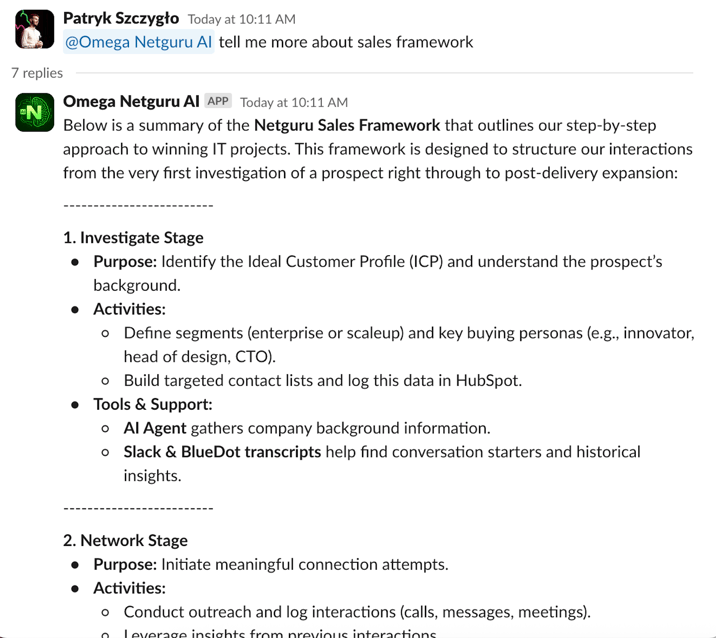
Omega is an internal AI agent Netguru built for its own sales team. It automates tasks, surfaces insight and walks reps through each stage of a deal in real time.
It sits inside Slack and Google Drive, helping prepare proposals, keep project details in order and stay aligned with the Sales Framework. What started as a proof of concept turned into a tool people use daily, shaped by feedback from the reps themselves.
The challengeWhat the teams actually needed
Selling meant hopping between tools, and a newly rolled-out framework had no support built into the places people actually work.
Challenge 01Scattered tools, manual work
Reps juggled Slack, Google Drive, HubSpot and Salesforce, which made context hard to hold and routine tasks slow.
Challenge 02A framework adopted unevenly
The Sales Framework was meant to sharpen deal qualification, but without real-time support inside the workflow, take-up varied across the team.
Challenge 03A foundation that has to last
To be useful the agent had to run complex workflows, reach several data sources and stay modular enough to keep changing.
What we did
A digital teammate that lives in Slack
Omega works next to the sales team in the channels they already use, taking the repetitive work, pulling up what matters and nudging people toward best practice at the moment it helps.
In every opportunity channel
Omega joins each opportunity’s Slack channel to follow the context, and finds and updates the matching project files in Google Drive.
Agendas, features and summaries
It drafts the agenda for an expert call, writes up feature lists, summarises meetings, and reads BlueDot transcripts to propose what should happen next.
Deadlines that do not slip quietly
Deal momentum and deadlines are tracked with updates in real time, so nothing sits unnoticed.
Modular, ready for the next agent
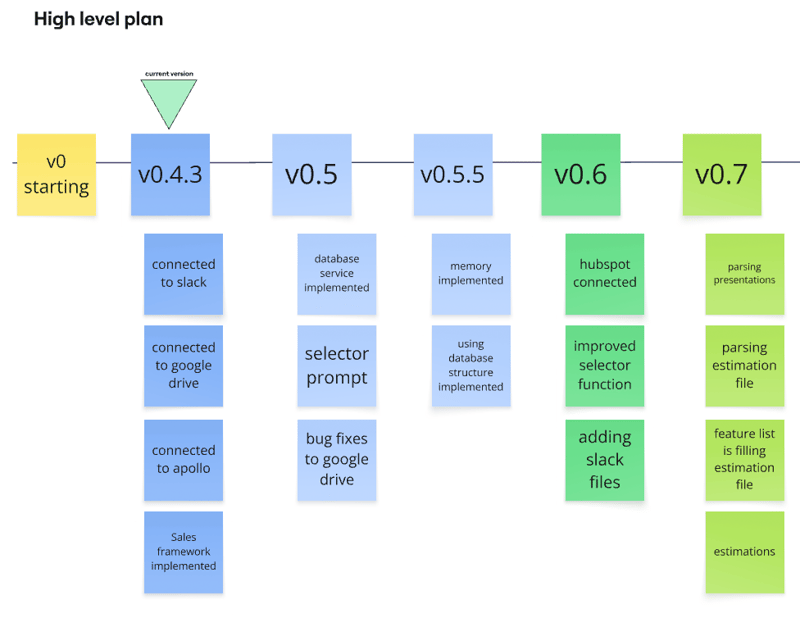
A black-box modular design with a multi-agent architecture leaves a foundation other departments can build their own agents on. Effort estimation and referencing past projects are still to come, and need deeper Salesforce and HubSpot integration.
Tech stackThe tools that made it possible
01
AWS Lambda
Core execution on serverless infrastructure, scaling with very little overhead.
02
Slack & Google Drive APIs
Cross-platform automation wherever the sales team already works.
03
Embedding models & vector search
Pulling the relevant pieces out of conversations and documents.
04
CI/CD
Netguru’s own DevOps standards, so the agent can iterate quickly and behave consistently.
More like thisOther places we scaled product teams for growth.
What’s next