
How to Create a Design System Governance Plan: From Chaos to Consistent UI

Contents
Design system governance distinguishes a successful component library from one that becomes disorganized over time. The following insights will help you achieve a consistently excellent UI.
Key Takeaways
- Governance prevents design drift: 79% of mature design systems have official governance, resulting in up to 60% better ROI by maintaining consistency between intended patterns and production reality.
- Six-step implementation framework: Define governance teams → map review processes → set contribution guidelines → create change workflows → establish version control → build documentation structure.
- Balance flexibility with control: Effective governance makes consistency the default, enabling teams to move quickly while maintaining quality standards.
- Track adoption and component reuse: Monitor usage rates, documentation engagement, and custom variants versus system components to identify drift early and demonstrate value to stakeholders.
- Clear decision rights are essential: Establish RACI matrices and approval workflows to prevent the common pitfall of unclear ownership that leads to delayed updates and fragmented experiences.
Without proper governance, even the most carefully crafted design systems inevitably succumb to component chaos and inconsistent user experiences. Investing in governance processes pays dividends by transforming your design system from a source of friction into a catalyst for efficient and scalable product development. Did you know that most design systems fail not because of poor technical implementation, but because of poor governance?
Teams invest countless hours in creating component libraries and style guides, only to watch them deteriorate. Design drift takes over without proper oversight - a gradual divergence between your design system's intended patterns and what ships in production.
Your design system needs a governance process to prevent entropy from taking over. But many teams find it challenging to implement design system governance models that balance flexibility with consistency.
This is why you should explore this detailed guide to design system governance frameworks. Your UI can evolve from fragmented to cohesive when you establish proper governance. This guide helps teams experiencing component chaos or those who want to future-proof their design systems.This piece tucks into the core components of effective design system governance. You'll learn a step-by-step implementation process and best practices that help your team maintain consistency without becoming the "Pattern Police." Let's get started!
What Is Design System Governance and Why Your Team Needs It
Design system governance defines the rules, processes, and responsibilities that show how teams should manage, update, and use a design system throughout an organization. A static style guide won't cut it. Governance serves as the operating model that makes consistency the natural choice for teams. Your design system becomes more than just a component collection. It transforms into a reliable design infrastructure that teams can build upon with confidence.
The difference between having a design system and governing it
Building a design system differs greatly from governing it. Organizations often pour resources into creating beautiful component libraries. These libraries slowly fall apart as time passes. A design system without governance resembles a city with no urban planning. Buildings pop up randomly, infrastructure becomes chaotic, and finding your way gets harder.
Governance answers vital questions that component libraries can't address on their own. Who makes the final call on pattern changes? Who solves the problems between product needs and system rules? Who decides between speed and consistency trade-offs? Teams will fork components, ignore rules, and let consistency slip away without clear answers to these questions.

Common signs your design system lacks governance
Your design system might lack proper governance if you notice certain warning signs. Invisible changes happen with no documentation - someone tweaks a component without recording what changed or why. Developers might copy and paste components instead of reusing them.Teams often raise conflicting needs with no clear way to handle these requests. Quality drops faster if no one takes charge of managing the system. Updates become random, bug fixes take longer, and documentation gets stale.
How governance prevents design drift and component chaos
Good governance stops design drift - the growing gap between your design system's intended patterns and what ships in production. This happens through several key steps:
Governance sets clear roles and decision rights. Someone must own the process of approving changes and managing exceptions.
A defined component lifecycle keeps everything on track (propose → review → build → document → release → measure → deprecate).
This makes additions purposeful and easy to trace.Silk design system shows how commerce teams stay consistent. It provides ready-made UI for common shopping flows and establishes governance frameworks. Teams can launch products faster and maintain customized experiences across platforms. They can safely test conversion-critical areas without UI becoming fragmented.
Note that governance isn't about policing or restrictions. It creates clarity that helps teams move faster while keeping quality high. The right governance turns your design system from a roadblock into a springboard for efficient, consistent user experiences.
Core Components of Effective Design System Governance
Design system governance needs several interconnected components that work together. These components help maintain consistency and let teams move quickly. Let's get into the essential elements that are the foundations of environmentally responsible governance frameworks.
Decision rights and approval workflows
Decision rights clearly show who can approve new components, variations, or breaking changes. A RACI (Responsible, Accountable, Consulted, Informed) matrix makes roles and responsibilities crystal clear. Project management tools optimize feedback collection and boost collaboration while reducing operational costs. These tools automate manual tasks and send timely notifications throughout the approval process.
Component lifecycle management
Each component needs a well-laid-out lifecycle that guides its trip from concept to retirement:
- Proposal - Component ideas are submitted through public discussion.
- Design and development - Teams build, test, and refine components.
- Release - Components are published with proper documentation.
- Maturity - Components gain usage history.
- Deprecation - Components are removed from active support when no longer needed.
Exception handling process
All but one of these complete systems need a structured exception process. A "safe exception" protocol prevents unmanaged drift when exceptions are reversible, observable, bounded, explicit, and shown in system contracts. Teams can turn one-offs into learning opportunities by documenting each exception's purpose, usage guidelines, implementation instructions, and future plans.
Communication channels and support protocols
Multiple support channels promote community growth and help teams get assistance quickly. Successful systems provide dedicated Slack channels, email support, regular office hours, and detailed bug reporting processes. So these touchpoints prevent duplicate work and build rapport between system makers and users.
Documentation requirements
Complete documentation serves as governance's backbone by establishing fundamentals, design guidelines, implementation details, and support resources. Documentation requirements should cover component functionality, usage guidelines, design principles, and contribution processes. Well-laid-out documentation reduces questions, shows system maturity, and helps teams implement the system correctly on their own.
How to Establish Design System Governance Step-by-Step
Let's look at a practical six-step approach to building your design system governance from scratch.
Step 1: Define your governance team and roles
Start by arranging your team into core and extended layers. The core layer should have people who manage foundational elements used across your organization. The extended layer has teams that own components specific to their domain but share them with others. Your team needs these key roles:
- Champion: A senior leader who gets resources and supports the project.
- Product Owner: Someone who manages timelines and directs vision.
- Implementation Support: Designers and developers who create content.
- Stakeholders: People who give feedback.
The Silk design system shows how commerce teams can move quickly while staying consistent. Teams launch products faster without UI fragmentation by knowing who controls common shopping components versus specialized checkout elements.
Step 2: Map your component request and review process
You need a clear workflow to manage new component requests. The document shows this 10-step process works well:
- Teams must try existing component options first.
- Contact the design system team to discuss needs.
- Determine if changes are one-off or system-wide.
- Create original prototypes.
- Conduct the first review.
- Perform UX and development testing.
- Complete final review.
- Document changes and schedule release.
- Release changes with version updates.
- Perform quality assurance.
Step 3: Set up your contribution guidelines
Quality control needs clear acceptance criteria. Here are key parameters to think over:Core components should show broad usage across multiple domains, set system-wide standards, and carry high risk if implemented poorly. Extended components might be domain-specific but valuable enough to share across teams.
Each contribution must prove its usefulness, uniqueness, usability, consistency, and versatility. This makes your design system stronger with every addition.
Step 4: Create your change management workflow
A good change management workflow helps direct updates smoothly. Start by understanding what changes you need and getting leadership on board. Score requests based on how they affect product areas, reuse potential, alternative solutions, and work needed.Open channels like Slack or GitHub keep the change process transparent. Design systems expert Brad Frost suggests this flow: public discussion → group decision → codified pattern.
Step 5: Establish version control and release cadence
Use semantic versioning to show how changes affect the system:
- Major (x.0.0): Breaking changes that need consumer action
- Minor (0.x.0): New features that work with older versions
- Patch (0.0.x): Bug fixes without new features
Your team's maturity level will help you choose between continuous releases (multiple times daily) or increment-based releases (every sprint). Regular "Version Packages" pull requests need team review before publishing.
Step 6: Build your documentation structure
Your design system documentation should explain how to use, contribute to, and get support for your design system. Make sure it has:
- Component functionality and usage guidelines
- Design principles and implementation details
- Contribution processes and requirements
- Support protocols and change management procedures
Good documentation needs regular updates. Plan who will update it, when, and how. Pick someone to own this task from day one to keep everything relevant long-term.
Design System Governance Best Practices and Success Metrics
Success metrics make design system governance practical rather than theoretical. Industry data shows that 79% of mature design systems have someone officially responsible for governance. This highlights why measuring your system's effectiveness matters.
Tracking system adoption rates
You need clear measurements across design, code, and documentation to track adoption effectively. Here's what to monitor:
- Component usage rates across projects.
- Documentation page views and feedback.
- Library usage in design files.
- API calls to system endpoints.
Design systems with good governance deliver up to 60% better ROI. These adoption metrics are vital to show stakeholders the system's value.
Measuring component reuse vs custom variants
The ratio between system components and custom implementations needs monitoring. Design drift shows early warning signs through rising override rates or component detachment. You should track component modifications - a high detachment rate could mean either that a customizable component works well or needs improvements.
Setting up regular governance reviews
Monthly governance meetings help teams review adoption metrics, exceptions, and system improvements. These reviews help identify which components need updates or retirement based on how they're used.
Learning from real examples: Silk design system approach
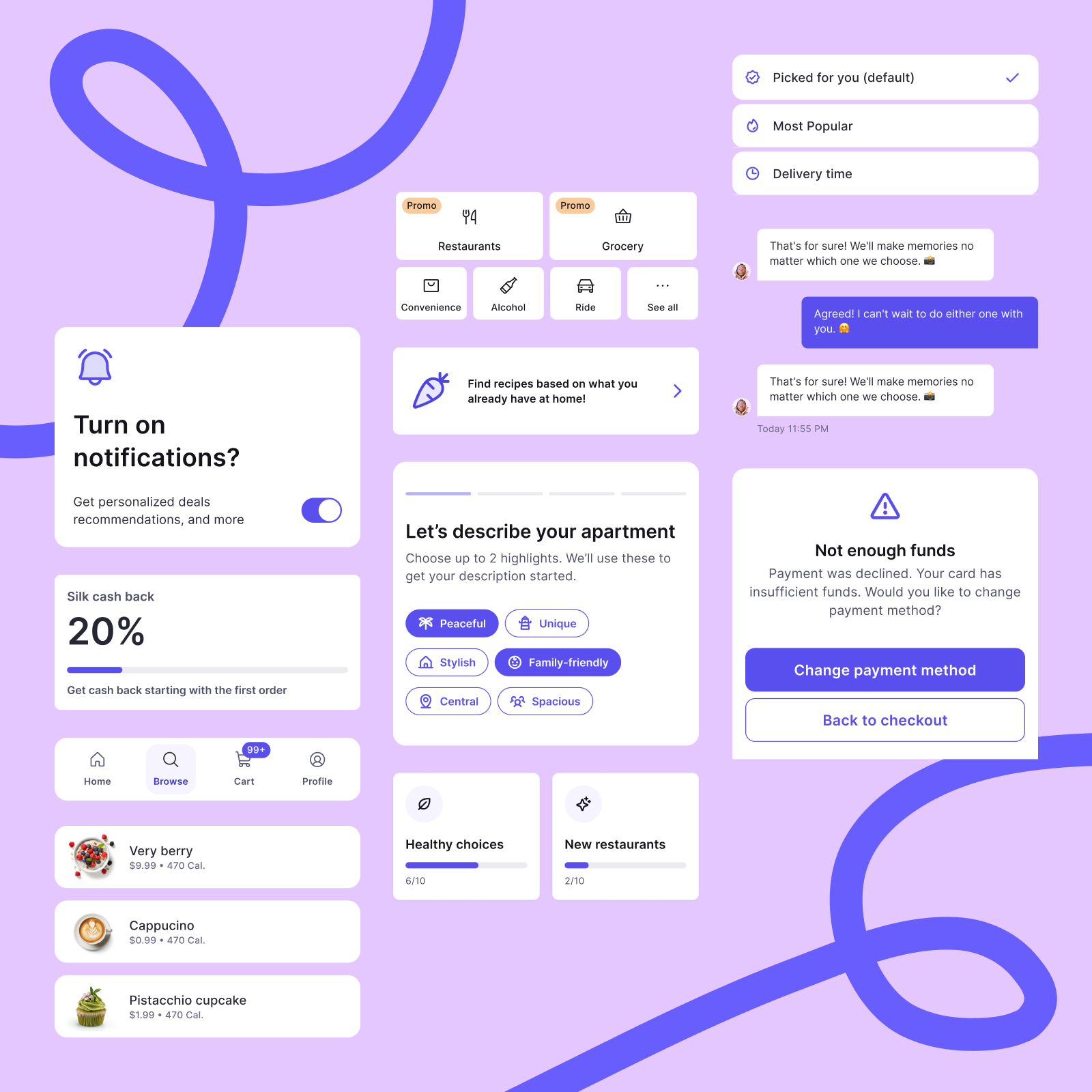
The Silk design system shows how to balance flexibility with consistency through effective governance. Commerce teams can launch products faster with its ready-made UI for common shopping flows. The system helps maintain consistent experiences across platforms. Teams can safely test and improve conversion-critical areas without fragmenting the UI.
Avoiding common governance pitfalls
Building too many components too quickly creates clutter. Unclear ownership results in delayed updates and incomplete documentation. The system loses trust when design assets, documentation, and code exist in different places.
Conclusion
Design system governance forms the vital foundation that revolutionizes a collection of components into a reliable, consistent design infrastructure. This piece shows how proper governance prevents design drift and will give your design system long-term sustainability.
Clear decision rights, defined component lifecycles, and structured exception processes work together. They maintain order while allowing flexibility. This balance shows the true power of effective governance—it makes consistency the default path rather than an uphill battle.
Teams that implement the six-step governance framework position themselves to succeed. Each step builds upon the previous one and creates a complete system that scales with your organization and adapts to changing needs.
The Silk design system shows these principles in action. Commerce teams use Silk to launch products faster with ready-made UI components for shopping flows while keeping consistency across platforms. Their success in iterating safely on conversion-critical areas without UI fragmentation proves governance at its best—enabling both speed and quality.
Governance isn't about restriction—it's about clarity and enabling teams. A well-laid-out design system reduces decision fatigue, speeds up development, and creates a unified experience for users. You can start small, measure progress, and refine your governance approach as your system matures.
Your design system represents a major investment. Proper governance will ensure this investment continues to pay dividends for years. These steps, adapted to your organization's needs, will help transform your UI from chaotic to consistently excellent.


