
Faster time to market: Where to cut calendar time first


Contents
Faster time to market is mostly a sequencing problem. The calendar time between an approved concept and a public launch is lost in a few specific places: approval queues, late integration, slow or flaky pipelines, and scope that was cut in the wrong spot.
Automating a stage that was never the constraint changes nothing. The right order is to measure where the weeks go, fix the largest queue first, then apply tactics such as MVP scoping, automation, parallel work or buying components. The right first fix depends on whether your wait sits in decisions, engineering or release.
Faster time to market: The short answer and the order of attack
Time to market (TTM) shrinks fastest when you find the longest wait between approved concept and public launch and remove that first. Measure TTM across those two events, then fix approval bottlenecks, scope the minimum viable product, and automate the CI/CD pipeline last.
We recommend this sequence because, in scaling teams, approvals are often the longest wait, and a faster CI/CD pipeline does nothing if a release waits on sign-off. If your measurement shows the delay sits in delivery, start there instead, then work through the remaining stages.
What is time to market, and where does the clock start and stop?
Time to market (TTM) is the calendar time from approved concept to public launch, and discovery work before the approval is excluded. The clock starts when someone with budget authority signs off and stops when real customers can use the product.
We define TTM as public launch date minus concept approval date. Both events need a dated record, such as a funding decision and a release announcement. If a project's start can't be dated, we recommend tracking lead time for changes for it and leaving it out of TTM comparisons.
The four measures that get confused, side by side:
| Measure | Starts | Stops | Scope |
|---|---|---|---|
| TTM | Concept approval | Public launch | Whole product |
| Lead time for changes (DORA) | Code commit | Change running in production | One change |
| Cycle time | Work begins on an item | Item done | One ticket |
| Time to value | Public launch | Customer's first meaningful outcome | One customer |
Speed to market is the competitive reading of the same span: how your TTM compares with rivals' for a comparable product. Lead time for changes sits inside TTM, so pipeline work alone shortens only the final segment. Cross-functional teams that own the path from approval to release can time the whole span, while split ownership hides the waiting inside handoffs.
Why faster time to market matters, and when speeding up is wrong
Faster time to market (TTM) pays off through earlier customer feedback, shorter delivery loops and earlier revenue. It backfires when the product is unvalidated, a regulator sets the pace, or the team is already late.
Speed is worth buying when it shortens the path to a verdict on demand. A minimum viable product that tests the riskiest assumption first turns that verdict into a cheap experiment. Companies that lack the capacity to run such experiments quickly can lean on digital acceleration services to shorten the path from idea to validated product.
Delivery speed also compounds. In the 2024 DORA report, elite performers have a lead time for changes of less than one day, while low performers take one to six months. Teams with short lead time for changes and high deployment frequency can ship corrections as fast as they ship features.
Three situations call for slowing down:
- Unvalidated demand: if no customer has asked for the product, launching sooner only lets you fail sooner. Run discovery first.
- Regulated domains: medical device software, payments licensing and similar approvals set a floor on TTM. Cutting verification or audit steps to hit a date creates recall and fine risk that outweighs a few weeks gained.
- Late headcount: Brooks's law, from The Mythical Man-Month (1975), holds that adding people to a late software project makes it later, because onboarding and coordination consume the capacity gained. Add people early, or cut scope.
Time to market calculation: Formula, DORA metrics and benchmarks
Time to market (TTM) equals the public launch date minus the concept approval date, in calendar days or weeks. Cycle time starts later, when work on one item begins, and time to value starts at launch and ends when the customer first gets the outcome they came for.
The DORA metrics cover only a slice of TTM. The following worked example uses assumed inputs, not observed data:
| Stage (assumed) | Weeks | Covered by |
|---|---|---|
| Concept approval to design sign-off | 4 | TTM only |
| Security and legal review queue | 4 | TTM only |
| Build of the minimum viable product | 12 | Cycle time |
| Merge to production, batched releases | 3 | Lead time for changes |
| Launch readiness and go-to-market | 3 | TTM only |
| Total | 26 |
In this example, the team deploys every three weeks, so merged code waits up to three weeks. That slice is the lead time for changes, and a CI/CD pipeline with daily deployment frequency could shrink it to days. The saving is roughly 2.5 weeks, about 10% of a 26-week TTM. The 8 weeks of approval queues and sign-offs are a larger target.
DORA's elite performers also deploy on demand. Track change failure rate beside both. Faster releases only count if failures do not rise with them.
We recommend logging both dates for every launch. Without a recorded approval date, TTM gets reconstructed from memory and the queues disappear from the number. DORA metrics alone would have scored the example team on 3 of its 26 weeks.
Time to market vs time to value
Time to market (TTM) ends at public launch, and time to value starts there and ends when the customer first gets the outcome they came for. Cycle time sits inside TTM and has a different owner.
The three metrics side by side. The owners are our suggested assignments, not a standard:
| Metric | Start event | End event | Suggested owner |
|---|---|---|---|
| Time to market | Concept approved | Public launch | Product lead with engineering lead |
| Cycle time | Work begins on an item | Item done or deployed | Delivery team |
| Time to value | Public launch | Customer's first outcome | Product with customer success |
The two can move in opposite directions. A minimum viable product (MVP) that skips onboarding or an integration can cut TTM by weeks, yet push time to value out by months if customers can't reach their first result without them.
We recommend setting the MVP boundary at the first customer outcome, not at the first feature that can be shipped. Teams that need help defining that boundary can lean on specialist MVP development services to scope the first release around the customer outcome.
Netguru's staff augmentation helped FairMoney cut its time to market by 30%. That figure ends at launch, so it needs an activation or first-outcome measure alongside it to show time to value.
What slows time to market down? Find the bottleneck first
Time to market (TTM) slows down at the stage with the longest queue, so map wait time per stage and fix the largest one first.
For each stage between concept approval and public launch, record two numbers: days of active work and days the item sat waiting. Most teams find the waiting column is larger than they assumed, and it points to the cause:
| Delay source | Where the wait shows up | What to measure |
|---|---|---|
| Complexity | Design and build | Elapsed time per work item against its estimate |
| Handoffs | Between design, build and QA | Days a ticket sits in "ready for" columns |
| Approval bottlenecks | Security, legal, budget sign-off | Days from request to decision |
| Scope creep | Build | Items added after concept approval |
| Regulation | Pre-launch compliance review | Days in review, plus rework loops |
Assume a 20-week TTM where 7 weeks are spent waiting for sign-offs. Those 7 weeks are the first target. Tuning the CI/CD pipeline would touch only the build stage.
Our view is that approval bottlenecks and handoffs are the usual first fixes, and cross-functional teams remove both by putting design, QA and security in one team with its own decision rights. Treat that as our judgement and check it against your own map.
Scope sets the baseline for comparison. A revamp of an existing platform or a simple app takes less time than a BI platform built from scratch, so compare stage times against projects of similar scope.
If the largest queue is build capacity, adding engineers is the right lever, within the limits covered under build or buy below. To see where each of these stages typically sits in a project, the stages of software development are a useful reference for building your map.
How to remove approval bottlenecks
Approval bottlenecks shrink when every gate has one named decision owner, a sign-off time limit, and a default of approve once the limit passes. Cross-functional teams hold the decision rights, and committees are informed after the fact.
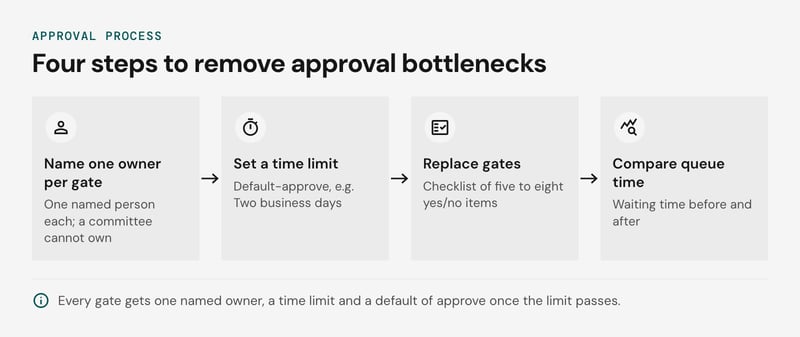
Four steps, in order:
- Name one owner per gate. List every gate between approved concept and launch (security, legal, brand, pricing, architecture). Assign one person to each by name. A committee cannot be an owner, because nobody on it is accountable for the delay.
- Set a time limit with default-approve. An illustrative starting point is two business days. If the owner has not responded, the change ships and the owner is notified. Keep explicit sign-off for irreversible or regulated decisions such as payments or personal data. Reversible changes behind feature flags suit default-approve.
- Replace stage gates with a checklist. Use five to eight yes/no items the team certifies itself: threat model linked, data-protection screening done, rollback plan written, automated checks green in the CI/CD pipeline. The reviewer is pulled in only when an item is "no".
- Compare queue time before and after. Reuse the waiting column from your stage map. Assume a gate that averaged six days of waiting gets a two-day limit; its median wait should fall to two days or less within a few release cycles.
Track default-approvals and change failure rate alongside queue time. If failures rise, tighten the checklist before you lengthen the limit.
How to scope an MVP without causing rework
Scope a minimum viable product by cutting what users see and keeping what the system stands on: the data model, authentication, and core integrations belong in release one, because changing them later means rework across every feature built on top.
The split we use:
| Cut from release one | Keep in release one |
|---|---|
| UI polish, animations, theming | Core data model and entity relationships |
| Handling for rare edge-case flows | Authentication and authorization model |
| Admin tooling and reporting dashboards (use scripts or manual ops) | Integrations with payments, identity, and core back-office systems |
| Secondary platforms and locales | Instrumentation for the metrics you will judge the launch by |
A schema migration on live data, or swapping an identity provider after users have accounts, touches every feature that depends on it. A button style changes in an afternoon. Reid Hoffman's line, "if you're not embarrassed by the first version of your product, you've launched too late", applies to the visible layer only.
Feature flags let you ship unfinished edge cases dark and keep trunk releasable. Turn them on for a pilot cohort once the core flow holds. Scoped this way, the Good Package MVP for Żabka, a food-waste feature in its app, shipped in six weeks, below budget.
Run a build vs buy decision for every component that does not differentiate the product, such as auth, payments, and notifications, before the first sprint. If you buy, wrap the vendor behind a thin interface so a later swap stays contained. Vinted GO partnered with Netguru to handle parts of its integration work so it could move faster without expanding its internal engineering team.
This split shifts in regulated domains. In fintech or health, failure paths such as identity-verification rejections are compliance requirements, so they stay in scope even though they look like edge cases.

Which automation removes manual handoffs?
A CI/CD pipeline removes the most manual handoffs when it runs automated regression testing on every merge and deploys on green with no human step in between. Infrastructure as code and containerization (Docker) remove the remaining ticket-driven waits for environments.
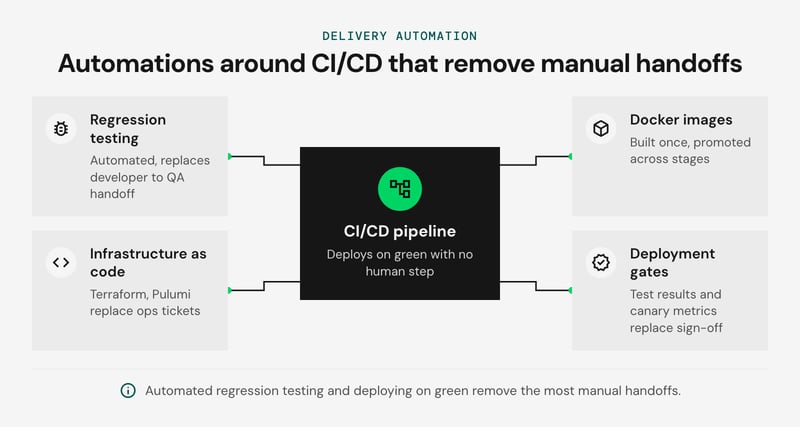
The handoffs worth automating first, and what each tends to break:
| Manual handoff | Automation | Failure to watch |
|---|---|---|
| Developer to QA for regression | Automated regression testing on every pull request | Flaky tests |
| Developer to ops for environments | Infrastructure as code (Terraform, Pulumi) | Unreviewed applies, state drift |
| "Works on my machine" setup | Docker images built once, promoted across stages | Slow builds, image bloat |
| Release sign-off | Deployment gates on test results and canary metrics | Advisory gates that people still override |
DORA tracks the payoff through lead time for changes and deployment frequency.
Flaky tests turn the pipeline into the bottleneck. Once engineers learn that a red build often means nothing, they re-run instead of investigating, and each re-run adds a full pipeline duration to lead time for changes.
We recommend quarantining a test the first time it fails nondeterministically, giving it an owner and a deadline, and tracking the quarantine count weekly. A smaller suite you trust beats a larger one gated by retry-until-green.
Docker and microservices each add overhead, so adopt them on conditions:
- Docker: use it when dev, CI, and production environments diverge, or when more than one team deploys. Skip it for a single small team on a managed platform with one service.
- Microservices: split only when independently deploying teams are blocked by a shared release train. If one team owns the codebase and already deploys daily, a modular monolith keeps one pipeline. Every extra service brings its own pipeline, contract tests, and observability.
How agile, parallel workflows and cross-functional teams cut cycle time
Running design, development and QA in parallel removes the waiting between phases. The trade-off is that each discipline builds against assumptions the others have not yet confirmed. Time saved early is repaid as rework if those assumptions diverge, and the bill tends to arrive close to launch, when fixes cost the most.
A worked example shows where the break-even sits. These figures are illustrative assumptions, not measured data:
- Sequential plan: 2 weeks design, 4 weeks build, 2 weeks QA, so 8 weeks.
- Parallel plan: design runs one slice ahead and QA tests each slice as it lands, so about 5 weeks.
- Saving: 3 weeks, provided integration goes cleanly.
If an interface mismatch surfaces in the final week, rework of 3 weeks or more erases the gain. If a contract test catches it in week one, the fix takes days. The schedule benefit therefore depends on how early mismatches are found. Teams that map design handoff and component work into a clear frontend development process tend to find them sooner.
The common parallel patterns, their early warning signs and the fix for each:
| Parallel work | Early sign | Mitigation |
|---|---|---|
| Frontend built before the API exists | Mocks drift from real responses | Agree an OpenAPI contract in week one, generate mocks from it, run contract tests in CI |
| Build starts before design is final | Components rebuilt after review | Design one slice ahead of development and ship design tokens first |
| Long-lived feature branches | Merges take days and conflict | Trunk-based development with branches that live under a day |
Trunk-based development makes integration continuous, so a contract mismatch shows up within hours. Feature flags let unfinished work ship dark, which separates deployment from release. Flags carry their own debt in stale toggles and untested combinations, so give each one an owner and a removal date.
Our decision rule: parallelize when the interface is stable and contract tests run in CI. If the core domain model is still unknown, run a short sequential spike first. Parallelize once one end-to-end slice has passed through the agreed contract.
Build or buy: Where off-the-shelf parts and added capacity save weeks
Buy commodity capabilities and build only what differentiates the product. That build vs buy decision is where many teams recover weeks of time to market (TTM). Payments, authentication, email delivery and carrier APIs are solved problems that vendors maintain for you.
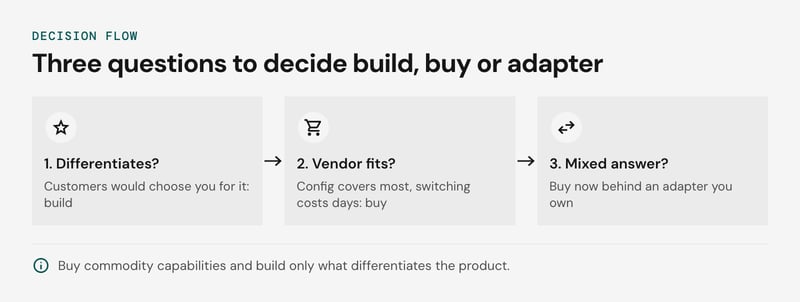
We apply three questions in order:
- Would customers choose you because of this capability? If yes, build it.
- If no, does a vendor cover most of the need through configuration, and would switching later cost days instead of months? If yes, buy it.
- If the answer is mixed, buy now behind an adapter you own, so you can replace the vendor when volume, pricing or control requirements change.
A worked example, using illustrative assumptions: a team needs transactional email. Building delivery, templates, retries and bounce handling takes three engineers four weeks, or 12 engineer-weeks. Integrating a vendor takes one engineer three days. The vendor route saves roughly 11 engineer-weeks and moves the launch up by three weeks or more.
Buying fails in recognizable ways. Watch for custom code wrapping the vendor that grows larger than the feature itself, and for usage fees that climb faster than revenue. In regulated domains, data residency or audit requirements can rule a vendor out before integration starts.
Added capacity is the second lever, and it has a limit. Fred Brooks argued in The Mythical Man-Month that adding people to a late software project makes it later. Newcomers need onboarding from the people already doing the work, and each hire adds communication paths.
The path count grows quickly: a team of six has 15 pairwise paths, and a team of nine has 36. Early signs of trouble are longer review queues, more merge conflicts in shared code and senior engineers shipping less in the weeks after new people join.
We recommend adding engineers only to workstreams behind a stable interface, such as third-party integrations or a mobile client, and embedding them in the existing cross-functional team on day one. Extra people pay off when the work is separable and scoped before they arrive. Landing them on the shared core in the final weeks before launch adds drag.
How AI tools speed up delivery, and where the gain stalls
AI coding assistants shorten individual tasks, but delivery speed stalls where review, testing, and approval queues absorb the extra code.
In a controlled experiment, developers using GitHub Copilot finished an HTTP server task 55.8% faster. That figure is the reduction in time to complete one bounded task written from scratch. A launch includes other queues the work waits in, so the per-task gain does not carry over directly.
Here is an illustrative example with assumed numbers, not measured data. A change spends 2 days coding and 3 days in review, testing, and approval, for 5 days total. Applying the 55.8% cut to coding, which is generous, brings the total to about 3.9 days, roughly 22% shorter.
Now suppose larger diffs stretch review wait from 1 day to 1.5 days. The total becomes about 4.4 days, a 12% reduction. Half the gain disappears without any change in coding speed.
DORA's 2024 report points the same way. It estimated that a 25% increase in AI adoption was associated with a 1.5% decrease in delivery throughput and a 7.2% decrease in delivery stability. Our reading is that larger batches are harder to review and riskier to ship.
We recommend measuring lead time for changes, from commit to production, and ignoring lines or pull requests written. Three checks show whether the gain is holding:
- Median pull request wait time before first review. If it rises after rollout, the gain is sitting in the queue.
- Change failure rate, read together with deployment frequency.
- Automated regression testing coverage on the paths assistants touch most, so reviewers can approve small diffs quickly.
AI shortens a launch when it is applied to a whole workflow with tests and hosting already in place.
Which tool categories help? A shortlist by bottleneck
Match each tool category to the queue that delays your launch.
| Category | Named example | Use case | Bottleneck it fixes |
|---|---|---|---|
| CI/CD pipeline | GitHub Actions | Build, test and deploy on every merge | Manual releases that stretch lead time for changes |
| Infrastructure as code | Terraform | Create staging and production environments from version-controlled config | Waiting on ops tickets for environments, config drift |
| AI coding assistant | GitHub Copilot | Boilerplate, unit tests, small scoped tasks | Individual task time, as long as review capacity keeps up |
| Feature flags | Unleash | Merge unfinished work to trunk and release by toggle | Deploy and release coupled together, long-lived branches |
| Test automation | Playwright | Run regression suites inside the pipeline | Manual QA queue before release |
We recommend measuring lead time for changes first and buying for the longest queue only. A team with weekly manual releases gets more from a pipeline than from an assistant. A team with a clean pipeline but multi-day environment requests should start with infrastructure as code.
No tool in this table clears approval bottlenecks. Sign-off queues need named decision owners and a service-level target, and that work sits outside the toolchain.
FAQ: Faster time to market
What is a good time to market for a digital product?
How do you calculate time to market?
What is the difference between time to market and time to value?
How do AI engineers enable faster time to market?
Does microservices architecture give faster time to market?
Does Docker give faster time to market?
How do you reduce time to market in software development?
Cut your time to market with Netguru
Netguru runs a time to market (TTM) bottleneck review that maps your path from approved concept to public launch and shows where the weeks go.
Our cross-functional teams of engineers, designers, and product specialists walk through discovery, approvals, build, and release, then rank each delay by the days it costs.
You leave with an ordered list of fixes your own team can start on, whether or not we build anything together.
Netguru has delivered 3,500+ projects for 900+ clients, so the review draws on many different delivery setups. Talk to our team to book one.


