
Modern Architecture for CTOs: Treating Infrastructure as a Product

Contents
System downtime costs large enterprises up to $100,000 per hour on average, making Infrastructure as a Product a critical strategy for modern CTOs. Customers expect 99.99% uptime, and anything less significantly impacts user confidence and bottom-line results.
Technical leaders face growing pressure to build architectures that process data in real-time, support AI/ML workflows natively, and scale elastically without breaking budgets. Cloud-native infrastructures enable rapid code deployment through CI/CD pipelines, allowing teams to push updates daily or even hourly. Yet choosing the right tech stack remains a consequential strategic decision with long-term implications.
EdTech platform infrastructure challenges illustrate this shift clearly, where compliance, scalability, and real-time data demands make treating infrastructure as a product especially critical.
What stands in the way of organizations achieving these ambitious goals? Traditional infrastructure management treats technology foundations as cost centers rather than strategic assets. This approach was effective when systems were simpler and change occurred slowly. But it fails when development teams need to move fast and infrastructure must adapt constantly.
The composable approach to infrastructure enables organizations to customize their IT systems by selecting and integrating the most suitable components tailored to their specific needs. When CTOs treat infrastructure as a product rather than a cost center, they can fundamentally change how their organizations build, deploy, and maintain critical systems. This shift requires rethinking governance models, implementation strategies, and organizational structures.
Let's explore how forward-thinking CTOs are applying product thinking to infrastructure, creating measurable business value, and establishing frameworks that strike a balance between innovation and stability. From real-world case studies to practical implementation roadmaps, we'll examine why Infrastructure as a Product has become essential for competitive advantage in the digital economy.
Key Takeaways for CTOs Embracing Infrastructure as a Product
Modern CTOs are transforming infrastructure from cost centers into strategic products that drive competitive advantage. By applying product thinking to infrastructure, organizations achieve measurable improvements in developer productivity, deployment speed, and business agility.
For a deeper dive across evaluation, security, and continuous monitoring, see our the broader practice of ai in telecommunications.
- Treat developers as customers: Successful infrastructure productization starts with recognizing internal developers as primary users, designing self-service platforms that reduce friction and eliminate manual processes.
- Assign dedicated product ownership: Appoint full-time product owners for infrastructure components to prevent duplicated efforts and ensure enterprise-wide value delivery with clear accountability.
- Measure business impact, not just uptime: Track deployment frequency, developer productivity, and time-to-market rather than traditional metrics like cost reduction and system stability alone.
- Enable self-service with governance: Implement developer portals and automation that provide autonomy while maintaining security guardrails, reducing operational bottlenecks without compromising compliance.
- Embed security from day one: Build security and compliance into infrastructure products from inception rather than bolting them on later, transforming compliance from a cost center to a business enabler.
Organizations implementing Infrastructure as a Product report deployment time reductions of up to 66%, improved developer satisfaction, and enhanced operational resilience. This approach positions infrastructure as a direct driver of innovation and a key source of competitive advantage in the digital economy.
CTOs seeking a competitive advantage through technology infrastructure will find that adopting a product mindset offers substantial benefits. When infrastructure shifts from a cost center to a strategic enabler, organizations experience measurable improvements in developer productivity, operational resilience, and business agility.
Understand your developers as customers
Successful infrastructure productization starts with recognizing internal developers as primary customers. Cloud infrastructure teams must maintain a relentless focus on delivering seamless, intuitive experiences for these internal users. Just as marketing teams prioritize customer experience, CTOs must place developers at the heart of infrastructure decisions. When engagement with platforms requires developers to learn new languages or navigate complex processes unnecessarily, adoption suffers. Consequently, teams revert to previous methods, undermining the entire initiative.
Assign dedicated product ownership
Infrastructure productization requires appointing a dedicated product owner, which represents a critical success factor. Without this role, individual teams simply create what they need in isolation, leading to duplicated efforts across the organization. This team-agnostic leader ensures infrastructure products deliver maximum value enterprise-wide. Assigning someone full-time to this role—rather than distributing responsibilities across a team—creates stronger accountability and signals organizational commitment to treating infrastructure as a strategic product.
Redefine infrastructure success metrics
Traditional infrastructure teams focus primarily on cost reduction and system stability. Platform engineering approaches emphasize enabling developers to deploy market-ready services quickly and easily. While short-term cost reductions may not materialize immediately, CTOs should track long-term improvements in:
-
Time to market and deployment frequency
-
Developer throughput and productivity
-
Consistency in provisioning and deployment
-
Mean Time to Restore (MTTR) during incidents
Embrace platform thinking and automation
Building internal developer platforms that abstract complexity and enable self-service capabilities should be a priority for forward-thinking CTOs. Automation across the entire software lifecycle—from infrastructure provisioning to security—allows teams to scale efficiently while maintaining governance. Additionally, tracking metrics that connect DevOps initiatives to business outcomes helps demonstrate the tangible value of infrastructure investments.
Position resilience as a competitive advantage
Resilient IT infrastructure goes beyond being merely a safety measure—it becomes a competitive differentiator that ensures business continuity during disruptions. For modern CTOs, resilience isn't optional but mission-critical. This requires embedding agility and preparedness into every layer of infrastructure strategy. Organizations with resilient systems respond dynamically to challenges, innovate faster, and maintain customer trust in unpredictable environments.
Align vision with technology capabilities
CTOs implementing infrastructure as a product must ensure that the technology strategy aligns with the overall business vision. This alignment isn't simply about adopting trendy tools—it's about connecting technological capabilities with organizational market objectives. When vision and technology align effectively, infrastructure becomes a driver of differentiation, enabling faster market response and competitive advantage.
Adopt data-driven infrastructure decisions
Data-driven companies are 23 times more likely to acquire customers and 19 times more profitable. CTOs must embed analytics, metrics, and experimentation into every stage of infrastructure management. This data-first culture empowers organizations to make smarter, faster, and more impactful decisions about technology investments and architecture choices.
Treating infrastructure as a product rather than a cost center allows CTOs to transform how their organizations build, deploy, and maintain mission-critical systems—ultimately accelerating innovation while maintaining stability and compliance.
From Cost Center to Product: The Evolution of Infrastructure Thinking
Enterprise infrastructure has long been viewed as a necessary expense—something organizations maintain to support operations without directly contributing to revenue. For much of the last two decades, infrastructure strategy focused primarily on cost control, with data centers built to support core IT functions while emphasizing efficiency and total cost of ownership. This approach positioned infrastructure as economically passive, returning value indirectly through productivity gains.
The shift we're witnessing today represents more than incremental improvement. It reflects a fundamental reimagining of how technology foundations create business value.
Infrastructure as a Service vs Infrastructure as a Product
Infrastructure as a Service (IaaS) emerged as a cloud computing model delivering on-demand access to infrastructure resources. IaaS provides virtualized computing resources—servers, storage, networking—over the internet, eliminating the need for significant upfront capital expenditures. Although IaaS shifted many organizations from capital to operational expenditures, it still largely maintained the cost-center mindset.
Infrastructure as a Product (IaaP) represents a fundamental departure from this thinking. Unlike the service-oriented approach, where infrastructure merely supports applications, the product mindset treats infrastructure as a direct driver of revenue and innovation. This transition enables organizations to focus on developer experience and self-service capabilities, apply product management principles to infrastructure components, establish clear value propositions and roadmaps for infrastructure offerings, and measure success through business outcomes rather than just uptime.
Jensen Huang, NVIDIA CEO, captured this evolution when introducing the concept of "AI Factories"—infrastructure beginning to act as a direct driver of revenue through data centers purpose-built not just to process information but to generate intelligence at scale. Infrastructure doesn't merely support products; it becomes the product itself.
Rise of Platform Engineering and Internal Developer Platforms
Platform engineering has emerged as a practice built upon DevOps principles that seeks to improve security, compliance, costs, and time-to-business value through enhanced developer experiences and self-service capabilities. Gartner expects approximately 80 percent of engineering organizations to have dedicated platform engineering teams by 2026.
Internal developer platforms (IDPs) form the backbone of this movement—systems that provide standardized, curated, and security-hardened environments and tools that streamline workflows and accelerate development cycles. These platforms offer self-service infrastructure, where developers can provision environments without submitting tickets. They also feature standardized workflows for CI/CD processes, observability, and deployments, as well as automation tools abstracted into repeatable workflows. Additionally, integrated security and compliance are built-in features.
Think of internal developer platforms as "paved paths" that guide developers through critical requirements while maintaining velocity—analogous to dirt trails that get paved as more people use them. Platform engineering adopts a product mindset, treating developers as customers and designing systems that reduce cognitive load and eliminate manual steps.
Why Modern CTOs Must Rethink Infrastructure Strategy
Several forces are reshaping the landscape of infrastructure. The rise of hybrid work, decentralization of data and compute, and growing dominance of multi-cloud architectures force CTOs to reimagine what infrastructure means. According to Gartner, by 2025, over half of all enterprise-generated data will be created and processed outside traditional data centers or centralized clouds.
Traditional infrastructure emphasized control and predictability, whereas today's CTOs must prioritize adaptability, speed, and scale. This necessitates evolving away from tightly coupled, monolithic systems toward modular architectures, including microservices, APIs, container orchestration, and infrastructure-as-code.
Cloud adoption has shifted approximately 79 percent of IT spend to operating expenditures, providing unprecedented clarity on unit costs. This transparency enables more analytical and intentional investment decisions through financial operations (FinOps).
For modern CTOs, the infrastructure-as-product approach isn't optional—it's essential for remaining competitive. Organizations that continue viewing infrastructure solely as a cost center risk falling behind as competitors transform their technology foundations into strategic assets that drive growth, innovation, and enhanced customer experiences.
Core Principles of Infrastructure as a Product (IaP)
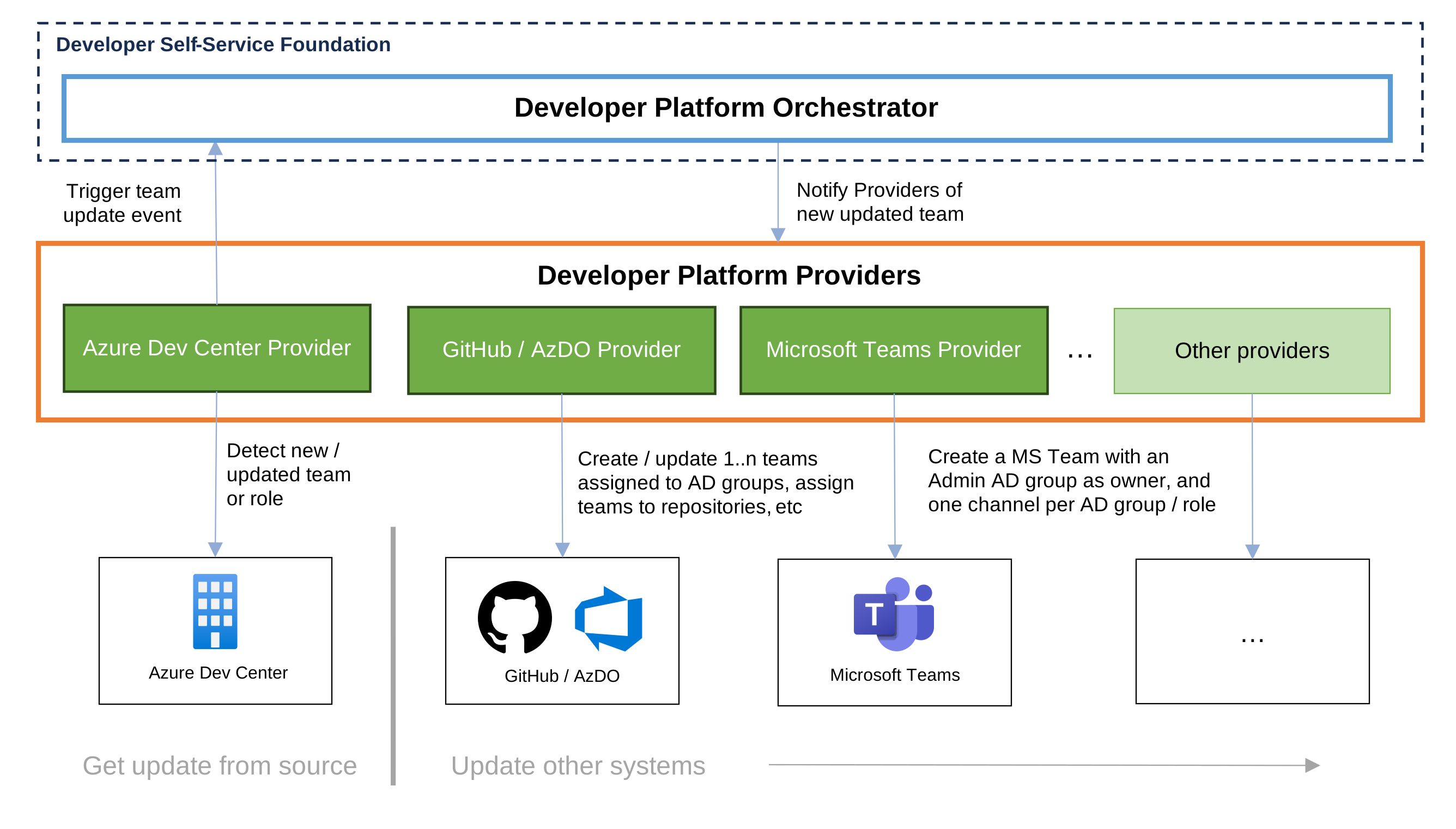
Image Source: Microsoft Learn
Successful infrastructure productization hinges on four fundamental principles that reshape how organizations approach technology foundations. Much like external products, internal infrastructure requires deliberate design, clear ownership, and continuous evolution based on user feedback.
Internal Developers as Customers
Treating developers as primary customers marks a critical shift in infrastructure management philosophy. Think of it this way: traditional IT departments often act like gatekeepers, while product-minded infrastructure teams function more like service providers focused on customer satisfaction.
Internal Developer Platforms (IDPs) function as centralized hubs providing everything developers need to build, deploy, and manage applications while simultaneously helping organizations standardize best practices and enforce governance. This approach recognizes that developers are the primary consumers of infrastructure services.
IDPs improve productivity by giving engineers a single access point for everything they need, dramatically reducing time spent searching for documentation, filing tickets, or seeking tribal knowledge. This centralization leads to more efficient development, faster onboarding, and reduced reliance on platform teams.
Admittedly, shifting to a customer-centric mindset can feel uncomfortable for infrastructure teams accustomed to saying "no" for security reasons. Yet effective infrastructure products strengthen the entire software delivery lifecycle by empowering developers with autonomy without compromising governance or security. This customer-centric approach reduces operational bottlenecks while maintaining necessary guardrails for safe delivery.
Product Ownership and Lifecycle Management
Infrastructure components require dedicated product owners who manage them throughout their lifecycle. For even modestly sized internal platform teams, appointing a delivery lead and product owner yields significant value. The product owner reinforces the concept of internal customers and drives understanding of their needs.
Infrastructure should be treated with the same priority and processes as external customer products. This includes:
-
Assigning a product manager responsible for the roadmap
-
Creating user stories and continuously delivering value
-
Using data and feedback to drive priorities
-
Measuring impact on business growth and customer satisfaction
Infrastructure lifecycle management makes organizations more efficient, delivers better end-user experiences, and identifies where expansion is needed. Without dedicated ownership, individual teams often create what they need in isolation, resulting in duplicated efforts across the organization.
Self-Service Interfaces and Developer Portals
Self-service capabilities transform how developers interact with infrastructure. Instead of opening tickets for every small task, developers gain access to pre-approved workflows they can execute themselves. This self-service model reduces operational dependency while maintaining security and ensuring auditability.
Self-service doesn't mean surrendering control—it means enabling developer autonomy by providing safe access to repeatable infrastructure so teams can move faster. Organizations typically implement self-service through:
-
Developer portals with intuitive interfaces
-
Command-line interfaces (CLIs) for programmatic access
-
APIs for integration with development workflows
-
Infrastructure-as-code templates and modules
Coupled with role-based access control, this approach removes guesswork about permissions. Access is not decided ad hoc but tied to teams and organizational permissions, making systems more secure and easier to manage as companies grow.
SLAs, Feedback Loops, and Continuous Improvement
Service Level Agreements (SLAs) serve as contracts between infrastructure providers and consumers, setting explicit standards for information production, delivery, and maintenance. They transform vague concepts like "fast" or "accurate" into measurable targets tracked daily.
Each reliability dimension becomes a service level indicator (SLI) with a target service level objective (SLO). Common metrics include "row-level mismatch rate of ≤ 0.5% over 30 days" or "99% freshness achieved each month". Because thresholds are numeric, monitoring tools can continuously test pipelines and alert teams when SLOs are at risk.
Publishing clear metrics creates accountability and prioritization. When an agreement states "pipeline uptime must remain above 99.9%," engineers know exactly where to focus efforts, and business stakeholders gain a yardstick for judging performance. This transparency builds trust faster than anything else.
For infrastructure products to evolve effectively, tight feedback loops with users are essential. Establishing forums for developers to provide input and influence roadmaps ensures platforms remain relevant. These feedback mechanisms drive continuous improvement and keep infrastructure products aligned with changing developer needs.
Real-World Examples of Infrastructure Productization
Organizations across industries are discovering tangible benefits from treating infrastructure as a product. These case studies show how this approach delivers measurable improvements in deployment speed, security compliance, and developer experience.
Fintech Case: Reducing Deployment Time from 2 Weeks to 2 Days
A leading global fintech company found itself stuck after committing to a major cloud transformation initiative with Microsoft Azure. Progress stalled due to siloed application teams, limited cloud expertise, and the absence of established migration processes. The company lacked internal cloud governance procedures and struggled with technical debt across subsidiary environments.
The breakthrough came when the fintech partnered with external experts who introduced "product thinking" as the central strategy for accelerating cloud adoption. This approach focused on the value generated for cloud stakeholders, while continuously seeking opportunities for improvement.
The results speak for themselves:
-
Migration time reduced by two-thirds (66%)
-
Five business-critical applications successfully migrated to Azure, including the world's largest bill payment application
-
Twenty reusable migration patterns developed for application teams
-
First applications successfully migrated to the cloud within just 16 months
Instead of building custom solutions for each deployment, the fintech enabled discrete business units to benefit from standardized, reliable infrastructure components. This productized approach transformed what had been a stalled initiative into a success story.
Enterprise Case: Platform Engineering for Compliance and Security
Enterprises subject to strict regulatory requirements face a particular challenge: how do you maintain security and compliance while enabling development teams to move quickly? Platform engineering provides a pathway to both objectives.
This approach helps consolidate diverse tools and teams onto unified platforms that facilitate more effective, data-driven DevSecOps automation. The numbers support this strategy—88% of CISOs recognize that DevSecOps would prove more effective if all teams operated from a single, integrated platform.
Platform engineering addresses this need by providing a unified infrastructure that bridges the gaps between previously siloed security, development, and operations teams. Through this consolidated approach, enterprises can:
-
Codify security governance by embedding policies directly into templated development processes
-
Create consistent, auditable trails that enhance transparency and simplify compliance
-
Break down communication barriers between teams
-
Make security an intrinsic part of development rather than an afterthought
Security becomes embedded from the outset rather than bolted on later, ensuring that infrastructure products maintain robust protection while delivering the speed and flexibility that development teams require.
SaaS Case: Lowering Infrastructure Costs While Improving Developer Experience
SaaS companies face a unique challenge: infrastructure costs typically represent 6-12% of revenue and constitute a significant portion of cost of goods sold. At the same time, these organizations need to maintain developer satisfaction and productivity to retain talent and ship features quickly.
How do you solve both problems simultaneously? The answer lies in treating infrastructure as a product focused on developer experience (DX). Quality developer experience creates a more fulfilled workforce while reducing common inefficiencies.
The financial impact extends beyond direct infrastructure costs:
-
Reduced employee turnover (LinkedIn reports losing an employee costs up to 250% of their annual salary)
-
Decreased support costs through self-service capabilities
-
Lower rework expenses from improved error handling
-
More efficient workflows with minimal context switching
One technology company implemented platform engineering tools specifically to enable self-service provisioning of services and provide automatic support systems, including performance metrics and application availability. As their lead architect explained, "The goal was to enable developers to work faster and more efficiently, while having all the necessary information to troubleshoot and optimize their applications".
These examples demonstrate that infrastructure productization delivers concrete, measurable benefits across diverse organizational contexts—whether the primary goal is to accelerate deployment, enhance security, or optimize costs while improving developer satisfaction.
Tools and Frameworks Supporting Infrastructure as a Product
Implementing Infrastructure as a Product successfully requires the right toolset. Modern tools facilitate automation, standardization, and self-service capabilities while maintaining governance and security standards across the organization.
Infrastructure as Code: Terraform, Pulumi
Infrastructure as Code (IaC) forms the foundation of treating infrastructure as a product. Terraform and Pulumi represent two different approaches to this practice.
Terraform uses HashiCorp Configuration Language (HCL), a domain-specific language optimized for simplicity. This approach makes Terraform accessible for beginners but can become complex as infrastructure grows. Pulumi integrates with mainstream programming languages, including Python, TypeScript, Java, .NET, and Go, enabling developers to leverage their existing skills.
The choice between these tools often depends on team preferences and existing expertise. Terraform typically appeals to teams transitioning from traditional infrastructure management to IaC due to its straightforward syntax, whereas Pulumi tends to attract teams already comfortable with software development practices.
GitOps Tools: ArgoCD, Flux
GitOps tools ensure that infrastructure changes follow rigorous governance processes. Both Argo CD and Flux CD implement GitOps principles where Git repositories serve as the single source of truth for infrastructure configurations.
Argo CD offers a visual management interface with application-centric workflows, making it well-suited for environments where graphical interfaces and monitoring capabilities are crucial. It excels in multi-cluster management, offering granular control over deployment processes.
Flux CD offers a lightweight, CLI-driven approach ideal for resource-efficient deployments. It features strong multi-tenancy support and deeper integration with the Cloud Native Computing Foundation ecosystem. Organizations with strict separations between teams often prefer Flux for its strong multi-tenancy capabilities.
Internal Developer Platforms: Backstage, Port
Internal Developer Platforms (IDPs) serve as access points to organized development environments. Backstage, developed by Spotify, provides a holistic solution for managing services, infrastructure, and documentation within a single platform.
Port offers a SaaS-based alternative designed for quick setup and ease of use. Its pre-built features and integrations enable teams to rapidly create functional developer portals. Both platforms support plugin architectures, CI/CD integration, and documentation features.
The primary distinction lies in their approach to customization. Backstage offers an extensive plugin ecosystem and flexibility, but requires significant technical expertise to implement. Port prioritizes user-friendliness and swift deployment with limited customization options.
Policy as Code: Open Policy Agent (OPA)
Open Policy Agent addresses the challenge of policy management across infrastructure. As a general-purpose policy engine, OPA unifies policy enforcement throughout the technology stack.
OPA's high-level declarative language, Rego, enables teams to specify policies for various use cases, including applications, Kubernetes, CI/CD pipelines, and API gateways. The tool decouples policy decision-making from enforcement, streamlining policy management while improving security and compliance capabilities.
The tool generates detailed audit trails for every policy decision, supporting compliance efforts and enabling the replay of decisions for analysis. This visibility proves especially valuable for organizations with complex regulatory requirements.
DevEx Metrics: Developer Satisfaction and Productivity
Measuring developer experience provides crucial insights into infrastructure effectiveness. DevEx metrics focus on developers' daily experiences rather than traditional metrics like code quality and performance alone.
Key metrics include Developer Satisfaction Score (DSS), time to onboard, API response time, and documentation quality. These measurements help organizations understand whether high productivity stems from sustainable practices or leads to burnout.
Tracking the right data helps create environments where team members feel valued and confident to innovate. Organizations tracking DevEx metrics report improvements in developer retention, recruitment, and overall team performance.
These tools and frameworks enable CTOs to transform their infrastructure from static resources into dynamic products that evolve with organizational needs while delivering consistent value to development teams.
Governance, Ownership, and ROI Modeling

Image Source: SlideTeam
Effective management of infrastructure products requires thoughtful governance structures, clear ownership definitions, and robust ROI calculation methods. As organizations scale their platform initiatives, these elements become increasingly critical for sustainable success.
Federated Governance Models for Platform Teams
Federated governance creates balanced frameworks where policies are defined centrally, while local domain teams retain autonomy in implementation. This hybrid approach merges centralized oversight with decentralized execution capabilities. Unlike strictly centralized models that may stifle innovation, federated structures provide domain-specific teams the freedom to adapt standards to their unique operational contexts.
The beauty of this approach lies in its practical balance. A central team establishes standardized policies—authentication processes, authorization protocols, and security requirements—while domain teams handle implementation within their specific environments. This distribution of responsibilities enhances organizational agility by allowing faster decision-making at the domain level without sacrificing consistency.
Defining Product Owners for Infrastructure Components
Infrastructure components require dedicated ownership roles tailored to their scope and purpose. The spectrum of ownership typically includes:
-
Platform Owners - Individuals responsible for platforms as collections of shared software assets who maximize the value these platforms create
-
Component Owners - Technical specialists who manage architecture building blocks like user-interface layers or payment services
-
Feature Owners - Team members who oversee capabilities that end-users interact with directly
Regardless of specific title, infrastructure product owners function as "CEOs" for their products—owning vision, roadmap, and value realization aligned with enterprise goals. Their effectiveness stems from empowerment and accountability rather than proxy stakeholder representation.
Measuring ROI: Time-to-Deploy, Cost per Environment, DevEx Score
Calculating the return on infrastructure investments presents unique challenges, as these projects typically don't generate direct profit. Traditional ROI formulas may prove inadequate for capturing true value. Organizations should consider broader value indicators:
-
Time-based metrics - Deployment frequency, time-to-market for new features
-
Cost efficiency metrics - Total cost of ownership reduction, resource utilization improvements
-
Developer experience (DevEx) scores - Satisfaction ratings, onboarding time, API response times
Infrastructure ROI must account for governance factors, including cloud security, compliance with industry standards, and overall cloud cost management. The comprehensive value formula should incorporate both tangible benefits (reduced labor costs) and intangible improvements (enhanced system resilience, decreased potential for failures).
Properly quantifying these benefits often makes the cost of implementing advanced monitoring and management tools appear insignificant compared to the business value they enable.
Challenges in Adopting Infrastructure as a Product
Transitioning to an infrastructure-as-product mindset presents distinct hurdles that CTOs must anticipate. Even with compelling technological advantages, several foundational challenges often determine the success or failure of these initiatives.
Cultural Resistance and Organizational Change
Infrastructure productization requires fundamental shifts in organizational thinking. Studies show that up to 70% of all change programs fail, primarily due to employee resistance and insufficient leadership support. Many team members fear that automation may threaten their roles, despite evidence showing AI and automation typically create net positive employment effects.
The reality is that people resist change when they don't understand the benefits or feel excluded from the process. Creating cross-functional teams helps bridge gaps between technology and business needs, ultimately enhancing both acceptance and effectiveness. Open communication about the "why" behind infrastructure changes proves just as important as the technical implementation itself.
Avoiding Platform Sprawl and Over-Engineering
A common pitfall involves "boiling the ocean"—attempting to solve every problem and address every edge case. This approach rapidly increases complexity and maintenance costs. Trying to accommodate the most challenging 10% of use cases introduces exponential complexity that rarely justifies the effort.
The most effective strategy focuses on building for 90% of use cases, while acknowledging that the remaining exceptions may require alternative solutions. It's tempting to create the perfect platform that handles everything, but perfect becomes the enemy of good. Teams that start simple and iterate based on actual usage patterns typically achieve better outcomes than those who try to anticipate every possible scenario upfront.
Managing Legacy Systems During Transition
Legacy systems integration presents unique challenges that extend beyond simple replacement. Outdated systems frequently support day-to-day operations, making a complete migration potentially disruptive. Organizations risk data loss, operational disruptions, and extended downtime without strategic planning.
A more effective approach involves incremental migration, which allows the continued use of critical legacy systems while gradually transitioning their functionality. This method provides the same benefits as new systems while refining existing setups and improving overall processes. Think of it as renovating a house while still living in it—you need to be strategic about which rooms to update first and how to maintain functionality throughout the process.
Embedding Security and Compliance from Day One
Security often becomes an afterthought in traditional development cycles—bolted on during design or development phases. This approach proves inadequate as security must be woven into initial concepts and requirements. Unless customers explicitly demand security features, product managers may overlook them entirely.
Embedding security from inception transforms it from a cost center into a business enabler. This proactive strategy reduces regulatory compliance risks, supports customer trust, and minimizes breach-related costs. The challenge lies in making security feel like a natural part of the development process rather than an obstacle that slows things down.
Future Trends in Infrastructure Productization
The infrastructure landscape continues to evolve at an unprecedented pace. Emerging technologies are reshaping not just how we build systems, but also how we think about the role of infrastructure in driving business outcomes.
AI-Driven Infrastructure Management and Predictive Scaling
Machine learning is moving infrastructure management from reactive firefighting to proactive optimization. Long Short-Term Memory (LSTM) networks can analyze historical usage patterns to forecast future demands with an accuracy of 85-92%. This predictive capability enables organizations to scale resources before demand spikes, minimizing disruptions while optimizing costs.
AIOps platforms are becoming the new standard, offering automated remediation and incident response that significantly reduces downtime. A striking 76% of global infrastructure leaders expect greater focus on data security through AI-enhanced monitoring over the next three years.
Organizations implementing predictive auto-scaling report measurable improvements—better latency and substantial cost savings by keeping resources aligned with anticipated demand. The shift from manual scaling decisions to automated intelligence represents a fundamental change in how infrastructure teams operate.
Compliance-as-Code and Regulatory Automation
Regulatory compliance is becoming less of a burden and more of a competitive advantage through automation. Organizations typically spend approximately $3.5 million annually on compliance activities, with audit-related tasks consuming 232 people-hours yearly.
The solution lies in treating compliance as code. By embedding security and compliance checks throughout the software development lifecycle, organizations can maintain consistent adherence without manual intervention. Currently, 99% of surveyed IT security professionals indicate their organizations would benefit from automating compliance activities.
This approach transforms compliance from a periodic, reactive process to a continuous, evidence-driven process. Rather than dreading audits, companies with mature compliance-as-code practices view them as routine validations of their automated systems.
Developer Experience as a Strategic Differentiator
Smart CTOs recognize developer experience as a crucial talent retention and productivity tool. When provided with optimized tools and platforms, 63% of developers can produce APIs within one week—a 47% increase from previous years. Companies that prioritize developer experience report higher recruitment success and improved team performance.
Four essential pillars support effective developer experience: cultural/organizational elements, methodologies/processes, tools/technologies, and physical/virtual environments. Organizations that balance these elements create development ecosystems where innovation happens naturally rather than by accident.
Infrastructure Products as Business Enablers
We're witnessing the evolution of infrastructure from a cost center to a revenue driver. Global AI workloads will increase data center demand by more than 50% by 2030, necessitating substantial upgrades to power, cooling, and network infrastructure.
Digital-physical infrastructure enables unprecedented business capabilities. AI-powered digital twins allow real-time network optimization, while proofs of concept in predictive maintenance have boosted fleet reliability by approximately 15% while lowering maintenance costs by roughly 20%.
This transformation makes infrastructure products direct enablers of business value rather than merely technical foundations. Infrastructure is no longer just keeping the lights on—it's powering the innovation that drives competitive advantage.
Conclusion
Infrastructure as a Product represents more than just a technological shift—it's a fundamental rethinking of how modern organizations approach their technical foundations. What we've seen throughout this exploration is that companies can no longer treat infrastructure as a necessary evil or cost center that simply keeps the lights on.
The journey from traditional infrastructure management to product thinking isn't simple. It requires confronting cultural resistance, rethinking long-held assumptions about ownership and governance, and accepting that the old playbook no longer works when development teams need to move at unprecedented speed. Yet the organizations making this transition successfully are seeing remarkable results.
Consider the evidence: fintech companies reducing deployment times by 66%, enterprise teams finally bridging the gap between security and development, SaaS companies cutting infrastructure costs while making their developers happier. These aren't theoretical benefits—they're measurable improvements that directly impact business outcomes.
The four core principles we've examined—treating developers as customers, establishing dedicated ownership, enabling self-service capabilities, and creating feedback loops—work together to create environments where innovation can flourish without sacrificing governance or security. It's admittedly complex to balance all these elements, but organizations that get it right gain significant competitive advantages.
Implementing Infrastructure as a Product requires the right combination of tools, governance structures, and cultural change. From Infrastructure as Code solutions to developer platforms, from federated governance models to ROI measurement frameworks, the technology ecosystem has evolved to support this approach. The challenge isn't finding the right tools—it's orchestrating them effectively while managing the human side of change.
Cultural resistance often proves the most difficult obstacle. Teams worry about automation threatening their roles, despite evidence showing that these initiatives typically create more opportunities rather than eliminating them. Platform sprawl and over-engineering present technical risks, while legacy systems create practical constraints that must be navigated carefully.
Looking forward, the trends are clear. AI-driven infrastructure management will make predictive scaling standard practice. Compliance-as-code will transform regulatory requirements from periodic headaches into continuous, automated processes. Developer experience will become a key differentiator for attracting and retaining top talent. Most importantly, infrastructure products will evolve from supporting business operations to directly enabling business value.
For CTOs ready to make this transition, the path forward requires a commitment to both organizational change and technical implementation. The results—faster time-to-market, improved operational resilience, enhanced security, and better resource utilization—position companies to thrive as digital transformation accelerates.
The future belongs to organizations that view infrastructure not as plumbing that should be invisible, but as products that deliver measurable business value through intentional design, clear ownership, and continuous evolution. The question isn't whether to adopt Infrastructure as a Product, but how quickly your organization can make the transition while competitors are still thinking of infrastructure as a cost center.


