
Design System Adoption Best Practices


Contents
You’ve invested in a design system. The component library looks great, the documentation is thorough—but teams still aren’t using it. But… no one’s really using it.
Designers copy components instead of pulling from the library. Developers build from scratch. Teams create their own “mini systems” on the side. What happened?
The problem isn’t the design system—it’s the disconnect between how it was built and how people actually work. Adoption doesn’t happen just because a design system exists. It happens when the system aligns with real workflows, capabilities, and day-to-day needs across teams.
That alignment requires more than clean code or elegant design. It takes empathy, observation, iteration—and a product mindset.
In this guide, we’ll walk through best practices for improving design system adoption, grounded in real-world examples and expert input. You’ll learn how to:
- Set up your system based on research, not assumptions
- Align complexity with team readiness
- Empower teams with scalable contribution models
- Measure adoption in ways that reflect real business value
Keep your system evolving as your organization grows
Whether you’re starting fresh or trying to fix a struggling system, these practices will help you create something people want to use.
2. Laying the Foundation: Set Up for Adoption
Design system adoption doesn’t begin with components—it begins with context.
The biggest mistake teams make is jumping into documentation, tokens, or UI kits without fully understanding how their organization actually works. If your system doesn’t reflect the workflows, needs, and constraints of real teams, it won’t get used—no matter how polished it looks.
This section outlines the four foundational best practices that help you build a system people are ready—and willing—to adopt.
Best practice #1: Start with research, not assumptions
It’s tempting to design the system based on what you think teams need. But assumptions lead to features no one uses and workflows that don’t fit reality.
Instead, use contextual inquiry—a research method that focuses on observing people in their natural work environment. Sit in on sprint planning, design critiques, and code reviews. Watch how teams actually use (or avoid) system assets.
Look for:
- Where teams copy components instead of using the shared library
- How often outdated versions show up in handoff
- What workarounds they’ve built for “missing” features
“If you skip research, you're not designing for real teams—you're designing in the dark.”
— Daniel Liss, Design Manager at Delivery Hero
This type of field research gives you a reality check—and a much stronger foundation for building adoption strategies that work.
Best practice #2: Build empathy with mapping and personas
Design systems are used by people—not roles. Design systems are used by people—not roles. It’s easy to lump everyone into broad categories like ‘design teams’ or ‘engineering,’ but each group engages with the system in different ways.
Use empathy maps to capture what people:
- Say: “I never know which component version is the latest.”
- Think: “If I change this token, I might break everything.”
- Do: Copy components locally.
- Feel: Frustrated, skeptical, or overwhelmed.
From here, define lightweight personas based on real behavior—not abstract traits.
Examples:
- The token hacker: deeply technical, bends the rules to ship faster.
- The skeptical developer: resists change, values stability and control.
- The brand guardian: laser-focused on visual consistency.
These personas help you tailor documentation, onboarding, and governance strategies to real needs.
Best practice #3: Map team capabilities and real workflows
Understanding who you’re designing for is only half the equation. You also need to understand how they work.
Not every team is ready for a complex system with tokens, automation, and contribution pipelines—and that’s okay. The goal is to meet them where they are.
Here’s how:
- Audit workflows: How do teams currently design, hand off, and build? What tools are involved? Where do blockers happen?
- Assess skill levels: Use short surveys or working sessions to gauge familiarity with tokens, accessibility, and versioning.
- Spot bottlenecks: Are there delays between design and development? Are teams duplicating effort because they don’t trust the shared system?
These insights help you avoid building a system that's either too advanced (and unused) or too simplistic (and bypassed).
Best practice #4: Align system complexity with organizational readiness
The most successful design systems are the ones that align with where the organization is. When a system tries to solve problems the teams aren’t yet ready to face, it often creates more friction than value. A capability-to-complexity matrix can help you find the right balance between what the system provides and what your teams are realistically equipped to adopt.
Tactics to apply:
- Tier your features: Offer prebuilt templates for newer teams and advanced tooling for power users.
- Stagger rollout: Introduce new concepts gradually, just ahead of current practices.
- Keep scope focused: Early on, it’s better to do fewer things really well than to overbuild and under-deliver.
“A design system should grow with the team—not outpace it.”
— Pauline Bertry, Engagement Manager at McKinsey & Company
A well-scoped system builds trust, increases usage, and sets the stage for long-term adoption.

3. Driving Adoption: Enable and Empower Teams
Once the foundation is in place—rooted in research, empathy, and realistic complexity—it’s time to focus on turning that system into something people actually use.
Design system adoption doesn’t come from simply offering access. It comes from making the system feel valuable, approachable, and worth the effort to adopt. That means treating it like a product, inviting others into the process, and tailoring the experience to different users' needs.
3.1. Treat the design system like a product
Design systems often fail to gain traction because they’re treated like internal documentation projects or collections of design system components, rather than as products that solve real user problems. But like any product, a design system has users, pain points, and measurable impact.
This means it needs a clear strategy, a roadmap that prioritizes solving real problems, and someone accountable for its quality and evolution. Ownership matters—without it, the system becomes a ghost town of outdated components and unclear guidance.
The roadmap should also focus on reducing design debt, speeding up delivery, and supporting long-term goals like accessibility and platform consistency. When system work is tied directly to outcomes teams care about, adoption follows.
As Camilo Saenz, Design Director at Publicis Groupe, put it:
“Without a clear strategy, teams chase shiny components that solve no real problems.”
3.2. Build a scalable contribution model
One team can’t build and maintain a system for an entire organization alone. As adoption grows, so does the need for a contribution model—something that lets other teams participate without sacrificing quality or consistency.
A successful model doesn’t have to be overly formal at first. Even a lightweight process for suggesting updates, flagging issues, or submitting new components can help teams feel ownership. Over time, contribution can scale into more structured levels: from feedback, to proposals, to full implementation.
Daniel Liss, Design Manager at Delivery Hero, shared this insight:
“The Design System team couldn’t manage everything—so we invested in a structured contribution program.”
When teams help shape the system, they’re more invested in using it. And when those contributions reflect real-world needs, the system stays relevant.
3.3. Create tiered access and tailored onboarding
Not every team needs the same level of access or depth of understanding. A product designer may want to go deep on tokens and states, while a content designer just needs layout flexibility. Overloading everyone with the same documentation or onboarding experience can lead to confusion.
Instead, think about how different users interact with the system—and meet them where they are. Create materials for different roles, surface only the tools or guidance they actually need, and provide clear paths for deeper engagement if and when they’re ready.
Try this:
- Segment your audiences: Core contributors vs. occasional users vs. external vendors.
- Offer content by skill level: Beginner guides, intermediate walkthroughs, advanced integration docs.
- Onboard by role: Give designers, developers, QA, and content teams tailored guidance for their responsibilities.
Tailoring onboarding in this way doesn’t just improve comprehension—it builds confidence. When teams feel like the system is made for them, not handed down to them, they’re much more likely to adopt it.
4. Sustaining Success: Manage, Measure, and Improve
Getting teams to adopt your design system is a big win, but keeping them engaged, supported, and aligned over time is what really makes it sustainable. Organizations evolve, toolchains shift, and team structures change. If the system doesn’t grow with those changes, adoption will eventually stall.
Sustained success means tracking the right signals, adjusting as you learn, and maintaining alignment between the system and the people using it.
4.1. Apply a lightweight maturity model
Design systems don’t need a heavy framework to track progress, but they do benefit from a shared understanding of where they are and where they’re headed. A lightweight maturity model helps you benchmark progress, set realistic goals, and prioritize next steps without overcomplicating things.
For example, a foundational system might include consistent tokens and basic components. At the emerging stage, patterns and usage begin to spread across teams. An operational system includes tooling integrations and feedback loops. And at the strategic level, the system influences product direction, scales across platforms, and becomes embedded in decision-making.
The goal is to understand your system’s current state, identify what’s working, and focus your energy where it will have the most impact.
4.2. Measure what matters: Adoption and impact Metrics
It’s easy to count what’s visible—how many components you’ve built, how many times the documentation is viewed—but those surface-level stats don’t always reflect real adoption or value. Instead, you need to focus on metrics that tie directly to outcomes teams care about.
Are designers and developers actually using the system? Is it helping them ship faster? Is the quality of what they deliver improving? Are more teams contributing back into the system over time?
Key design system metric s might include Figma library usage, token changes, pull requests to shared code, or even cycle time improvements. The more you can connect system usage to business results—like saved hours, reduced bugs, or faster releases—the stronger the case for continued investment and adoption.
Measuring impact in practice: The Silk example
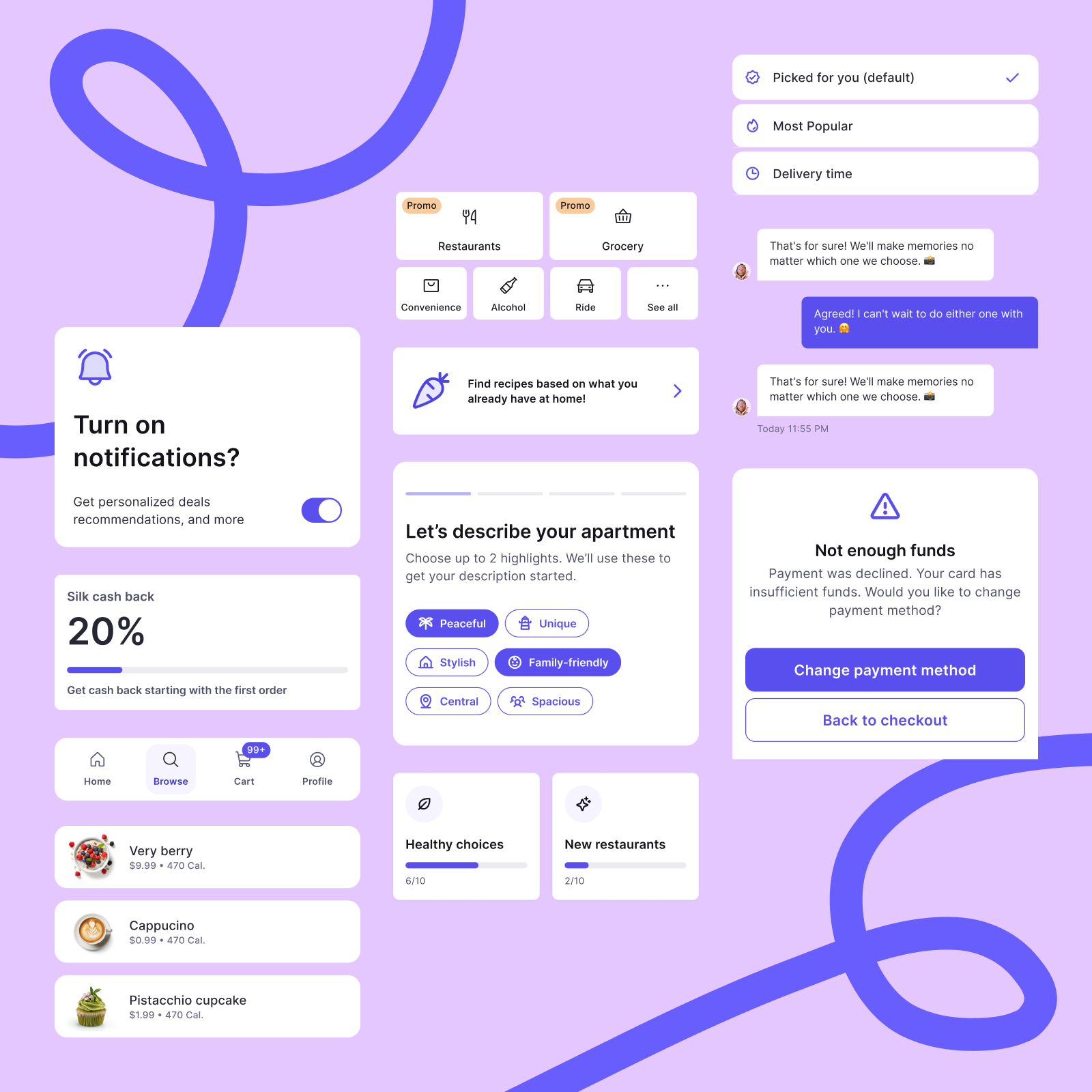
A practical example of connecting adoption to measurable outcomes is Silk — our design system built for commerce products across mobile and responsive web. Instead of tracking only documentation views or component counts, we evaluated Silk based on delivery impact.
In client implementations, Silk reduced setup and prototyping time by up to 50% and shortened MVP timelines from six months to three. During sprint cycles, teams saved 3–6 days by reusing structured components and tokens. In one rebranding scenario, core UI updates were delivered in just 2 days, with the full rollout completed in approximately 3 working days.
These results made the system’s value visible beyond design teams — strengthening executive buy-in and reinforcing long-term adoption.
4.3. Keep listening: Feedback, adjustments, and iteration
A design system isn’t static. Even a well-adopted one needs to evolve. The tools your teams use will change. New platforms will emerge. Organizational priorities will shift. If your system stays frozen, people will slowly stop using it.
That’s why it’s critical to build in feedback loops. Don’t wait for complaints—actively ask for feedback during retros, design critiques, or through quick pulse surveys. Watch how people interact with the system over time, and don’t be afraid to refine or remove parts that no longer serve them.
When a design system evolves alongside its users—adapting to new tools, changing team structures, and shifting priorities—it stays relevant, trusted, and widely used.
5. Conclusion: Adoption Is the Strategy
Design system adoption doesn’t happen just because you publish components—it happens when the system reflects how people actually work. Adoption is an ongoing process rooted in empathy, aligned with team capabilities, and supported through clear strategy and feedback.
The best design system practices go beyond documentation and polish. They prioritize real-world workflows, invite meaningful contributions, and scale with the organization. When systems are designed with adoption in mind from the start, they’re easier to use, easier to trust, and more likely to stick.
A design system is a product, a shared language, and a living part of your delivery process. When you treat it that way, adoption becomes not just a goal—but a natural outcome.


