
From Keywords to Style Agents: Zalando’s AI Commerce Playbook

Contents
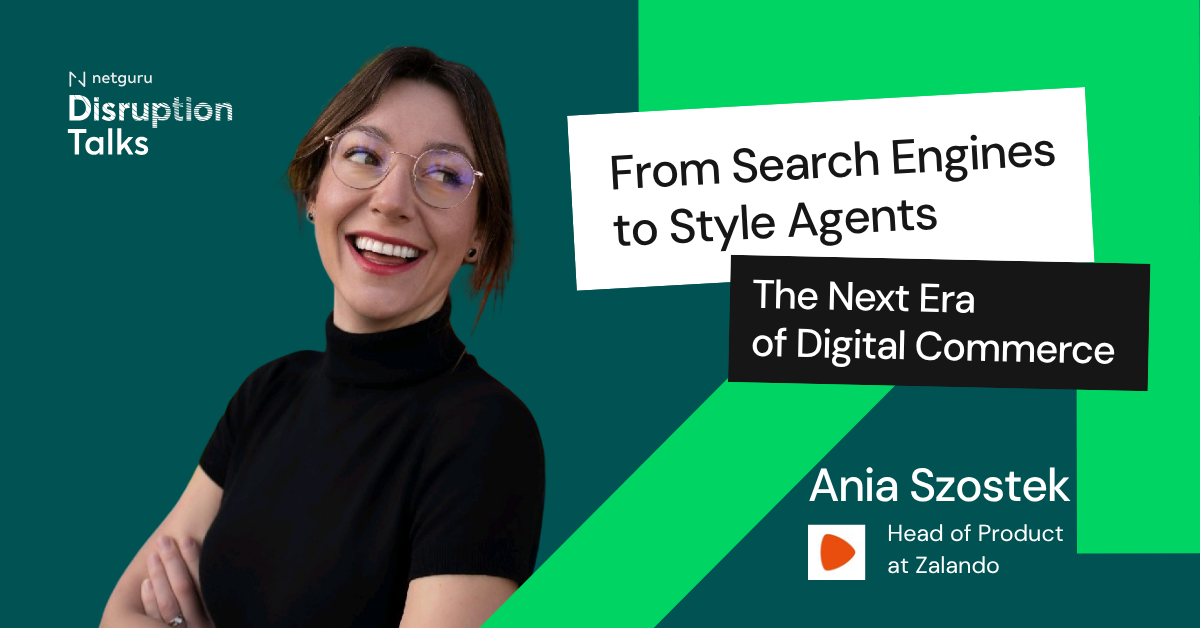
AI is rewriting digital commerce, shifting from keywords to conversations. In this Disruption Talk with Zalando session, Ania Szostek, Head of Product at Zalando, shares how style agents, not search bars, will power the next wave of shopping.
Key insights for digital commerce leaders
- From search to agents: Move beyond keyword matching to conversational, intent–aware AI that can translate lifestyle needs into product requirements.
- Taste as a product requirement: Build frameworks for “taste,” personalization, and human–in–the–loop evaluations to avoid generic outcomes.
- T‑shaped product teams: Elevate Product Managers as builders who can design, code, and prototype quickly alongside UX and Engineering.
- Know–do shift: Prepare for agents that act on users’ behalf, integrating trust, safety, and latency into operational excellence.
From the front lines: Szostek’s perspective
Szostek’s view is forged across the full product spectrum. She began with physical products at Procter & Gamble, moved into Trust & Safety and Google Shopping at Google, then tackled scaled consumer experiences at Tinder.
Today at Zalando, she has led AI fashion assistance from inception, translating ambiguous human style language into measurable signals, orchestrating catalog search with LLMs, and building evaluation systems that account for the most subjective variable in commerce – taste. Her story is not a list of logos; it is a playbook for building AI that respects context, culture, and the reality of production.
PMs must become builders again.
From keywords to style agents
The old search paradigm demanded literal matches between user queries and database attributes. That breaks in fashion, where people think in aesthetics, occasions, and trends. Szostek’s team reframed the problem: let users talk naturally, then let AI decompose intent into constraints the catalog can execute on – material, color, silhouette, climate, and price – all tuned to personal style.
"You can ask in the natural language, 'I need a full outfit for my trip to Peru,' and AI is going to translate it into specific requirements."
Deep dive: From Coachella to catalog relevance
One thorny case: translating open–ended prompts like “outfit for a Coachella festival.” The system must map festival vibes to product signals the search stack understands, then retrieve relevant, in–stock items.
The hardest part was connecting LLM reasoning with catalog constraints and measuring “correctness” when good looks different for different people. The solution blended prompting, retrieval, and rigorous human–in–the–loop evaluations to align outputs with style, context, and inventory.
Taste cannot be automated.
The new product manager: T‑shaped and outcome‑driven
In Szostek’s world, boundaries between Product, UX, and Engineering blur. PMs need intermediate design and coding skills to ship learning faster, reduce dependency bottlenecks, and ask better questions. With AI‑assisted prototyping, the team can validate flows in hours, not sprints, and move from opinions to evidence.
"We have to become builders again... you need to be able to design and code yourself."
This shift elevates technical empathy, but also resets accountability. If PMs help build, they also help measure – through robust evaluations, latency targets, and safety guardrails. It is full‑stack product work, optimized for outcomes, not artifacts.
Making LLMs shop the catalog
Turning conversation into commerce requires pragmatic engineering. Zalando’s team connects LLM understanding with search systems that optimize for both hard criteria – size, color, material – and subjective fit for a person and context. Latency matters. Users tolerate streaming responses more than before, yet slow experiences still drive churn. Trust and safety frameworks must scale across markets.
Above all, models trained on the internet risk averaging out style; closing that gap demands personalization signals, RAG, and targeted training where ROI proves out.
The contrarian view: Challenging the status quo
Conventional wisdom says to make new AI features prominent to boost adoption. Szostek cautions against it. In tests, surfacing the assistant too aggressively hurt performance. The fix was to integrate conversational styling naturally into the journey, solving real problems rather than showcasing novelty.
"Don’t do AI for the sake of doing AI… integrate it more naturally in the user journey and solve real user problems."
This hot take matters because the next disruption is not chat – it is agents that do. If teams chase flash over fit, they will miss the operational discipline required to earn trust at scale.
From knowing to doing: agents are next.
Your strategic roadmap: What to do next
The 24‑hour win
- Run a quick audit: where do users express intent that your system fails to translate? Collect five examples – e.g., occasions, trends, or lifestyle prompts – and test if your search stack can retrieve relevant, in‑stock items.
- Define “good” for one use case. Draft an evaluation rubric with human reviewers, including correctness, relevance, personalization fit, and safety.
The 90‑day strategy
- Prototype a style agent for one high‑value journey. Connect LLM intent parsing to your catalog via RAG and guardrails. Optimize for latency with streaming responses.
- Stand up taste frameworks and signals. Incorporate preference data, past returns, sizes, and visual discovery. Invest in human–in–the–loop reviews, offline metrics, and A/B tests to tune for real outcomes, not demos.
Expert Q&A
Q: How is a style agent different from a traditional search bar?
A: Traditional search requires literal keyword matches. The agent lets users speak naturally, then translates intent into product constraints and retrieves relevant outfits that match context and personal style.
Q: Why is fashion one of the hardest domains for AI assistants?
A: Fashion is subjective. “Good” varies by person and occasion, making evaluations tricky. Models trained on the internet skew to average taste, so teams must add personalization signals and expert reviews to reach meaningful relevance.
Q: How should Product Managers adapt in the AI era?
A: Become T‑shaped builders. Learn enough design and coding to prototype quickly, reduce handoffs, and own evaluations, latency, and safety with Engineering and UX. The role shifts from writing requirements to shaping taste and outcomes.
Conclusion
The leap from search to style agents is here. Build for conversations, connect LLMs to your catalog with rigor, and treat taste as a first‑class requirement. For more details and real‑world examples from Zalando, listen to the full DT with Zalando conversation on LinkedIn.


