
What Is a Chatbot? Definition, How It Works & Use Cases


Contents
Learn what a chatbot is, how it works using NLP and AI, the main types, real-world use cases, and key benefits and limitations — explained in plain language.
What Is a Chatbot? (Quick Answer)
A chatbot is software that simulates human conversation — via text or voice — to answer questions, complete tasks, or guide users through a process without a live agent. Some chatbots follow fixed decision trees (rule-based), while more advanced systems use Natural Language Processing (NLP) to interpret what a user actually means, not just what they typed. Conversational AI takes this further, enabling multi-turn dialogue that adapts based on context — the difference between a phone menu and a genuine back-and-forth exchange.
Chatbot Definition: More Than a Simple FAQ Bot
A chatbot is a software system designed to conduct conversations with humans through text or voice interfaces — but that single sentence covers an enormous range of capability. The earliest example, ELIZA (developed at MIT in 1966), simulated a psychotherapist by matching user input against simple patterns. Modern systems operate in an entirely different league.
The practical spectrum runs across three distinct tiers:
- Rule-based chatbots navigate users through fixed decision trees — predefined branches of if/then logic. They're predictable and auditable, but they break the moment a user phrases a question the designer didn't anticipate.
- ML-trained chatbots use Natural Language Processing to perform intent recognition (what does the user want?) and entity extraction (what specific values — dates, product names, account numbers — did they mention?). These systems generalise beyond scripted paths.
- LLM-powered chatbots — built on models like those underpinning ChatGPT — generate responses dynamically, handle ambiguity, and sustain multi-turn dialogue that feels genuinely conversational.
The distinction matters commercially. A decision tree bot handling "what are your opening hours?" costs almost nothing to build and almost nothing when it fails. An LLM deployed in a regulated industry — finance, healthcare — failing to contain its outputs carries real liability.
Conversational AI is the broader category: chatbots are one implementation within it, alongside voice assistants and process automation agents, all of which rely on conversational user interfaces that enable natural language interactions. Treating every chatbot as interchangeable obscures the architecture decisions that determine whether a deployment succeeds or quietly erodes customer trust.

How Does a Chatbot Work? Step-by-Step
Every chatbot interaction — whether you're asking a bank's virtual assistant about your balance or troubleshooting software with an AI agent — follows the same fundamental pipeline. Here's what happens between the moment a user hits send and the moment a response appears.
1. Input capture
The system receives raw input: typed text, transcribed speech, or a button tap. Voice inputs are first converted to text via speech-to-text processing before anything else happens.
2. NLP parsing
Natural Language Processing (NLP) — the branch of AI that helps computers interpret human language — breaks the raw text into structured components. This step handles spelling correction, language detection, and tokenisation (splitting text into individual words or phrases the system can analyse).
3. Intent recognition
This is where the chatbot asks: what does the user want to do? Intent recognition is the classification step that maps a phrase like "I need to change my delivery address" to a predefined intent such as update_order. Rule-based systems match keywords explicitly; ML-trained systems learn intent patterns from thousands of labelled examples; LLM-powered systems infer intent from context without requiring pre-labelled training data at all.
4. Entity extraction
Beyond intent, the system extracts entities — the specific values that make a request actionable. In "book a flight to Berlin on Friday," the entities are destination: Berlin and date: Friday. Without entity extraction, a chatbot knows what someone wants but not the details needed to fulfil it.
5. Dialogue management
This layer decides what happens next: ask a clarifying question, call a back-end API, return an answer, or — critically — escalate to a human agent. Weak dialogue management is one of the most common failure points in production deployments; a bot that loops on misunderstood input or ignores context from earlier in the conversation erodes user trust fast, echoing real-world AI failure examples that shaped robust agent design.
6. Response generation
The system constructs and delivers a reply — either from pre-written templates (rule-based), ranked candidate responses (ML), or dynamically generated text (LLM).
Platforms like Dialogflow (Google) and Rasa (open-source) expose each of these layers as configurable components, which is why they're common starting points for enterprise chatbot builds. Dialogflow abstracts much of the NLP complexity through pre-trained models; Rasa gives engineering teams direct control over the full pipeline — a trade-off between speed to deploy and architectural flexibility that’s explored in depth in a practical guide to what Dialogflow is and why you need it.
Types of Chatbots: Rule-Based, AI, and LLM-Powered
Not all chatbots are built the same way — and choosing the wrong architecture is one of the most common reasons deployments underperform. The three categories differ fundamentally in how they interpret input, generate responses, and handle unexpected user behavior, so applying chatbot UX tips and best practices is critical to designing conversations that match each architecture’s strengths.
Rule-Based Chatbots (Decision Tree)
Rule-based chatbots operate on explicitly programmed logic: if the user says X, respond with Y. Navigation is structured as a decision tree — a branching set of predefined paths that guides users toward specific outcomes. There's no language understanding happening; the system pattern-matches keywords or button selections against a fixed script.
Pros: Predictable, auditable, fast to deploy, easy to comply with regulated-industry requirements (no hallucination risk).
Cons: Brittle outside the happy path. A user who phrases a request in an unexpected way — or makes a typo — breaks the flow. Maintenance burden grows with every new use case, and failure modes are sharp: the bot either responds correctly or completely stalls, often frustrating users into abandoning the conversation entirely.
Best fit: narrow, high-volume, low-variance tasks — appointment booking confirmations, FAQ deflection for a fixed product catalog.
ML-Trained Chatbots (Intent Classification)
Machine Learning-based chatbots introduce Natural Language Processing (NLP) — specifically intent recognition (classifying what the user wants) and entity extraction (pulling out the relevant details, like a date or product name). Instead of matching keywords, the model is trained on labeled examples of real user messages, learning to generalize across phrasing variations.
This is the architecture behind most enterprise conversational AI deployments from platforms like Dialogflow, IBM Watson Assistant, and Amazon Lex.
Pros: Handles natural phrasing variation gracefully; can be retrained as usage patterns evolve; intent confidence scores enable clean human-in-the-loop escalation when the bot is uncertain.
Cons: Requires a labeled training dataset and ongoing maintenance. Performance degrades outside trained intents — the model won't know what it doesn't know, which can produce confident-but-wrong responses.
LLM-Powered Chatbots (Generative AI)
Large Language Model (LLM)-powered chatbots — built on models like those underlying ChatGPT — don't rely on predefined intents at all. They generate responses token by token, drawing on billions of parameters trained across vast text corpora. This gives them genuine conversational flexibility: they can handle novel questions, maintain context across long exchanges, and synthesize information rather than retrieve it.
Global GenAI models market will exceed $25 billion in 2026 and reach $75 billion by 2029 ([Gartner, 2026].
Pros: Dramatically reduced intent-mapping overhead; capable of nuanced, multi-turn reasoning; can be grounded in proprietary knowledge via retrieval-augmented generation (RAG).
Cons: Hallucination risk is real and requires mitigation — guardrails, source citation, and human escalation paths are non-negotiable in customer-facing deployments. Latency and cost per query are higher than rule-based or ML systems, and auditability is harder.
In practice, production chatbots rarely fit cleanly into one category. Netguru's implementations for clients in financial services and e-commerce have used hybrid approaches — LLM-powered response generation constrained within ML-classified intent boundaries — to capture flexibility without sacrificing reliability, especially when deployed on scalable multi-chatbot platforms built on Azure.
Rule-Based Chatbots
Rule-based chatbots operate on explicitly programmed logic — if the user says X, respond with Y — structured as a decision tree that branches based on keyword matches or button selections. There's no inference happening; the bot follows a predetermined script, every time.
That predictability is genuinely valuable in the right context. A bot handling utility bill payments or appointment confirmations doesn't need to interpret nuance — it needs to execute a defined flow reliably and cheaply. Rule-based systems are faster to build, easier to audit, and straightforward to comply with in regulated industries.
The brittleness is the trade-off. The moment a user phrases a request outside the scripted paths — or asks a follow-up the decision tree doesn't anticipate — the bot fails, often visibly. Without a clear human escalation path built in, that failure erodes trust fast.
AI and Machine-Learning Chatbots
Where rule-based bots break down is exactly where ML-trained chatbots begin to shine: handling the same question asked fifty different ways. Instead of matching exact keywords, these systems use Natural Language Processing (NLP) and Machine Learning to identify the intent behind a message — what the user actually wants — regardless of how they phrase it.
Intent recognition is the core mechanism: the model is trained on labeled examples ("track my order," "where's my package," "has my shipment left yet" all map to order_status) so it generalizes to phrasing it's never seen before. A related process, entity extraction, pulls out the specific variables — an order number, a date, a product name — that the bot needs to act on the intent.
The trade-off is upfront investment. Reliable ML chatbots typically require thousands of annotated training examples per intent, plus ongoing retraining as language patterns shift. Get the training data wrong — too narrow, too biased toward one customer segment — and you've built a bot that fails confidently, which is often worse than a bot that fails obviously.
Generative LLM-Powered Chatbots
The most significant shift in Conversational AI arrived with Large Language Models (LLMs) — systems trained on vast text corpora that generate responses rather than retrieve them. Where ML chatbots classify intent from a predefined set, an LLM-powered chatbot like ChatGPT constructs answers dynamically, handling ambiguous, multi-part, or entirely novel queries without a single hand-coded rule.
The practical upside is real: LLM chatbots can draft personalized responses, summarize account histories, and hold coherent multi-turn conversations. The risk is equally real. LLMs hallucinate — producing confident, plausible-sounding answers that are factually wrong. In Customer Service Automation, a hallucinated refund policy or incorrect dosage instruction isn't an edge case; it's a liability. Production deployments need retrieval guardrails, output validation, and clear human-escalation paths to remain trustworthy.
Common Chatbot Use Cases Across Industries
The gap between "chatbot as experiment" and "chatbot as core infrastructure" usually comes down to one question: does the deployment solve a problem with measurable volume? The strongest use cases share a common trait — high-frequency, pattern-driven interactions that don't require human judgment on every exchange.
Customer Service Automation remains the dominant deployment context. Support teams handling thousands of tickets monthly are natural candidates: chatbots resolve password resets, order status queries, and policy questions without agent involvement, showcasing the transformative role of AI chatbots in customer service. 80% of routine customer support interactions are automated by AI without human escalation in 2026 (FastBots, 2026).
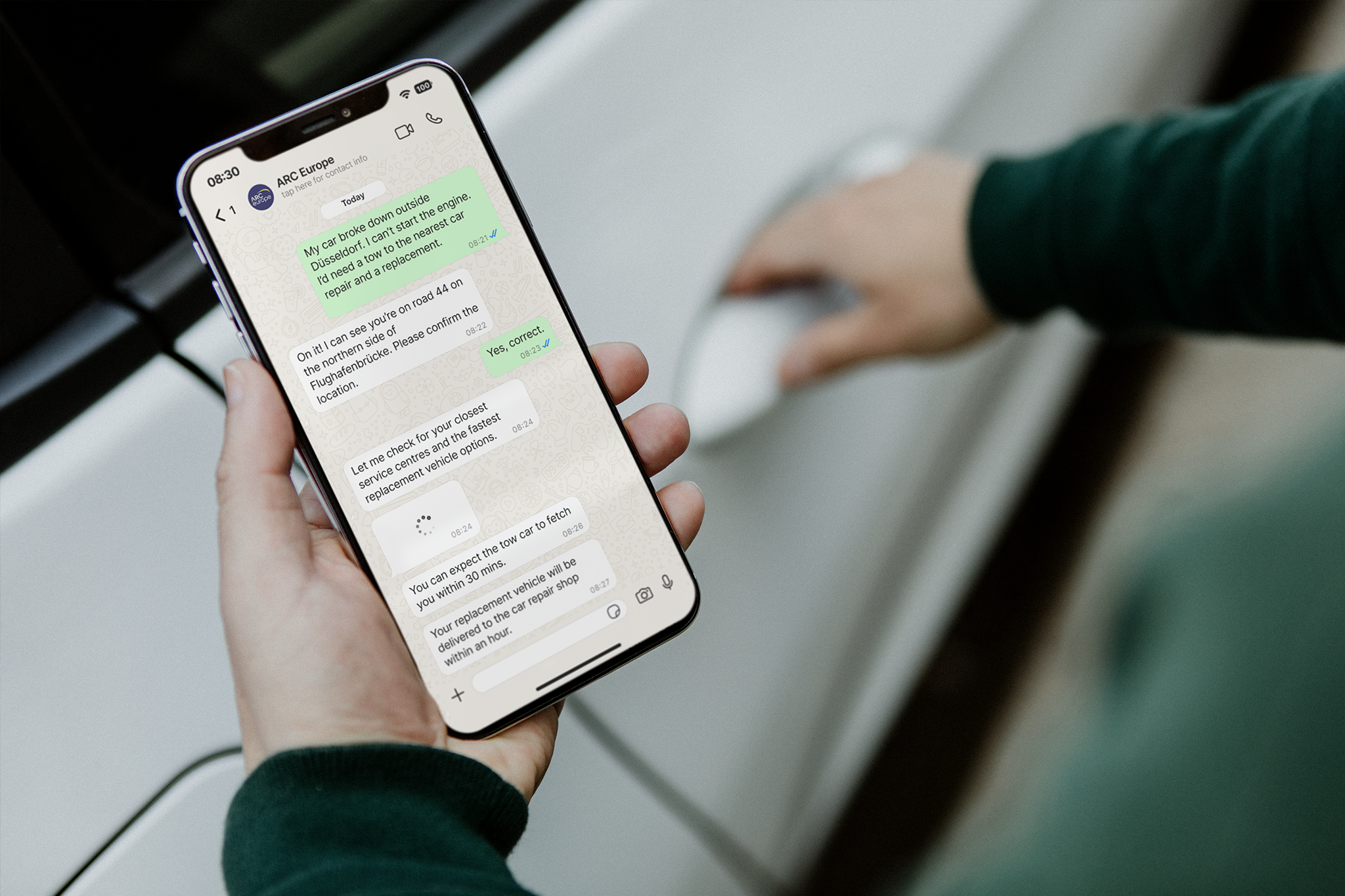
For example, ARC Europe implemented a custom AI chatbot to automate post-incident support through WhatsApp. Delivered by Netguru, the solution asks drivers only a few targeted questions, identifies whether they need a taxi, hotel, or replacement vehicle, and guides them to the right next step without adding a new interface.
E-commerce deployments extend beyond basic FAQ handling. Order tracking is table stakes; the more interesting applications involve real-time product recommendations driven by browsing context, abandoned cart recovery through proactive messaging, and post-purchase support that reduces return friction. A chatbot that can ask three qualifying questions and surface the right product variant — similar to AI product discovery chatbots for complex catalogs — eliminates a common drop-off point in the purchase funnel.
Healthcare triage bots handle appointment scheduling, symptom pre-screening, and medication reminders — tasks where speed matters but clinical judgment is explicitly out of scope. Human-in-the-loop escalation isn't optional here; it's a design requirement. The bot collects structured information and routes; a clinician decides. Getting that boundary wrong is one of the clearest chatbot failure modes in a high-stakes vertical, especially as healthcare chatbots transform patient access and care delivery.
HR and employee onboarding is an underrated use case. New hires generate predictable, repetitive questions about benefits, IT access, and policies during their first 90 days. A well-trained internal bot answers these consistently at any hour, without consuming HR bandwidth on queries that have documented answers.
Across all four contexts, the pattern holds: chatbots create value where interaction volume is high, queries are bounded, and speed of response directly affects user experience or operational cost — especially when they’re integrated into a broader AI-powered transactional ecosystem beyond stand-alone chatbots.
Key Benefits — and Real Limitations — of Chatbots
Chatbots earn their place in production environments through a specific set of advantages — but they also fail in predictable ways that teams consistently underestimate before deployment.
Where chatbots genuinely deliver:
- 24/7 availability without linear cost scaling. A chatbot handles the 2 a.m. billing query and the Monday morning ticket surge with identical capacity.
- Speed. Average chatbot response time is measured in milliseconds; average human agent first-response time in live chat is average first response time for live chat support is 40 seconds (Freshworks, 2026). For simple queries, customers notice the difference immediately.
- Cost per interaction. 78% of service agents say they have all the tools they need (Salesforce Research State of Service, 2024) puts automated resolution costs significantly below agent-handled tickets — particularly meaningful when Customer Service Automation is absorbing thousands of repetitive contacts monthly.
- Consistency. A well-configured chatbot gives the same accurate answer on return policy at contact 1 and contact 10,000. Human agents vary.
Where chatbots predictably break down:
Rule-based systems collapse on anything outside their decision tree. Even Natural Language Processing (NLP)-powered bots struggle with context that spans multiple turns — a user who changes their mind mid-conversation, references something said three exchanges earlier, or uses ambiguous phrasing can derail intent recognition entirely.
LLM-powered systems handle context better but introduce different risks: confident-sounding incorrect answers, scope creep into topics the bot shouldn't address, and inconsistent tone.
The escalation gap is where most deployments fail silently. When a chatbot can't resolve an issue and the handoff to live chat is clunky — no conversation history transferred, no context preserved — customers repeat themselves and satisfaction drops sharply. Human-in-the-loop handoff, done well, means the agent receives the full transcript and a summarized intent before saying a word, avoiding many of the pitfalls highlighted in why most chatbot implementations fail and how to avoid it.
Chatbot vs Live Chat vs Virtual Assistant: Key Differences
These three terms get used interchangeably, but they describe meaningfully different tools with different capabilities and cost profiles.
Chatbot — software that handles structured conversations automatically, ranging from rule-based decision trees to LLM-powered systems capable of open-ended dialogue. No human in the loop unless escalation is triggered.
Live chat — a human agent responding in real time through a messaging interface. High quality ceiling, high cost per interaction, and hard to scale during volume spikes. Often the escalation target when a chatbot reaches its confidence threshold.
Virtual assistant — a broader category. Voice-first interfaces like Alexa or Siri are virtual assistants; so are enterprise AI agents that execute multi-step tasks (booking a meeting, pulling a CRM record). Conversational AI and Large Language Model (LLM)-driven assistants increasingly blur this line, combining natural dialogue with action-taking capability.
|
Chatbot |
Live Chat |
Virtual Assistant |
|
|---|---|---|---|
|
Availability |
24/7 |
Agent hours |
24/7 |
|
Scalability |
High |
Low |
High |
|
Handles complex nuance |
Limited–High* |
High |
Medium–High |
|
Cost per interaction |
Low |
High |
Low–Medium |
*Depends on whether the system is rule-based, ML-trained, or LLM-powered — a distinction covered in the next section.
Frequently Asked Questions About Chatbots
Are chatbots the same as AI?
Not necessarily. A rule-based chatbot follows scripted decision trees with no machine learning involved — closer to an automated phone menu than artificial intelligence. Conversational AI and LLM-powered chatbots like those built on GPT-4 do qualify as AI: they use Natural Language Processing (NLP) to interpret meaning, not just match keywords. The term "chatbot" covers the entire spectrum, so the honest answer is: some are, some aren't.
Can chatbots replace human agents?
For high-volume, repetitive queries — password resets, order status checks, FAQ responses — chatbots handle the load effectively, with well-implemented deployments achieving 60–80% deflection rates. But replacement isn't the right frame. Chatbots fail on emotionally charged issues, complex multi-step problems, and edge cases outside their training data. The reliable model is augmentation: chatbots resolve what they can, escalate what they can't. Human-in-the-loop escalation isn't a fallback — it's a design requirement.
How accurate are chatbots?
Accuracy depends heavily on system type and training data quality. Rule-based chatbots are precise within their defined scope but break immediately outside it. ML-trained systems improve with volume but need ongoing retraining as language and customer needs shift. LLM-powered chatbots handle wider variation but introduce hallucination risk — confidently wrong answers — which makes human review critical for regulated industries.
What is the difference between a chatbot and a virtual assistant?
A virtual assistant — think Siri or a sophisticated customer service agent — is multi-modal and proactive: it can take actions (book meetings, query CRMs, send emails) and often operates across voice and text. A chatbot is typically single-channel and reactive, responding to inputs within a defined conversation scope. The boundary is blurring as Conversational AI platforms gain tool-use capabilities, but the functional distinction still holds for most enterprise deployments.
How long does it take to build a chatbot?
A rule-based chatbot handling a narrow use case — a returns flow or an FAQ widget — can go live in two to four weeks. An ML-trained, NLP-driven chatbot integrated with backend systems typically takes three to six months, including intent design, training data curation, and UAT. LLM-powered builds can compress timeline but extend the evaluation phase, since prompt engineering, safety testing, and hallucination mitigation add complexity that simple deployments don't face.
Ready to Build a Chatbot for Your Business?
Understanding the technology is one thing — deploying a chatbot that actually reduces support load, handles edge cases gracefully, and knows when to hand off to a human is another. Netguru has built conversational AI and customer service automation solutions across fintech, healthcare, and e-commerce, helping clients move from prototype to production systems that handle real query volumes as part of its broader AI development services for solving complex business challenges.
Whether you're evaluating a rule-based setup for a narrow use case or an LLM-powered assistant for complex customer interactions, the architecture decisions made early determine long-term performance.


