
Are Chatbots Worth It? ROI, Costs, and Business Impact Explained


Contents
Chatbot ROI starts with compelling numbers: businesses reduce customer service costs by 30-40% within the first year, and 57% of companies report strong returns even with minimal investment. Yet many chatbot projects fail to deliver value. The difference between potential and reality usually comes down to implementation strategy rather than technology limitations.
Customer expectations create pressure for instant responses, and 63% of customers will leave after just one poor experience. This puts businesses in a difficult position. They need faster support without sacrificing quality, but poorly implemented chatbots can make the problem worse.
The question is no longer whether chatbots work—the technology is proven. The real challenge is determining when chatbot investment makes sense for your specific situation. This guide examines actual costs, measurable returns, and practical frameworks to help companies make informed decisions about chatbot implementation.
Key Takeaways
Chatbot ROI extends beyond simple cost reduction. Companies need to measure real business impact across customer satisfaction, revenue generation, and operational efficiency.
Deciding a chatbot is worth building is the easy part — a ai development company handles the model selection, integration, and productionization that follow.
- Chatbots typically reduce customer service costs by 30–40% within the first year, with successful implementations achieving 40–70% deflection rates
- Total implementation costs often exceed initial estimates by 30–50%, including hidden expenses like data preparation, compliance, and ongoing maintenance
- Revenue attribution reveals chatbots generate 3–5× more value than cost-savings-only measurement, with conversion rates improving 10–100% across industries
- 40% of chatbot projects fail due to poor human handoff options and unrealistic scope expectations rather than technology limitations
- Positive ROI typically materializes within 8–14 months for businesses with clear use cases and proper integration strategies
Success comes from strategic implementation with realistic expectations, proper training data, and seamless escalation processes. Companies that focus on solving specific, high-volume customer queries see better results than those trying to automate everything from day one.
Breaking Down Chatbot Business Value
Chatbot business value extends beyond automation metrics. The real challenge isn't calculating ROI—it's understanding what you're actually measuring and what realistic outcomes look like for your specific situation.
What Chatbot ROI Really Measures
The ROI formula looks simple: [(Benefits - Costs) / Costs] × 100%. An ROI of 200% means earning twice your investment. The complexity lies in defining total value honestly.
Many organizations treat chatbot ROI as purely financial, when it actually measures automation effectiveness across operational processes, service quality, and team productivity. This creates a measurement gap. A poorly implemented chatbot might reduce queries reaching human agents, but leave more customer issues unresolved if the bot lacks proper escalation tools.
This creates a measurement gap that stems from viewing chatbots in isolation rather than integrating AI into your operations as part of a broader transactional ecosystem.
Successful ROI tracking requires linking chatbot performance to tangible business outcomes rather than isolated technical metrics. You need to know whether your chatbot actually solves problems or just moves them around.
To track essential chatbot KPIs that connect to business outcomes, you need to know whether your chatbot actually solves problems or just moves them around.
To track essential chatbot KPIs that connect to business outcomes, you need to know whether your chatbot actually solves problems or just moves them around.
Direct vs Indirect Returns
Chatbot impact splits into two categories, each requiring different measurement approaches.
Direct returns are immediately measurable. Lower support costs come from automating tasks that would otherwise require human agents. Chatbots handle volume spikes without additional staffing costs. Revenue generation happens through product recommendations, cross-selling, and smarter lead capture that qualifies intent in real-time. Faster user action occurs when instant answers move customers from consideration to purchase.
Indirect returns create substantial long-term value but prove harder to quantify. Consistent 24/7 support maintains operations when teams are offline. Chatbots create more interaction points by actively guiding users through questions or tasks. Internal efficiency increases as support teams shift from repetitive queries to complex or strategic work. Employee satisfaction improves when routine automation reduces burnout.
The numbers support both categories. Companies using conversational AI see customer satisfaction increase by 55% and customer loyalty rise by 51%. More tellingly, 62% of organizations report more productive customer service agents, and 24% see agents working on tasks that improve overall customer experience.

Industry Benchmarks and Realistic Expectations
ROI expectations vary significantly across sectors. A Forrester study found chatbot implementation could yield 210% three-year ROI and $2.10 million in cost savings for a tech company. Companies like Jumia report 70% containment rates with 76% CSAT improvements.
For ecommerce specifically, key metrics include conversion rates from chat interactions, cart recovery rates for abandoned carts, average order value influenced by chatbot recommendations, and resolution rates. These metrics reveal how chatbots drive sales, reduce abandonment, and improve customer experience.
Healthy implementations typically reach 40-70% deflection rates once mature, with AI assisting in 20-40% of conversations. Misunderstanding rates should drop below 10% after the first month, then fall below 5% as the system improves. These benchmarks provide realistic targets for measuring effectiveness against industry standards.
What matters most is matching expectations to your specific business context rather than chasing universal benchmarks.
The True Cost of Implementing Chatbots
Pricing transparency creates the biggest challenge when evaluating chatbot costs. Published rates rarely reflect what businesses actually spend once implementation begins, deployment scales, and hidden expenses surface.
This is also where architectural choices start to impact ROI. Many businesses find themselves choosing between rigid SaaS tools that limit long-term value and expensive custom builds that delay returns. Increasingly, organizations are adopting more adaptable chatbot platforms—such as Chatguru—that provide faster deployment while still allowing deeper integration and control over business logic.
Platform Subscription Fees
Subscription-based chatbot platforms offer the most predictable pricing structure. Small business plans typically range from $15 to $500 per month, covering basic features like visual flow builders and common messaging channel connections. Mid-market tiers jump to $800-$1,500 monthly, adding AI capabilities, advanced CRM integrations, and higher conversation volumes. Enterprise solutions start at $3,000 and can exceed $10,000 per month, including robust AI/NLP, dedicated support, SLAs, and enhanced security features.
Platforms like ChatBot by Text start at $19 per user monthly (billed annually) for essential features, while growth plans cost $79 monthly with 200 AI agent resolutions included. Botsonic offers tiered pricing from $16 monthly for beginners up to $249 for advanced plans with 12,000 messages per month. These published rates help with initial budgeting but represent only the starting point for total cost of ownership.
Development and Integration Expenses
Custom chatbot development costs vary dramatically based on complexity. Basic rule-based chatbots handling FAQs cost $5,000-$30,000. AI-powered chatbots with NLP, integrations, and advanced automation range from $30,000 to $100,000. Enterprise-grade solutions with custom AI models and compliance features easily exceed $150,000.
Integration expenses often surpass the chatbot platform cost itself. Connecting to CRM systems runs $5,000-$13,000, while e-commerce platform integrations cost $7,000-$17,000. Legacy system integrations can reach $13,000-$50,000 due to complexity.
In many cases, a “simple” order status chatbot can require tens of thousands of dollars in integration work across order management, shipping carriers, customer database, and returns systems. The chatbot platform itself cost only $35,000. What initially seems straightforward often becomes a complex integration project once all required systems and data sources are mapped.
Training and Maintenance Costs
Ongoing expenses consume 15-20% of initial development cost annually. Basic system maintenance runs $1,000-$5,000 per year, while NLP retraining costs $2,000-$10,000 quarterly. Security updates add $500-$2,500 monthly.
AI chatbots at moderate scale cost $400-$1,500 per month just in operational expenses. High-volume enterprise workloads easily exceed $2,000 monthly in token usage, storage, and hosting. Staff training and optimization support add another layer, with companies spending $500-$5,000 annually on team training. Enterprises running advanced AI sentiment analysis may invest $20,000+ in ongoing support.
Hidden Costs Most Businesses Miss
Data preparation represents the most underestimated expense, consuming 80% of AI project time. Poor data quality increases project costs by 25-40%. Training data creation alone costs $30,000-$80,000 for most implementations.
Compliance requirements add substantial unplanned expenses. HIPAA violations can cost up to $1.5 million per incident. One healthcare startup spent $120,000 solely on compliance upgrades after deployment, while a financial firm required $150,000 to secure approval for LLM-based automation. Financial service chatbots require 25-35% more budget due to audit requirements.
Total cost of ownership consistently increases 30-50% beyond initial estimates. LLM inference costs increase 8-12x when moving from proof-of-concept to production, and 27% of companies cite runaway cloud costs as their biggest AI challenge. Companies must plan for these realities rather than hoping published rates reflect actual spend.
Measuring Chatbot ROI: Metrics That Matter
Most companies track the wrong chatbot metrics. Only 44% actively measure their bot's performance, and among those that do, 35% of AI customer service projects never break even. The problem isn't measurement itself—it's measuring what actually drives business value.
Deflection rate is often treated as the primary measure of chatbot success. High deflection meant the bot was working, right? In practice, deflection without resolution creates more problems than it solves. A bot that deflects 80% of inquiries but leaves customers frustrated isn't delivering value—it's creating it elsewhere in your support funnel.
Cost Savings Calculations
Cost per interaction reveals whether your chatbot investment makes financial sense. Agent salaries, team size, and ticket volume establish your baseline. With 50 service agents earning $80,000 annually handling 200,000 tickets at $20 per ticket, you can calculate real savings potential. Human agent interactions typically cost $8-$15, while AI resolution runs $0.50-$2.00.
Dartmouth reduced service desk costs by over $1 million annually after implementing AI that achieved 86% auto-resolution of support requests. What matters more than the percentage is whether those resolutions actually solve user problems. Chatbots handle approximately 20% of support requests end-to-end, translating to measurable agent hour reductions. Businesses automating routine inquiries see 30-50% decreases in operational costs.
Revenue Generation Tracking
What most businesses miss is that chatbots generate 3-5x more value than cost-savings-only measurement suggests. Revenue attribution breaks into four categories: direct sales from purchases completed during conversations, cost avoidance from AI-resolved issues, lead capture value from qualified prospects, and retention revenue from preventing churn.
Capturing this value depends heavily on how the chatbot is implemented. Systems that integrate deeply with product data, customer context, and workflows—rather than operating as standalone widgets—consistently outperform more limited implementations.
Fewer than 18% of businesses can attribute specific revenue to AI conversations. This represents a massive blind spot. A mid-market ecommerce brand running 50,000 monthly conversations might see $425,000 in direct AI-attributed sales, $120,000 in deflected ticket savings, $165,000 in lead pipeline value, and $108,000 in retained customer revenue. Against a $3,000-$5,000 monthly platform investment, this can represent extremely high ROI, often significantly exceeding traditional cost-saving benchmarks.
Revenue per conversation (RPC) benchmarks range from $3.50-$15.00 in ecommerce, with AI-influenced revenue rates spanning 8-25% of total revenue.
Customer Satisfaction Impact
CSAT scores tell you whether customers find chatbot interactions helpful. But tracking CSAT by conversation type reveals which flows work and which frustrate visitors. Harvard Business School research found AI chatbots reduced response time by 22% and improved customer sentiment by 1.63 points.
Resolution quality matters as much as deflection rate. High deflection only drives value when resolution quality stays high. A Chinese utility company achieved 100% reduction in customer wait times and 50% increase in self-service through chatbot deployment. The key was ensuring customers could actually complete their tasks, not just interact with the bot.
Conversion Rate Improvements
Chatbot-assisted conversion rates typically range from 5-12%. Ecommerce implementations recover up to 30% of abandoned carts, while chatbots achieve 3x higher conversion rates when recommending products. Adobe Analytics found US visitors to retail sites from AI services were 38% more likely to convert compared with non-AI traffic.
The average conversion rate increment with chatbots lands between 10-100% depending on industry, calculated on top of base conversion rates. These results depend on the chatbot actually helping users find what they need.
Calculating Your Chatbot ROI
The ROI formula stays simple: ROI = (Total Benefits - Total Costs) / Total Costs × 100. A practical example shows monthly costs of $700 (platform subscription plus maintenance) against $4,100 in monthly benefits (cost savings, shopping assistance revenue, cart recovery), yielding 486% ROI. Every dollar invested returns $4.86 in benefits.
Businesses should expect initial ROI indicators within 60-90 days, with positive net ROI materializing within 8-14 months. The timeline matters because it takes time to optimize conversations and identify which metrics actually predict business success.
Real-World Chatbot Performance Across Industries
Performance varies dramatically across sectors. Automation rates and customer acceptance differ substantially depending on industry context and implementation approach.
Customer Service Automation Results
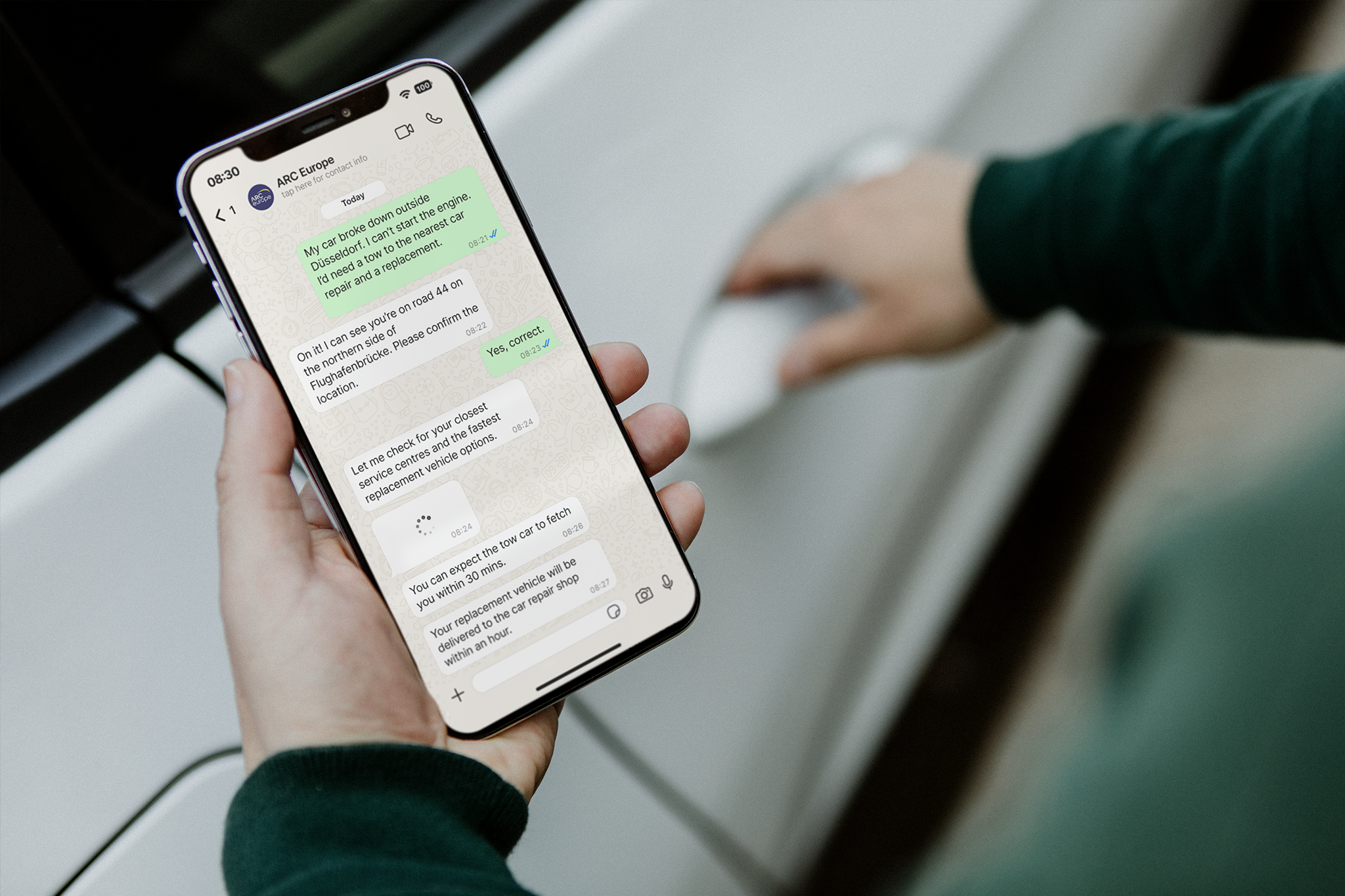
Customer service automation creates the most value when it targets specific, repetitive journeys rather than trying to replace the entire support function. In post-incident support, for example, customers often need fast guidance under stressful conditions, but the process still follows a structured logic: understand the situation, identify the needed service, and route the customer to the right next step.
ARC Europe applied this approach with a custom AI chatbot for post-incident support. Delivered by Netguru, the solution works through WhatsApp and asks drivers only a few targeted questions to identify whether they need a taxi, hotel, or replacement vehicle. This helped simplify a complex service flow, reduce customer effort, and make access to assistance faster and more convenient across European markets.
Ecommerce and Retail Impact
Retail implementations show 69.2% of conversations suitable for chatbot automation. Ecommerce chatbots cut cart abandonment by 20-30% through re-engagement. The revenue impact can be substantial: a fashion retailer saw 35% increase in completed purchases and 22% decrease in cart abandonment within three months. A jewelry retailer achieved 13% conversion rate and $50 million in incremental sales.
Adoption is widespread: 85% of retail and ecommerce businesses have implemented chatbots. This suggests the technology has moved beyond experimental to essential for competitive operations.
Lead Generation and Sales
Sales applications account for 41% of business chatbot deployments. Chatbots increase sales by an average of 67%, with 26% of all sales starting through chatbot interaction. 35% of business leaders report chatbots helped close sales deals, and a SaaS provider saw 30% boost in trial sign-ups.
The pattern shows chatbots work particularly well for qualifying leads and moving prospects through initial sales stages.
Healthcare and Financial Services
Healthcare chatbot market reaches $543.65 million by 2026. A healthcare clinic reported 35% increase in online appointment scheduling. Financial services show mixed but significant adoption: each of the top 10 commercial banks deployed chatbots, with 37% of the US population interacting with banking chatbots in 2022.
Bank of America's Erica reached 32 million customers with over 1 billion interactions by October 2022. Financial institutions save $0.70 per customer interaction with chatbots versus human models. However, 74% of banking customers still prefer human agents for routine queries. This highlights the importance of choice and proper escalation paths.
Common Pitfalls and How to Avoid Them
Over half of chatbot deployments fail to meet business expectations. The technology works. Implementation mistakes create the gap between potential and actual returns.
Why 40% of Chatbot Projects Fail
Failure rates hover between 40-60% for chatbot initiatives. The biggest culprit: no human handoff option when customers need help beyond the bot's scope. Poor escalation processes account for over 65% of chatbot abandonment rates.
Insufficient training data ranks as the second major cause. Chatbots trained on generic data rather than industry-specific terminology misunderstand customer queries 61% of the time. Unrealistic scope expectations follow closely. Teams often try handling every question from day one instead of starting narrow.
Many organizations treat chatbot deployment like installing software rather than designing a customer experience. This mindset leads to poor outcomes regardless of the underlying technology.
Setting Realistic Expectations
Successful implementations start by identifying the 10-20 questions that comprise bulk support volume. Train the AI to handle these exceptionally well first. Resolution rates below 40% signal problems with training data or scope.
Organizations must communicate chatbot limitations upfront and provide easy escalation when needed. Customers accept bot limitations when they know help is readily available. They abandon interactions when they feel trapped.
Building for Scale and Flexibility
Chatbot deployment is not a one-time implementation. Customer expectations change constantly, requiring ongoing analysis rather than static implementations. Weekly reviews of failed conversations reveal improvement opportunities.
Teams that allocate 20–30% of project resources to ongoing optimization and change management see significantly higher adoption. This isn't overhead—it's essential maintenance that keeps chatbots effective as business needs evolve.
Ensuring Proper Human Handoff
Effective handoff strategies monitor specific thresholds: resolution progress stalls, complexity exceeds bot scope, sentiment turns negative, or high-value customers require personalized attention. Context must transfer seamlessly—conversation history, attempted solutions, and sentiment indicators—preventing customers from repeating information.
Systems detecting frustration, repeated rephrasing, or emotional language should trigger immediate escalation. The goal isn't perfect automation. It's creating a seamless experience where technology and human support work together.
Conclusion
Chatbots deliver measurable value when businesses implement them correctly. Organizations with support-heavy operations, ecommerce platforms, or complex customer experiences typically see positive ROI within 8-14 months. The technology works, but success depends entirely on realistic expectations, proper integration, and ongoing optimization.
Companies should avoid chatbot investment if they lack clear use cases, cannot integrate with existing systems, or plan to treat the bot as a simple website widget. For businesses ready to commit to thoughtful implementation—often supported by more adaptable platforms like Chatguru—chatbots reduce costs by 30–40%, improve customer satisfaction, and free teams to focus on high-value work. The question is not whether chatbots work, but whether they are implemented in a way that delivers measurable business value.
FAQs
Q1. Is investing in a chatbot worthwhile for my business? Investing in a chatbot can be highly worthwhile if your business handles high volumes of customer inquiries, operates an ecommerce platform, or needs to provide 24/7 support. Most businesses see a positive return on investment within 8-14 months, with typical cost reductions of 30-40% in customer service expenses. However, success depends on proper implementation, realistic expectations, and ongoing optimization rather than treating it as a simple plug-and-play solution.
Q2. What are the typical costs involved in implementing a chatbot? Chatbot costs vary significantly based on complexity and scale. Small business subscription plans range from $15-$500 monthly, while enterprise solutions can exceed $10,000 per month. Beyond platform fees, businesses should budget for development costs ($5,000-$150,000+ depending on complexity), integration expenses ($5,000-$50,000), and ongoing maintenance (15-20% of initial development cost annually). Total cost of ownership typically increases 30-50% beyond initial estimates due to hidden expenses like data preparation, compliance requirements, and staff training.
Q3. How do I measure if my chatbot is delivering real value? Focus on metrics that connect directly to business outcomes rather than vanity metrics. Key measurements include cost per interaction (comparing human agent costs of $8-$15 versus AI costs of $0.50-$2.00), resolution rates (healthy chatbots achieve 40-70% deflection), customer satisfaction scores, and revenue attribution from direct sales, lead capture, and cart recovery. Businesses should expect initial ROI indicators within 60-90 days and positive net ROI within 8-14 months.
Q4. Why do many chatbot projects fail to meet expectations? Studies show 40-60% of chatbot projects fail, primarily due to lack of proper human handoff options when customers need help beyond the bot's scope. Other common causes include insufficient training data, unrealistic scope expectations (trying to handle every question from day one), and poor escalation processes. Successful implementations start narrow by focusing on the 10-20 most common questions, provide clear escalation paths, and allocate 20-30% of project resources to ongoing optimization and change management.
Q5. What kind of results can I expect from a chatbot in my industry? Results vary significantly by industry. In customer service, chatbots typically handle up to 80% of routine inquiries and reduce interaction costs by 90%. Ecommerce implementations see 20-30% reductions in cart abandonment and conversion rate improvements of 10-100%. Sales chatbots increase conversions by an average of 67%, with 26% of all sales starting through chatbot interactions. Healthcare and financial services show strong adoption, though some sectors like banking still see 74% of customers preferring human agents for routine queries.


