
Designing an Intuitive App Creator for Academics at UCLA

The client

Chorus is a participatory mobile framework letting patients, doctors, researchers and community leaders build personalised mobile health interventions and share them with one another.
A visual interface makes it possible to assemble automated text messaging, interactive voice and web applications in minutes. The idea came from academics at UCLA, who needed a team to develop it.
The challengeWhat the teams actually needed
The goal was an interface that lets people with no technical background create their own data-driven apps — a platform built on automation and on communication running both ways.
Challenge 01Recommendations that get followed
Patients needed help remembering and sticking to what their doctor told them.
Challenge 02App building for non-programmers
Building an app is a serious obstacle for someone who does not write code, and this had to feel closer to stacking wooden blocks.
Challenge 03An interface for everyone
The same product had to engage children and the elderly alike, which rules out most of the shortcuts.
What we did
Health interventions anyone can assemble
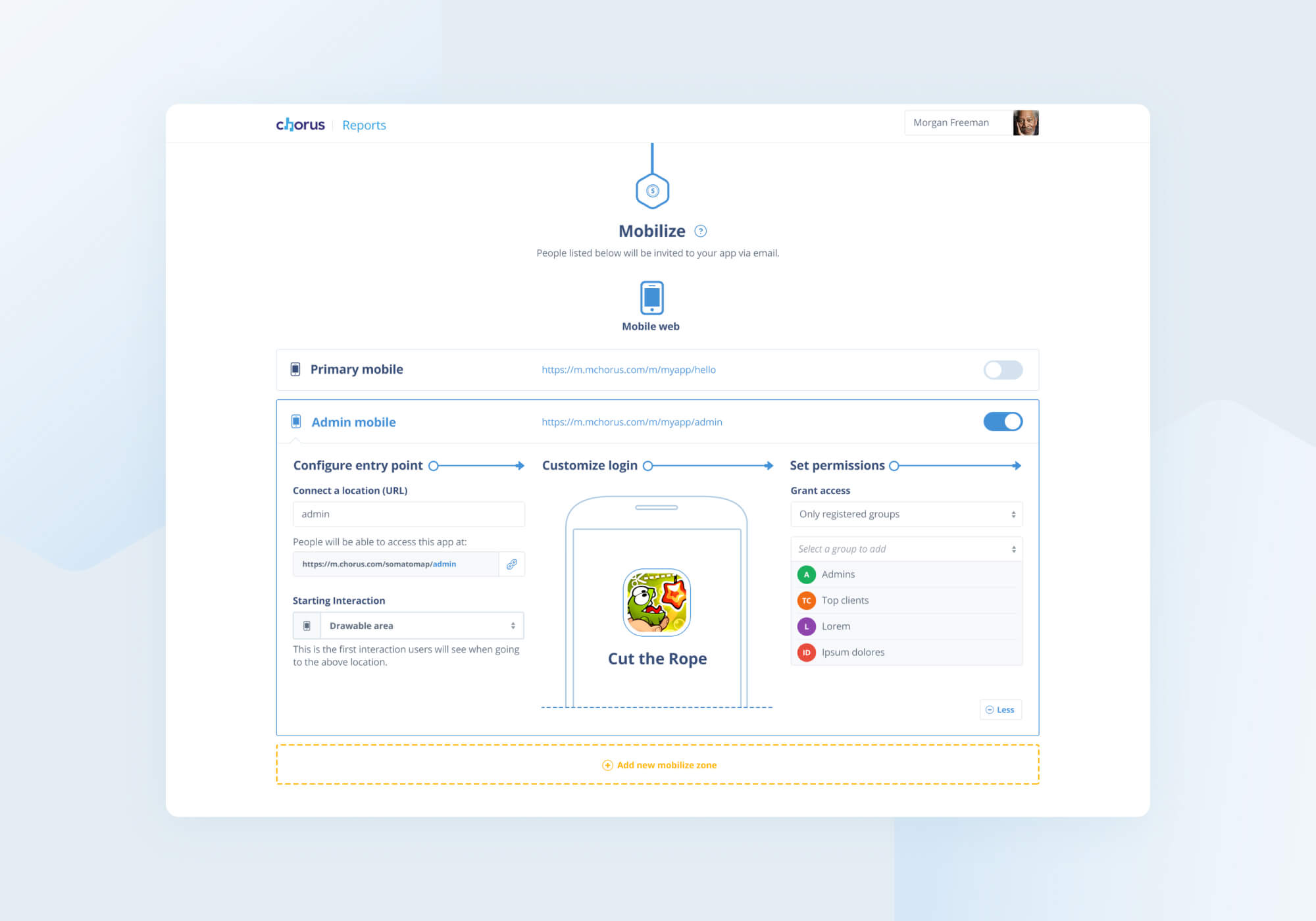
Chorus apps are multi-layered and lean on large amounts of data, so users are guided step by step through the most intuitive object-oriented design we could manage.
Simple as building blocks
The interface was designed so someone without technical training can put a data-driven app together themselves.
SMS, voice and web
Automated text messaging, interactive voice response and web applications all come out of the same visual builder, in a few minutes.
Both directions
The platform runs on automation and on two-way communication — patients, researchers and community leaders all talking to each other rather than being broadcast at.
Reminders through to surveillance
Uses run from medication reminders and health status reporting through educational material and games about health, to listings of local resources and surveillance of an outbreak — and nonprofits can develop them rapidly and cheaply.
More like thisOther places we scaled product teams for growth.
What’s next