
Agentic AI: Turning Complexity Into Clarity for the C-Suite

Contents
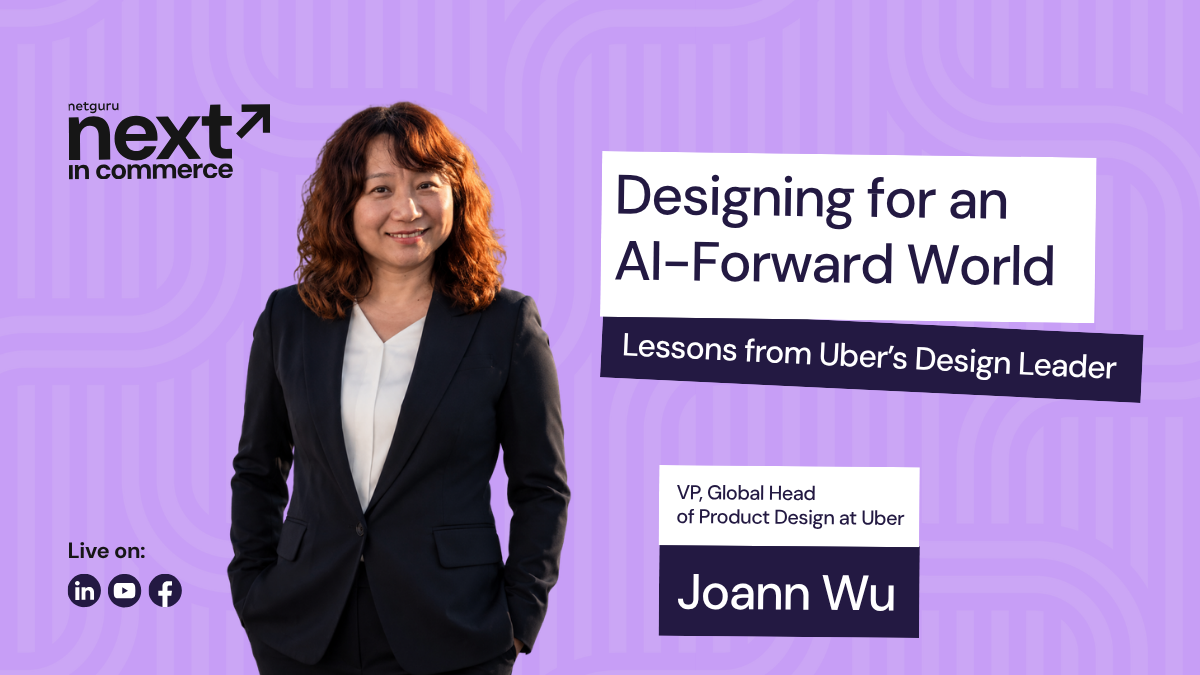
AI is rewriting the playbook in real time. Joann Wu, VP and Global Head of Product Design at Uber, shares how design leaders can adapt in our Next in Commerce session.
Key insights for product and design leaders
- Adaptive leadership: Build resilience and principles, then move fast as signals change.
- Agentic AI at scale: Use AI to translate complexity into clear, time-saving experiences.
- Operational fluency: Evolve from reactive AI experiments to embedded workflows and measurable outcomes.
- Responsible design: Bake transparency, fairness, safety, and user control into AI from day one.
From the front lines: Joann Wu’s perspective
Wu has led design across some of the most complex, multi-product platforms in tech. She sharpened her craft in branding and advertising, scaled consumer product design at LinkedIn, and now owns end-to-end product design at Uber. That path forged a leader who pairs strong principles with fast adaptation. Her teams deliver clarity from data, reduce friction, and anticipate user needs—across marketplaces where one poor decision can cost time, trust, or income.
Design fast, iterate faster.
Turning complexity into clarity with agentic AI
The challenge: real-world mobility is messy, and both earners and riders must make quick, high-stakes decisions. Wu’s answer is agentic AI experiences that summarize conditions, guide choices, and reduce cognitive load—without hiding the interface. AI becomes a copilot that speeds decisions while staying transparent.
"Be adaptive – but build that adaptiveness on top of resilience. And always bias toward action."
Deep dive: the Earner Assistant
Uber’s Earner Assistant interprets complex earning trends and heat maps, then surfaces real-time guidance so drivers can choose where to go next. It also helps them navigate the app more efficiently by answering follow-up questions in context. On the rider side, voice booking turns multi-part requests into natural conversations, blending voice input with clear, on-screen options for accessibility and speed.
Design conversations, not screens.
From reactive to embedded: building AI fluency
Wu maps AI maturity across four stages—from limited and reactive, to developing, embedded, and finally transformative. The inflection point is intentional adoption. Her framework—Inspire, Invest, Deliver—meets teams where they are and removes friction to first wins, then scales with training and peer-to-peer enablement.
"I built a framework around three words: inspire, invest, and deliver."
In practice, Wu’s team ran show-and-tell sessions to spotlight practical uses, collected early use cases into a shared library, and used bottom-up training to raise fluency. Measurement closed the loop—tracking both tool adoption and outcomes like speed, quality, and breadth of ideas explored.
Make adoption measurable and repeatable.
Designing conversations, not screens
Designers now orchestrate dynamic systems where AI makes decisions in real time. Wu urges teams to understand model capabilities and failure modes, then design graceful fallbacks. That means pairing strong UX craft with data literacy and systems thinking so that conversational flows, prompts, and guardrails work together—and users can always override the machine.
"Previously, you’d design a screen… now you’re designing a conversation, a flow, an experience where AI is making decisions in real time."
Responsible AI sits inside this implementation. Uber treats transparency, fairness, safety, and user control as core design principles. At scale, a wrong recommendation can affect someone’s livelihood, so teams build explainability into interfaces and test for bias across diverse contexts.
The contrarian view: challenging the status quo
Conventional wisdom says leaders set direction while teams handle the tools. Wu flips that—she and her directors get hands-on to normalize learning in public. She also rejects paralysis around AI and jobs. Anxiety drains focus; growth mindset compounds it.
"Worrying about things outside your control won’t help – it’ll only distract you from what you can actually do."
Why it matters: hands-on leadership accelerates capability building, creates psychological safety, and speeds the shift from experiments to embedded practice. Teams move faster when leaders model curiosity and execution, especially in ambiguous AI terrain.
Your strategic roadmap: what to do next
The 24-hour win: Audit two active journeys—one earner-facing and one customer-facing. Ask: Where do users face decision debt? Where could summarization, guidance, or voice remove cognitive load while keeping control obvious?
The 90-day strategy: Stand up an AI adoption program using Inspire, Invest, Deliver. Launch monthly show-and-tell demos, seed a shared use case library, and run peer-led training by your strongest design builders. Instrument adoption metrics and outcome metrics, then prioritize two agentic pilots with responsible AI guardrails.
Expert Q&A
Q&A: How is design evolving with agentic AI?
Answer: The toolkit expands beyond static screens to conversations and flows. Designers must understand model limits, anticipate failure, and design recovery paths. Craft remains the base, but data fluency and systems thinking are now table stakes.
Q&A: How do you measure impact from AI in design?
Answer: Track adoption—active users, frequency, and workflow stages—and outcomes like time saved, quality gains, and breadth of ideas. The strongest signal is when designers say AI changed how they think about a problem, not just how fast they shipped.
Q&A: What does responsible AI look like at Uber’s scale?
Answer: Treat responsibility as a design principle, not a checkbox. Build transparency so users know when and how AI acts, audit for fairness and bias, design for safety in high-stakes use cases, and preserve user control with clear overrides.
Conclusion
Wu’s message is clear: anchor on principles, move with adaptability, and make AI a copilot that turns complexity into clarity. Start small, measure rigorously, and model the growth mindset you want your teams to embrace.
Want more nuance and examples? Listen to the full Next in Commerce conversation on LinkedIn for the complete story behind Uber’s AI-forward design approach.


