





Legacy systems modernised without stopping the business

We help enterprise engineering teams replace ageing platforms incrementally — reducing technical debt, cutting operational costs, and keeping production running throughout every stage of the work.

Trusted by

Book a discovery call

Platform engineering experience you can measure

18+

Years in business

Over eighteen years of delivering complex software engagements for enterprise clients across regulated and high-growth industries.

2,500+

Projects delivered

More than two and a half thousand projects completed, spanning greenfield builds, legacy overhauls, and cloud migrations.

400+

In-house specialists

A team of over four hundred engineers, architects, and cloud practitioners — all employed directly, not subcontracted.

4.9/5

Average client rating

Clients rate our engagements 4.9 out of 5 on average, reflecting consistent delivery quality and clear communication throughout.

What application modernisation services actually cover

Application modernisation is the process of changing how existing software is built, deployed, and maintained — without necessarily replacing the business logic that makes it valuable. The goal is to remove the structural constraints that slow down your engineering team and inflate your operating costs.

Our modernisation services cover:

  • Assessing legacy codebases and infrastructure to identify where technical debt is highest and where risk is concentrated
  • Decomposing monolithic applications into independently deployable services guided by domain boundaries
  • Migrating workloads to cloud-native infrastructure using containers, Kubernetes, and managed platform services
  • Introducing CI/CD pipelines and automated testing to shorten the feedback loop between code and production
  • Running ongoing platform operations after go-live, so your internal team inherits a stable, well-documented system

What modernisation services do not cover is rewriting your product from scratch on a speculative new architecture. We do not replace working business logic for the sake of it, and we do not treat cloud migration as an end in itself. The measure of success is whether your team can ship faster, your system costs less to run, and your platform can absorb the next wave of product demands.

If you are looking for a vendor to outsource routine maintenance or staff an offshore support desk, our services are not the right fit. We work with engineering leaders who have a specific structural problem and need a clear, time-bounded plan to fix it.

Five capabilities that cover the full modernisation journey

Most legacy platforms need more than one intervention. These five service areas can run in sequence or in parallel depending on where your system is today.

Assessment and roadmap

We audit your codebase, infrastructure, and team workflows to produce a prioritised modernisation roadmap with effort estimates and risk ratings — so you know what you are committing to before work begins.

Monolith-to-microservices decomposition

We use domain-driven design and bounded contexts to identify the right service boundaries, then extract components incrementally rather than rewriting the whole application at once.

Cloud-native rebuild

For systems where the architecture is the constraint, we rebuild targeted modules on cloud-native foundations — containers, managed databases, and event-driven communication — while keeping the rest of the platform live.

Strangler-fig migration

We route traffic progressively from the legacy system to new services, retiring old components only when the replacement is proven in production — eliminating the big-bang cutover risk entirely.

Platform operate

After the migration work is complete, we provide structured handover, runbooks, and an optional ongoing operations layer so your team inherits a platform they can own confidently.

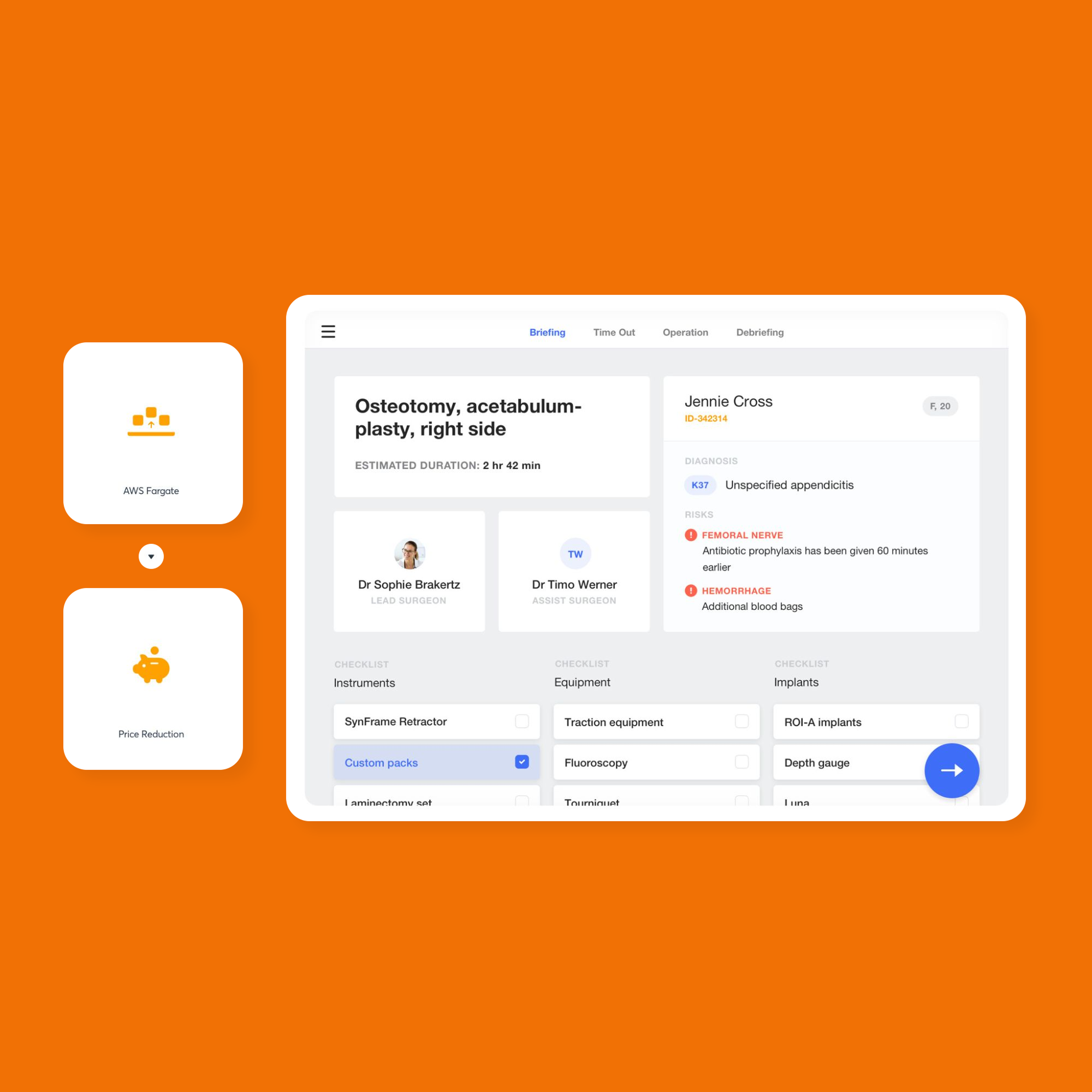
Helping Nodus Medical scale surgical platform infrastructure across Europe securely

Nodus Medical provides a mission-critical healthcare platform supporting surgical teams across Europe. As their user base grew, they faced the challenge of scaling their infrastructure in a way that met stringent healthcare compliance requirements, ensured high availability, and maintained robust security — all without disrupting the clinical workflows their customers depend on.

Netguru's DevOps team migrated Nodus Medical's infrastructure to Amazon Web Services using AWS Fargate, establishing a secure multi-availability zone architecture with proper isolation, encryption, and comprehensive logging. The result was a scalable, highly available cloud environment with automated disaster recovery, continuous monitoring through DataDog and CloudWatch, and a maximum downtime of just five minutes in the event of an availability zone failure.

Since we operate in healthcare, where tolerance for critical issues is relatively low, we’re constantly improving the quality of our software.

Lukas Vogt

Former CEO at Nodus Medical

Read case study
Nodus Medical orange square preview

Helping Orbem make Genus customer-ready in six months

Orbem is an agritech company developing AI-powered imaging technology to transform egg sexing in the poultry industry. To bring their Genus product to market, they needed a fully functional hybrid infrastructure that could seamlessly connect cloud-based software with on-premises imaging devices — a complex engineering challenge that had to be solved before any customer deployment could begin.

Netguru built a robust hybrid infrastructure using Terraform, Kubernetes, Helm, and Ansible, supported by monitoring and automation tools including Elasticsearch, Prometheus, and Traefik. The development pipeline was also migrated to GitLab CI with SonarCloud quality gates to ensure long-term code reliability. Within six months, Orbem advanced from Technology Readiness Level 2 to Level 6, delivering a scalable, plug-and-play on-premises system that made the Genus product genuinely customer-ready.

As a startup, the collaboration with Netguru brought us the push and the expertise we needed to create our ambitious hybrid infrastructure.

Miguel Molina

CTO and Co-founder at Orbem

Read case study
Orbem case study

What our clients say

Netguru's work has resulted in an improved average order value, increased basket size, and higher number of monthly active users. They're proactive, caring, and highly experienced.

Ayman Kaheel

CTO, Breadfast

They leave no stone unturned when it comes to understanding the business context. Thanks to their unique approach, we were able to reduce the workload on our operations team whilst improving the user experience.

Tiago Goncalves Cabaço

VP of Design, Careem

Netguru has been the best agency we've worked with so far. They are able to design new skills, features, and interactions within our model, with a great focus on speed to market.

Adi Pavlovic

Director of Innovation, Keller Williams

Common questions from engineering and IT leaders

What is the difference between big-bang migration and incremental modernisation?

A big-bang migration replaces the entire legacy system in a single cutover. The appeal is simplicity: one go-live date, one clean break. The risk is that any failure affects the whole platform simultaneously, and rollback is often impossible without losing weeks of work.

Incremental modernisation moves one bounded piece of the system at a time. Each change is small enough to test thoroughly, and the legacy system continues to serve production traffic until the replacement is proven. The total elapsed time may be longer, but the risk at any single point is far lower — and your business keeps running throughout.

How long does an application modernisation engagement typically take?

It depends on the size and condition of the system, the number of integration points, and how much of the work your internal team can absorb in parallel. A focused assessment and roadmap phase typically takes four to six weeks. Execution phases for a mid-sized monolith commonly run between six and eighteen months when delivered incrementally.

We scope every engagement after the assessment, so you receive a timeline grounded in your actual codebase rather than a generic estimate. The roadmap phase exists precisely to remove that uncertainty before you commit to a larger programme.

How does the strangler-fig pattern keep production running during modernisation?

The strangler-fig pattern works by placing a routing layer in front of the legacy system. New requests are directed to the replacement service for specific features, while everything else continues to hit the legacy application as normal. The legacy system is not switched off — it is gradually surrounded and superseded.

As each new service proves itself in production, the routing rules shift more traffic to it. The old code path for that feature is retired only once the new path is stable. At no point does the entire system depend on an untested replacement, which means a failure in one new service affects only that feature, not the whole platform.

Is it cheaper to modernise an existing system or rebuild it from scratch?

A full rebuild carries a predictable appeal: a clean codebase, no legacy constraints, and the chance to apply everything your team has learned. The practical problem is that rebuilds routinely take longer than forecast, and during that period you are maintaining the old system in parallel while paying to build the new one.

Modernisation preserves the business logic that already works — the rules, workflows, and integrations your organisation has refined over years. You pay to change the structural parts that are causing problems, not to recreate what is already correct. For most enterprise platforms, that is significantly cheaper and faster than a clean-sheet rebuild.

The right answer depends on the state of the existing codebase. Our assessment phase is designed to give you an honest comparison of both paths before you commit to either.

How do bounded contexts guide the split from a monolith to microservices?

A bounded context is a clearly defined part of the business domain where a specific model applies and a specific team owns the rules. In a monolith, these contexts exist implicitly — they are tangled together in shared databases and shared code, which is why a change in one area breaks something in another.

Domain-driven design makes those boundaries explicit. Once you know where one context ends and another begins, you have a natural seam along which to extract a service. The extracted service owns its own data and communicates with the rest of the system through a defined interface rather than direct database access. This removes the coupling that makes monoliths fragile and gives each team a clear area of ownership.

What happens after the modernisation work is complete?

We do not consider a modernisation engagement finished at the point of technical delivery. The final phase of our engagement model is Operate: we produce runbooks, document architectural decisions, and run structured knowledge-transfer sessions with your team.

For teams that need additional support beyond handover, we offer an ongoing platform operations layer. This covers monitoring, incident response, and continuous improvement work on the new platform. The goal is that your internal team inherits a system they understand and can evolve independently — not a dependency on us.

Start with a no-commitment modernisation assessment

The first conversation is diagnostic, not a sales pitch. We review your current architecture, ask the questions your team is already asking internally, and give you an honest view of where modernisation will have the most impact. You leave with clarity — regardless of whether we work together beyond that point.

Book your assessment call