
How Allegro Builds AI-First Design Systems for Predictable Scale

Contents
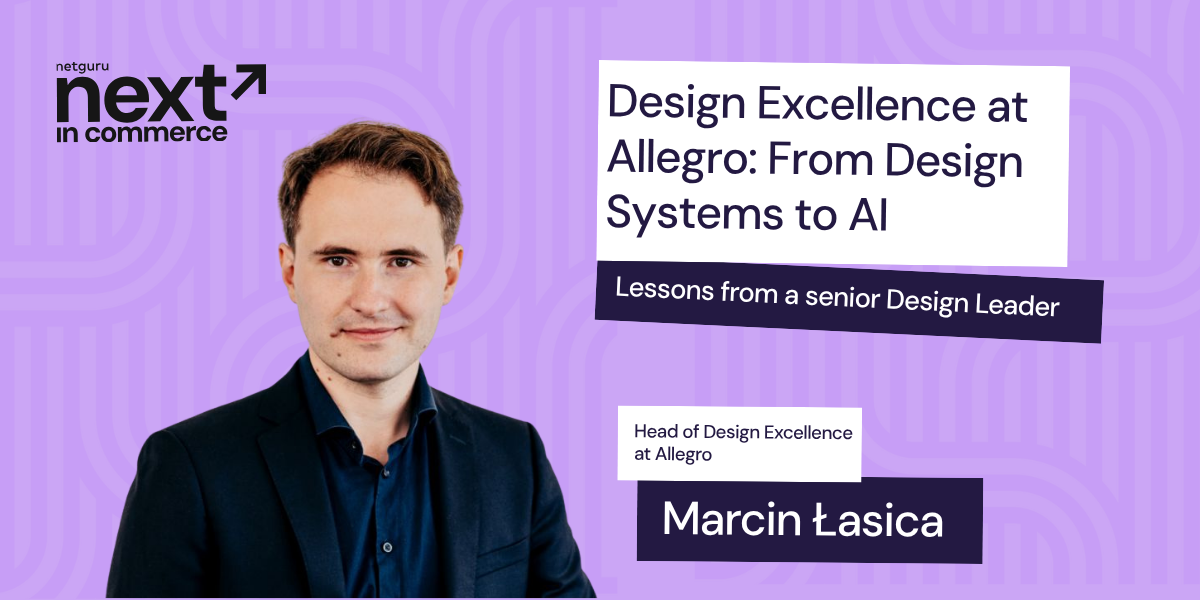
AI is rewriting product craft. Marcin Łasica, Head of Design Excellence at Allegro, shares how his team builds for speed, quality, and scale on the Next in Commerce session.
- AI-first design systems: Treat large language models as users to reduce inconsistency and hallucinations.
- Strategy over execution: Shift designers from pixel work to product and business outcomes.
- Controlled automation: Replace ad-hoc prompting with internal tools and plugins for predictable results.
- Guard against silos: AI can accelerate output, but it also increases the risk of one‑person, disconnected delivery.
From the front lines
Łasica operates inside one of Central Europe’s largest marketplaces, where millions of users raise the bar for consistency, accessibility, and performance. His vantage point is hands-on – rolling out a modernized design system while the industry embraces AI. That tension shapes his leadership: keep craft and quality high, even as automation speeds everything up. He frames AI as an amplifier, not a replacement, and pushes designers toward strategy, communication, and measurable product outcomes.
Design systems for AI as a first‑class user
The core challenge is ensuring that AI-generated interfaces align with Allegro’s standards. Traditional systems served designers and engineers; now they must also guide models. Without that guidance, speed becomes chaos – fragmentation, off-brand patterns, and hallucinated components.
Łasica’s solution is an AI-aware system that encodes structure, names, and constraints so LLMs can compose experiences that stay on brand and accessible from the start.
"we consider ai as one of our first-class users that needs to be incorporated from the get-go."
Deep dive: accessibility and consistency by default
Allegro’s new system bakes accessibility into the fundamentals, then exposes consistent building blocks that humans and models can assemble. The aim is to modernize the interface, keep it fresh, and prevent divergence across a massive product surface. Designers and developers move faster, while LLMs receive the same guardrails – reducing drift and helping every flow feel unmistakably Allegro.
Build guardrails, not just components.
From execution to strategy: the designer’s new mandate
Design work is shifting from manual creation to shaping product direction. With AI taking over repetitive tasks, teams must invest time in user understanding, business trade-offs, and clear written specs. That demands stronger communication – moving from pictures to precise language that models and collaborators can execute.
"communication becomes one of the most important elements now in the toolbox."
Łasica underscores that speed is not the point – sustained quality is. Designers step closer to Product Manager territory, translating intent into durable decisions and specs that scale across teams, tools, and agents.
How to make AI predictable: internal tools over ad‑hoc prompts
Pure prompting often yields inconsistent outcomes. Allegro’s designers counter this by building internal tools – including plugins – that encapsulate patterns, rules, and constraints. This turns probabilistic generation into repeatable creation, accelerating delivery while maintaining control.
If you create your own internal tool that you then use to execute design, then the results become predictable again."
That approach also raises the technical ceiling for designers. They can prototype advanced workflows without writing code, operationalizing quality through reusable automation instead of one‑off prompts.
The contrarian view: challenging the status quo
Common wisdom says AI makes teams more collaborative by freeing time. Łasica argues the opposite risk: AI enables a one‑person army that ships fast, but drifts from the rest of the organization. When ownership narrows, systems fragment, and product coherence suffers. He calls for more collaborative AI workflows – akin to how Figma unlocked real-time co-creation – to preserve connected, end‑to‑end quality.
Your strategic roadmap: what to do next
The 24-hour win
- Audit your design workflow for unpredictability. Where are prompts producing inconsistent UI, naming, or accessibility? Identify one area to replace with a lightweight internal tool or spec template.
The 90-day strategy
- Stand up an AI-aware design system track. Document canonical component names, constraints, accessibility rules, and usage examples in model-readable form. Pilot two internal tools or plugins that translate specs into consistent outputs across teams.
Expert Q&A
Q&A: How is the new design system different?
It modernizes the UI and, crucially, integrates accessibility at the foundation. It also treats AI as a user, so LLMs can compose experiences that remain consistent with Allegro’s patterns.
Q&A: Where does AI create the biggest gains in design?
It shifts effort from execution to strategy – user needs, product direction, and business outcomes. It also empowers designers to build internal tools and plugins that make outputs predictable and fast.
Q&A: What are the top risks to watch?
One‑person AI silos that fracture product coherence, unrealistic expectations about model capabilities, and ethical concerns around data sources and IP, plus long‑term dependency on external vendors.
Conclusion
Allegro’s playbook is clear: make AI a first‑class user of your design system, invest in communication and strategy, and operationalize quality through internal tools. That is how you scale speed without sacrificing craft.
For more nuance, real examples, and context, listen to the full Next in Commerce conversation on You Tube
.


