
Internet of Everything (IoE): What it is and how it differs from IoT


Contents
Internet of Everything (IoE) gets treated as a rebrand of IoT, but the distinction matters at the architecture level. IoT is a connectivity layer; IoE is an operating model that binds that layer to people, process, and decision workflows.
For a CTO evaluating this as a strategic bet, the real question isn't definitional: it's what changes in your system architecture, attack surface, and data pipeline when you move from connected devices to a connected network. Here's what that shift actually requires.
Internet of Everything (IoE): The short answer
Internet of Everything (IoE) is Cisco's framework for connecting people, process, data, and things into one networked system, rather than just sensors reporting to a dashboard. IoT supplies the things and the connectivity; IoE adds the people who act on the data and the processes that turn it into decisions.
That difference shows up when a deployment grows. Most IoT pilots stall once devices outnumber the network and data model built for a demo, which is why enterprises scaling their IoT infrastructure need a plan built for growth from the start. The pillar that's usually missing is process: governance for the machine-generated data the devices produce.
The scale is real. IoT Analytics expected the number of connected IoT devices to grow 14% in 2025 to 21.1 billion, and to reach 39 billion by 2030. At that volume, smart systems in healthcare, manufacturing, and logistics need more than connectivity to hold together.
How is IoE different from IoT?
Internet of Things (IoT) describes devices that sense and transmit; Internet of Everything (IoE) describes the architecture that has to make sense of what they send. IoT is a connectivity layer: machine-to-machine communication between things, sensors, and gateways. IoE adds the people, process, and data pillars Cisco built the framework around, which changes what you're actually engineering.
The practical split shows up in scope, not hardware:
| IoT | IoE | |
|---|---|---|
| Unit of design | Device and network | Device, workflow, and decision |
| Data handling | Telemetry ingestion | Big data analytics feeding process change |
| Failure mode | Device drops offline | Process breaks when data model can't scale |
| Ownership horizon | Deployment | Full device lifecycle, including decommissioning |
The distinction often matters most at decommissioning. Teams plan the IoT rollout (provisioning, connectivity, dashboards) and overlook what happens when a device fleet ages out, firmware forks, or a vendor sunsets a protocol. That's an IoE problem: it touches process and people, not just the thing itself, and over a device's lifetime it can cost more than the initial hardware.
Architecturally, IoT projects often stop at edge-to-cloud ingestion. IoE systems extend past that boundary into the applications that consume the data: supply chain rerouting, clinical alerting in healthcare, predictive maintenance workflows. The devices don't change. What changes is whether your systems treat the data as an event to log or a decision to trigger.
The four pillars of IoE: People, process, data, things
Cisco's IoE framework names four pillars (people, process, data, and things) to explain what changes once you move from connecting devices to connecting everything. Each one carries its own architectural burden rather than just a marketing label.
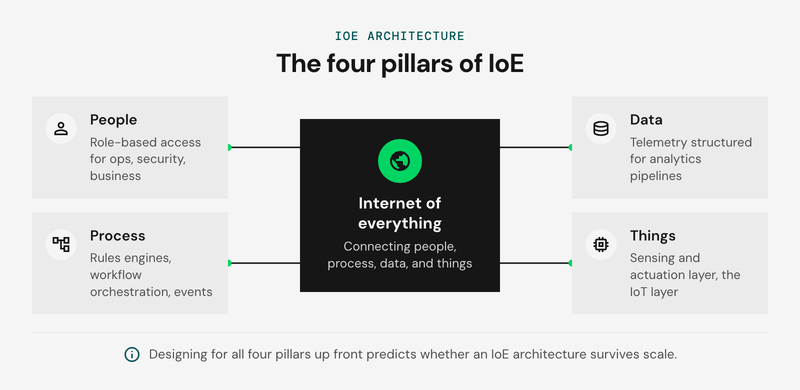
Things stay the sensing and actuation layer, the IoT layer most teams already have. Data is where the real engineering shift happens: raw telemetry has to become structured input for IoT analytics pipelines, not just a stream sitting in a message queue.
That means schema versioning, retention policy, and a decision on what gets processed at the edge versus shipped to the cloud before you onboard device number one.
Process governs how data triggers action: rules engines, workflow orchestration, event-driven architecture that decides which alerts reach a human and which get resolved automatically. People is the pillar teams underbuild for: role-based access across ops, security, and business stakeholders who now consume the same data streams a device fleet generates, each with different latency and permission requirements.
As fleets grow, Process tends to break before Things do. Alert rules tuned for a 200-sensor pilot can turn into alert storms at 20,000 devices if nobody modelled the fan-out.
Designing against all four pillars up front, rather than retrofitting process and people once things and data are live, is what lets an IoE architecture survive scale.
How did IoT evolve into IoE?
Internet of Things (IoT) architecture answered one question: how do we get sensor data off a device and into a database. Internet of Everything (IoE) architecture answers a harder one: how do people, processes, data, and things stay synchronized once device count moves from hundreds to hundreds of thousands.
That shift didn't happen on a roadmap slide. It happened because centralized IoT backends started failing under their own success. Every additional device meant more round trips to a cloud region, more latency, and a wider attack surface to defend.
Edge computing is the architectural response, not a bolt-on feature. Processing moves to gateways and on-device compute so systems make decisions locally and only sync summarized data upstream.
The practical consequence for teams planning IoE builds: total cost of ownership now includes edge hardware lifecycle and decommissioning, not just cloud spend, which changes the sourcing conversation from day one.
Connectivity technologies powering IoE: 5G, NB-IoT, LPWAN
No single protocol powers Internet of Everything (IoE) deployments. The right choice of 5G, NB-IoT, or broader LPWAN connectivity depends on device density, power budget, and how much processing happens at the edge before data reaches a system of record.
How the three options compare:
| Technology | Best for | Power draw | Typical range |
|---|---|---|---|
| 5G | High-bandwidth, low-latency use cases (video, robotics, digital twin sync) | High | Cell-based, sub-km for mmWave |
| NB-IoT | Dense static sensor deployments (utility meters, smart building sensors) | Very low | Several km |
| LPWAN (LoRaWAN, Sigfox) | Rural or industrial sites with sparse gateways | Very low | 10-15 km in open terrain |
Dense healthcare or logistics fleets running tens of thousands of things rarely use one technology alone. A hybrid pattern (NB-IoT or LPWAN for telemetry, 5G for the subset of devices needing real-time control) pushes more compute to edge computing nodes so the network layer only carries what's necessary upstream.
This matters for total cost of ownership beyond the radio bill. Battery-powered LPWAN sensors are cheap to deploy but expensive to service once they're buried in walls or embedded in machinery, and decommissioning a five-year-old fleet with mixed connectivity standards can take months when the hardware isn't documented.
IoE use cases across industries
IoE use cases cluster in four areas where connecting people, process, data, and things across a live network changes the economics of operations: smart cities and energy, healthcare, retail, and manufacturing. Each sector runs a different edge computing footprint, and each accepts a different level of attack surface expansion in exchange for the visibility gained.
Smart cities and energy
Smart cities stitch traffic control, waste routing, and smart grid load balancing onto one connectivity layer, typically LPWAN for meter reads and 5G for latency-sensitive signals.
Utilities running smart grid rollouts increasingly pair sensor data with a digital twin of the distribution network to simulate load before a fault takes a substation offline. According to IEA figures, around 320 million distribution sensors have been deployed in power grids globally, and the number of smart meters exceeded 1 billion in 2022 (IEA via Enlit, 2023).
Healthcare
Remote patient monitoring is the clearest IoE application in healthcare: wearables and home devices stream vitals into a clinical system that flags deterioration before a hospital readmission.
The harder problem usually isn't the sensor. It's reconciling device data with the electronic health record without introducing a new compliance gap.
Retail
Retail uses IoE to link shelf sensors, POS systems, and supply chain data into one demand signal, cutting the lag between a stockout and a reorder. Smart shelving and RFID feed the same data lake that drives dynamic pricing.
Manufacturing and IIoT
Industrial IoT (IIoT) is where predictive maintenance pays back fastest. McKinsey found that predictive maintenance typically reduces machine downtime by 30 to 50 percent and increases machine life by 20 to 40 percent. The gains depend on an edge layer sized for the device count at full scale, not just at pilot.
Digital twins in manufacturing and energy
A digital twin pairs a live data stream from physical equipment with a virtual model, so an engineering team can run predictive maintenance and simulate load changes before touching the real system.
In manufacturing, the twin ingests sensor data from a production line and flags bearing wear or thermal drift days before failure.
In energy, the same pattern runs at grid scale: a smart grid digital twin models transformer load and renewable intermittency, letting operators reroute power before a substation trips.
Both cases lean on edge computing to pre-process device data locally, since a manufacturing plant or grid segment generates more telemetry than it makes sense to backhaul raw. That ties the twin directly to IoE's process and data pillars: it's a decision system, not just a monitoring tool.
Security risks of the Internet of Everything
The core security risk of Internet of Everything (IoE) deployments is attack surface expansion: every device, sensor, and edge node added to the network is a fresh entry point into the people, process, and data layers Cisco's four-pillars framework ties together.
Edge computing makes this worse before it makes it better. Pushing compute to the device means patching, certificate rotation, and firmware updates happen across thousands of physically distributed endpoints instead of one data center, and many fleets lack the tooling to do that consistently past the pilot stage.
Machine-to-machine communication compounds the problem. M2M traffic runs device-to-device with no human in the loop, so a single compromised sensor can issue commands to peers without tripping the alerts a person-facing system would trigger. On a 5G or LPWAN network carrying telemetry from tens of thousands of things, that lateral movement is hard to see until it has already touched several systems.
Device lifecycle and decommissioning is the risk teams underweight. A retired sensor with a still-valid certificate is a live credential sitting on the network with no owner watching it, and total cost of ownership models rarely price in secure offboarding at scale.
A common failure mode: a proof of concept secures 50 devices cleanly, then the same architecture, unchanged, gets rolled out to 20,000, and the certificate management, monitoring, and firmware update processes that worked by hand stop scaling.
The exposure is already wide: StationX's roundup of IoT security research puts the share of IoT devices vulnerable to medium- or high-severity attacks at 70%, citing CybelAngel and HP.
What's next: AI and edge computing in IoE
Edge computing and digital twins define where Internet of Everything (IoE) architecture goes next, pulling compute and simulation closer to the device fleet instead of the cloud core.
In this pattern, a digital twin of a production line or a fleet of connected vehicles ingests sensor data locally, runs inference at the edge, and only syncs summarized state upstream. That cuts bandwidth cost and keeps latency-sensitive use cases, such as healthcare monitoring and industrial control, running when connectivity drops.
Gartner predicts that by 2028 more than two-thirds of enterprise-managed data will be created and processed outside the data center or cloud (Gartner Market Guide for Edge Computing Platforms, via ZEDEDA). That trajectory changes the total cost of ownership math for IoE systems, since every additional edge node adds decommissioning and re-provisioning cost to the device lifecycle, not just deployment cost.
5G and LPWAN rollouts make denser device meshes viable, which raises the same attack surface questions from device onboarding through firmware end-of-life. If IoE is on your roadmap, budget for the full lifecycle, not the pilot.
FAQ: Internet of Everything questions answered
What is meant by the internet of everything?
What is IoT vs IoE?
Is IoT still a thing?
Is IoT a high paying job?
Does IoT need coding?
Is your architecture ready for IoE?
Internet of Everything architecture fails less on protocol choice and more on what happens after the pilot: device counts climbing past a few thousand, edge computing nodes multiplying, and nobody having modelled decommissioning cost into the total cost of ownership. That's where fleets tend to stall.
If you're weighing edge-to-cloud patterns, attack surface, or where 5G and LPWAN fit your device roadmap, our IoT engineers can help you pressure-test the architecture before it has to handle real data volume. Talk to our team before you lock in an architecture that can't scale past the pilot.


