
AI Exposes Weak Design — Integration Drives Measurable ROI

Contents
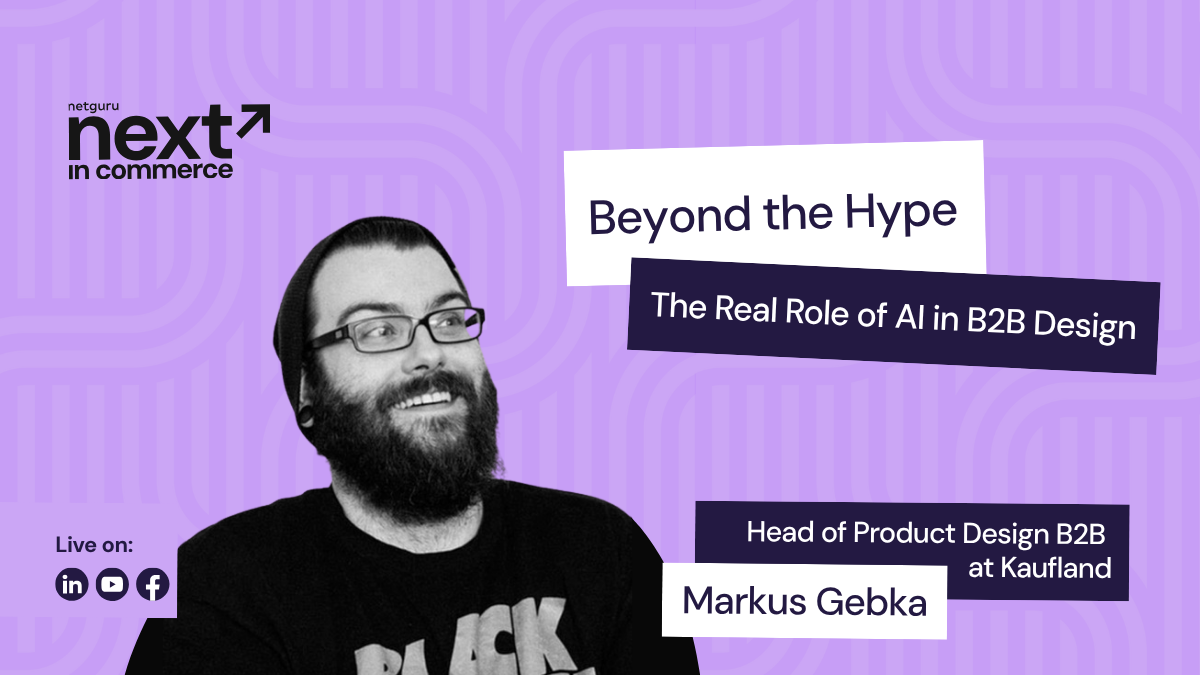
AI won’t replace design — it will expose weak design. In this Next in Commerce Podcast session, Markus Gebka, Head of Product Design B2B at Kaufland, explains how to cut through AI noise and build design that moves the business.
Key insights for ecommerce leaders
- Integration over speed: Competitive advantage comes from how well AI is integrated — not how fast you adopt tools.
- Design ops as a growth engine: Robust systems and documentation make products AI–ready and unlock scale.
- Experience beats mockups: Vibe–coded, near–real prototypes align teams faster and reduce feasibility risk.
- Balanced teams win: Mix data, systems, and visual strengths, and hire for growth mindset to future–proof capabilities.
From the front lines: Markus Gebka’s perspective
Gebka didn’t step into leadership by title — he earned it by shipping B2B products where every friction costs sellers time and revenue. Starting as a Senior Product Designer and growing into Head of Product Design B2B, he shaped a team that is equal parts business–savvy and systems–minded. His north star is simple: design must measurably improve how sellers work with the marketplace. That lens keeps his team close to UX metrics, platform robustness, and clarity across diverse seller workflows.
Design must move a metric.
Cutting through the AI noise
The biggest challenge in ecommerce design isn’t a model or a feature — it’s distraction. Gebka sees a market flooded with hot takes and quick wins, which leads to a dangerous threshold of “good enough.” His solution is to reset expectations and ground decisions in outcomes, not demos. That means aligning AI with core design and business goals, then resisting the urge to bolt on novelty.
"Hey, good enough actually isn’t. We need to be moving beyond that."
Deep dive: From static slides to real interaction
Gebka’s team replaced static Figma flows with vibe–coded prototypes. One internal demo called for a landing page featuring a dotted world map that reacts to cursor hover. In the past, this would have meant a day of Figma work and a lot of imagination. With AI–assisted coding, the team built a working interaction in minutes. Because it ran in code, the feasibility discussion disappeared, and stakeholders could experience the idea — not interpret it.
Show it — don’t tell it.
Design ops, reimagined for AI–ready product teams
The second big shift is organizational. AI has made the value of design ops impossible to ignore. What used to be a tough budget conversation is now a necessity — your systems, tokens, and documentation determine how effectively your teams can embed AI and scale patterns across experiences.
"Our systems are not really AI ready. How can we do that? Well, design ops."
Gebka connects the dots: a strong pattern library in Figma still matters — not as the destination, but as the rule–set. His team pipes that library via MCP into tools like Claude so that prototypes and experiments inherit the real system’s logic, reducing drift between concept and production.
From idea to interaction: the new prototyping playbook
Gebka’s “how–to” focuses on speed to experience. Keep Figma as source of truth for components, but shift exploration to code–adjacent workflows. Use AI to generate vibe–coded demos that stakeholders can click and feel. Automate the tedious parts — PRDs, summaries, synthesis — so designers spend more time on decisions that matter.
"Bottom line — less Figma prototypes, less green slideshows, but more actual vibe–coded prototypes."
He is clear–eyed about trade–offs. When you need pixel–parity with production or highly specific behavior, you will sometimes fight the model. The trick is to treat AI–coded demos as sketches and reserve handcrafted depth for high–signal bets.
The contrarian view: challenging the status quo
Gebka rejects the narrative that AI will replace whole roles. He argues the future belongs to balanced, resilient teams where AI removes drudgery but never replaces discovery, judgment, or the craft of product thinking. His other hot take: the fastest adopters will not win by default — the winners will be the best integrators.
"Replacing entire professions... that’s, in my book, absolute BS."
This matters because it reframes investment. Instead of chasing tools, leaders should fund integration — from design ops to research knowledge bases — and protect teams from FOMO so they can execute.
Integration beats acceleration.
Your strategic roadmap: what to do next
The 24–hour win
- Run a quick audit: where are static mockups slowing decisions? Pick one high–leverage flow and replace the next review with a vibe–coded demo that uses your current component library.
- Ask your team: which repetitive tasks drain energy weekly? Automate one — PRD skeletons, synthesis summaries, or meeting notes — using your existing stack.
The 90–day strategy
- Stand up a design ops lane with a clear charter: make your system AI–ready. Document tokens, patterns, and content guidelines, and pipe them into your preferred model via MCP or similar.
- Build a research knowledge base that answers questions in–flow. Let designers and PMs query past interviews and feedback in Slack to shorten discovery loops without bypassing research quality.
Expert Q&A
Q: How should product designers show business impact in B2B marketplaces?
A: Tie every initiative to seller outcomes and UX metrics. Measure platform robustness, clarity, and time to first value for sellers, then prioritize work that removes friction and speeds activation.
Q: Why is design ops suddenly essential in the AI era?
A: AI exposes weak systems. When your design tokens, patterns, and content rules are structured, you can pipe them into models and ship consistent experiences faster. Without design ops, AI amplifies chaos.
Q: How has AI changed prototyping and research in practice?
A: Prototyping moved from static slides to coded demos that stakeholders can feel. Research remains human–led, but access to insights is smoother — team members can query a knowledge base to pull validated findings into the work.
Conclusion
The takeaway is focus over frenzy. Treat AI as an amplifier — of your systems, your clarity, and your craft. Invest in integration, not novelty, and let real experiences lead the conversation. For more nuanced examples, listen to the full Next in Commerce Podcast.


