
Akeneo vs Bluestone PIM for B2B: architecture, cost and fit


Contents
Akeneo and Bluestone PIM solve the same problem with different assumptions about who does the engineering. Akeneo offers a large collection of connectors and a choice between a self-hosted Community Edition and the SaaS Akeneo Product Cloud.
Bluestone PIM is an API-first, composable platform that expects more integration work from your team in return for workflow flexibility. For a B2B catalog the deciding factors are the ERP integration pattern, how the data model handles customer-specific assortments, and three-year cost. This comparison covers each, with a decision rule per company profile and a PoC plan to run before signing.
Akeneo vs Bluestone PIM: Short answer and key differences
Choose Akeneo Product Cloud when your team will own the ERP and channel integrations on an API-first PIM. Choose Bluestone PIM when you want a configurable suite that asks for less integration engineering. The split follows three conditions: your engineering capacity, whether the ERP stays system of record for attributes, and how many channels you syndicate to.
The sections below compare architecture, hosting, data models, ERP integration, and cost. Netguru appears only where build effort is relevant; treat this verdict as a hypothesis until your PoC confirms it. Now let's examine each factor in detail.
Akeneo and Bluestone PIM compared at a glance
Akeneo and Bluestone PIM differ most in how much engineering each one asks of your team, and less in features. Both hold a single source of truth for logistics data, pricing, copy, and assets, and both syndicate to retailers and marketplaces.
Market share and connector counts do not show that gap. The table weights dimensions for B2B, where the ERP owns pricing and logistics data. It ends with rows on what each system demands from your team.
| Dimension | Akeneo (Community Edition, Product Cloud) | Bluestone PIM |
|---|---|---|
| Deployment | Community Edition is open source and self-hosted. Product Cloud is the SaaS edition. | Hosted suite |
| Architecture | API-first, positioned on MACH architecture. Check the MACH Alliance member directory for current status. | Configurable suite with built-in modules |
| Data model | Attribute families, locales, channels, and completeness rules | Configuration-led model, set up in the admin UI |
| DAM | Asset management sits in the paid editions. Confirm against current docs. | Bundled with the suite, per vendor positioning. Confirm in a demo. |
| AI | AI-assisted enrichment is part of Akeneo's product experience management (PXM) positioning. | Confirm current capabilities with the vendor. |
| Pricing | Community Edition has no license fee. Product Cloud is quote-based. | Quote-based |
| Size fit | Mid-market to enterprise with in-house developers | Mid-market teams with limited engineering capacity |
| Demand: ERP connector | Your developers or an integrator build and maintain it. | Ask whether a prebuilt connector exists for your ERP and who maintains it. |
| Demand: channel mappings | Your team owns mappings per retailer and marketplace. | Ask how much the vendor configures versus your business users. |
| Demand: upgrades | Self-hosted Community Edition means your team schedules and tests them. Confirm Product Cloud terms. | Confirm in the contract. |
| Demand: data model changes | Business users for attributes, developers for anything custom | Business-side admin UI, per vendor positioning |
How to apply the demand rows
Weigh the last four rows first. If your developers already maintain the ERP integration and you expect custom data structures, Akeneo's engineering demand is a fit. If your team is business-led with little developer time, Bluestone's configuration model may cost less to run, provided its ERP connector matches your system of record.
Two early signs suggest the demand was underestimated. A connector estimate that excludes ongoing maintenance is one. A pilot where every new retailer needs a ticket to IT is the other.
Vendors change packaging often, so treat every cell as a prompt for your demo, not a verdict.
API-first composable or configurable suite: Which architecture fits?
Choose an API-first PIM when more than two systems consume the catalog over API and your engineers can own the integration layer; otherwise a configurable suite costs less.
Akeneo fits a MACH architecture: product data sits behind a REST API, and the storefront, marketplace feeds, and ERP sync each pull what they need. Verify any MACH certification claim against the MACH Alliance member directory.
Bluestone PIM keeps import, enrichment, and export inside one product, so the team configures mappings instead of writing services.
Teams that want a third route, an open-source PIM platform they can extend and own, can also look at Pimcore, which unifies product data and digital commerce in a single codebase.
The threshold is our rule of thumb, not an industry benchmark. Each API consumer adds a contract to maintain: authentication, rate limits, and mappers that break when an attribute family changes. Total cost of ownership rises with every one of them.
The trade-offs by situation:
| Situation | Better fit | Why |
|---|---|---|
| ERP plus one web shop, no dedicated integration engineers | Configurable suite | A vendor ERP connector covers a standard ERP; custom integration is a standing cost |
| Storefront, mobile app, marketplaces, B2B portal, and print all need the catalog | API-first PIM | Per-channel scoping and API access beat one fixed export format |
| Heavy customization of the data model, with engineers to maintain it | API-first PIM | Attribute families and locales stay under your control |
| Small team, standard channels, fast launch | Suite, or a lighter tool | Less to build and less to own |
Assume five consumers and two engineers who also run the storefront. The integration layer then competes with feature work, and a suite's built-in export may be the cheaper choice even though it constrains you. Reverse the numbers (two consumers, four engineers) and the suite's configuration limits cost more than the code you would write.
Teams with no engineering capacity at all should also look at lighter tools. Plytix and Sales Layer suit SMBs, while Informatica Product 360 and Salsify PXM target complex data structures at enterprise scale (Netguru: 9 Top B2B PIM Platforms: Expert Picks for 2026).
Akeneo community edition vs Bluestone PIM: Hosting, licensing, upgrades
Akeneo Community Edition costs nothing to license, but your team hosts, patches, and upgrades it. Bluestone PIM and Akeneo Product Cloud are vendor-hosted SaaS, so those jobs sit with the vendor.
| Option | Hosting | Licensing | Upgrades and security patches | Support terms |
|---|---|---|---|---|
| Akeneo Community Edition | Your infrastructure | Open source, no license fee | Your team, on your schedule | No vendor SLA; self-supported or through a partner |
| Akeneo Product Cloud | Akeneo-hosted SaaS | Subscription | Akeneo | Confirm SLA and response targets in the contract |
| Bluestone PIM | Cloud-based, built on Azure | Subscription (confirm on the vendor's pricing page) | Bluestone | Confirm SLA and response targets in the contract |
| Netguru | Not a PIM vendor; implementation partner | Services contract | Scoped per engagement, for example integration build and upgrade support | Defined in the services agreement |
Hidden costs to price before you compare
A free license still carries infrastructure and operations costs. For Community Edition, budget for:
- A production cluster plus staging environments for upgrade testing
- MySQL and Elasticsearch operations, including backups and monitoring
- On-call coverage for outages and security patches
For the SaaS options, ask each vendor how often releases ship and whether you can defer one. Ask whether sandbox environments are included, and what happens when you exceed user, SKU, or language limits.
Where self-hosting breaks down
The first failure is upgrade drift. Akeneo runs on PHP, Symfony, MySQL, and Elasticsearch, so each major release can mean runtime bumps and re-testing custom bundles. Teams that skip one cycle tend to skip the next. An early sign is a runtime version past its end-of-life date.
The second is feature gaps. Some capabilities, such as asset management and approval workflows, ship in paid editions (check Akeneo's edition comparison). Teams fill them with custom bundles or ERP-sync scripts, and those later block upgrades.
Total cost of ownership
Assume a quarter of one engineer's time goes to patching, upgrades, and Elasticsearch operations. At an illustrative $150,000 loaded cost, that is about $37,500 a year before any feature work and before hosting bills. Compare that total with a Product Cloud or Bluestone quote.
Bluestone's own materials state a cloud-native Azure architecture and report that customers sped up digital commerce by more than 40%. Its pricing starts at approximately £1,000 per month and scales with named users, SKU volume, and active languages. Treat both as vendor-reported. Its GDSN data pool support matters if you must align product data with global standards.
Community Edition still fits a team that already runs PHP services in production and syndicates to one or two channels.
How the data models handle B2B catalogs
Akeneo's data model organizes B2B catalogs around attribute families, locales, and channels. Customer assortments and ETIM or GS1 attributes are structures you configure on top. Bluestone PIM's equivalents should be checked against its documentation before shortlisting.
The table lists how Akeneo handles each concept, the workaround it needs, and what to confirm with Bluestone.
| Concept | Akeneo | Confirm with Bluestone PIM |
|---|---|---|
| Families and variants | Attribute families set required attributes. Family variants support two levels of variation. | Number of variation levels, and whether required-attribute rules differ by channel |
| Locales and channels | Attributes can be localizable and scopable. Completeness is calculated per locale and channel pair. | Per-market, per-channel values and completeness reporting |
| Customer assortments | No native per-customer assortment object. Workarounds: one channel or category tree per customer segment, or keep assortments in the ERP or commerce layer and push them via API. | Native assortment or export-segment support |
| ETIM classification | Model ETIM features as attributes and map each ETIM class to a family. Unit and value-list handling is custom work. | Native ETIM import and how new ETIM releases are applied |
| GS1 / GDSN | GTIN, net content, and packaging hierarchy live as attributes. GDSN exchange runs through a certified data pool connector, not the PIM. | Supported data pools and packaging-hierarchy modeling |
Worked example: customer assortments. Assume (illustrative figures) a distributor with 40,000 SKUs and three customer groups: installers, wholesalers, and one contract customer with a 2,500-item price list. In Akeneo, the first two groups can each be a channel or category tree.
The contract list stays in the ERP, which tells the commerce layer which SKUs to show, while the PIM supplies attributes and assets for those SKUs over the API.
Worked example: ETIM mapping. An ETIM supplier file carries a class code (EC prefix), feature codes (EF prefix), and values. Mapping it to Akeneo involves five steps:
- Map the ETIM class to one Akeneo family.
- Map each feature to an attribute whose type fits the ETIM type (alphanumeric, numeric, logical, or range).
- Convert units, such as mm to cm, where your catalog standardizes on one.
- Map ETIM value codes (EV prefix) to attribute option codes.
- Reject rows with unmapped features before import.
For GS1, a common modeling choice is a group of attributes per packaging level (each, inner pack, case, pallet), each with its own GTIN and quantity. Ask Bluestone whether packaging levels are a native structure or the same attribute workaround.
Supplier onboarding is where these gaps surface first. Suppliers send ETIM or GS1 feeds in their own structure, and someone has to map that structure to your families before the data touches the catalog.
We recommend testing this during evaluation. Run one real supplier ETIM file and one GS1 feed through each vendor's trial, and check whether mapping, validation, and rejection happen before or after the data reaches the product catalog.
The assortment workaround has limits. With thousands of contract-specific catalogs, a channel per customer in Akeneo becomes unmanageable, and the assortment logic belongs in the ERP or commerce platform. The PIM then holds only product truth.
Akeneo vs Bluestone PIM ERP integration: Connector or custom build?
Use a connector for Shopify and Adobe Commerce (Magento) storefronts, and plan a custom integration for SAP, where connector mappings break on custom attributes. Akeneo Product Cloud and Akeneo Community Edition both expose a REST API.
Check Akeneo's marketplace for current Shopify and Adobe Commerce connector versions before you commit. SAP usually ends up on the API or a partner-built connector.
Bluestone PIM reports more than 15,000 accounts. Its Azure-based architecture, the vendor says, speeds digital commerce by more than 40%. Bluestone PIM says Agentic PIM cuts annual costs for a 500,000 SKU catalog from €14.60 to €8.80 per SKU, roughly 40% reduction (Bluestone PIM, 2026).
Both figures are vendor-reported. Its real-time syndication and comments-and-tasks collaboration are outbound and workflow features, so confirm ERP connector coverage separately. If you are still weighing a PIM against spreadsheets, our comparison of PIM services vs. manual catalog management shows where the time savings come from.
The approaches side by side. Effort figures are our illustrative planning assumptions for one ERP and one storefront, not vendor benchmarks:
| Approach | Fits | Breaks when | Illustrative effort |
|---|---|---|---|
| Akeneo connector (Shopify, Adobe Commerce) | Standard product model, few custom attributes | Attribute family changes outpace the mapping | 2-4 weeks of configuration and mapping |
| Akeneo API custom build (SAP) | Custom characteristics, B2B pricing, multi-plant data | Nobody owns the integration after launch | 8-16 weeks plus a named maintainer |
| Bluestone PIM | Confirm connector list and API limits in its documentation | Unverified connector coverage | Not estimable until confirmed |
| Netguru (vendor-neutral integration partner) | Custom ERP-to-PIM layer for either vendor | Scope stays vague on attribute ownership | Scoped per ERP after a mapping workshop |
Connectors map standard fields. Add a custom attribute to an attribute family, or rename an SAP characteristic, and the mapping drops the field or fails the sync until someone edits it. Before signing, add a throwaway attribute in staging and watch what the connector does.
When the ERP stays the attribute system of record, its scheduled export overwrites enrichment done in the PIM. Assign field-level ownership: the ERP owns SKU, price, stock, and logistics data, and the PIM owns descriptions, media, and channel-specific attributes. Reject ERP writes to PIM-owned fields at the integration layer.
Budget the connector for mapping work and the custom build for ongoing maintenance, since both recur whenever attribute families change.
Do you need a PIM if you already have an ERP?
A PIM is still worth adding next to an ERP such as SAP once the catalog needs channel-specific enrichment that the ERP schema cannot hold. Below that threshold, the ERP alone is enough. If you are still deciding what belongs in that layer, a broader look at the range of PIM platforms can help you judge whether you need one at all.
SAP remains the system of record for SKUs, pricing, stock, and logistics attributes. Product experience management (PXM) covers the layer above it: per-locale descriptions, channel-specific titles, rich media, marketplace attribute mappings, and completeness rules per channel.
Modeling that in an ERP usually means heavy custom fields and change requests. Teams that go this route often choose a dedicated PXM platform, and our Salsify development services cover how that layer is set up on top of an existing ERP.
We recommend adding a PIM when any of these hold:
- You publish to several channels (marketplaces, distributor feeds, your own storefront) with different attribute requirements.
- You localize content into multiple locales and need per-locale completeness tracking.
- Merchandisers must enrich and approve content without waiting on ERP releases.
If you sell through one channel with a small catalog and logistics-level attributes, skip the PIM. Our PIM vs ERP comparison covers the architectural split in detail. If you outgrow that setup and need to compare PIM platforms such as Akeneo and Pimcore, our broader PIM system comparison shows how they differ on capabilities and enterprise fit.
What Akeneo and Bluestone PIM cost over three years
Three-year total cost of ownership for Akeneo Product Cloud or Bluestone PIM is licence, hosting, integration, onboarding, and internal staff time, summed over 36 months. Both vendors price by quote, so we give the formula and leave the inputs for you to fill from written offers.
TCO(3y) = 3L + 3H + I + O + 3(F × C)
L is annual licence, H annual hosting, I one-time integration build, O onboarding and data migration, F the fraction of an FTE spent running the PIM, and C that FTE's loaded annual cost. The table shows how each licence model changes the inputs:
| Input | Akeneo Product Cloud (SaaS) | Akeneo Community Edition | Bluestone PIM (SaaS) |
|---|---|---|---|
| L | Quoted subscription | 0 | Quoted subscription |
| H | Typically bundled in L | Your infrastructure bill | Typically bundled in L |
| I | Depends on ERP connector vs custom integration | Custom, built by you | Depends on ERP connector vs custom integration |
| O | Partner or vendor quote | Partner or internal | Vendor quote |
| F | Lowest of the three | Highest (upgrades, security, backups) | Low to medium |
The Community Edition's zero licence line is the one most often mistaken for a saving. It moves cost into H and F, and the F term compounds over three years. When evaluating the Community Edition, price its F at no less than a half-time platform engineer before comparing it with a subscription quote.
Bluestone PIM reports more than 15,000 accounts Bluestone PIM has 174 customers in the Product Information Management category (6sense), a vendor-reported figure that says nothing about contract size. Ask each vendor for a quote at your SKU count, locales, and channels, since all three drive L.
The largest swing is usually I. An ERP connector with SAP field mappings already built lowers it, while a custom integration inflates it. Request the connector scope in writing, and run the formula once per vendor with the same F and C.
Who should choose Akeneo and who should choose Bluestone
We recommend Akeneo Product Cloud when engineers will own the integrations and the catalog feeds many channels, and Bluestone PIM when a small team needs ERP-fed B2B catalogs and data syndication without a build project. The rule below is our judgment; check each line against the vendor's written offer.
| Condition | Lean Akeneo | Lean Bluestone PIM |
|---|---|---|
| Engineering capacity | Engineers available to own the API integrations | No dedicated integration team |
| ERP landscape | Several ERPs, or a heavily customized one | One ERP with a documented connector |
| Channel count | Many channels and locales, each with its own completeness rules | A few channels with shared data requirements |
| Compliance | Rules you model yourself in attribute families | Standards alignment you want handled by the vendor |
Akeneo is the wrong choice if nobody will maintain the connectors. An API-first PIM only pays off when someone writes against the API, and a custom ERP integration becomes a recurring cost.
Akeneo Community Edition also lacks the enterprise features of Product Cloud, so it suits a proof of concept more than a regulated catalog. If you are also weighing hosting models, our breakdown of cloud versus on-premise PIM covers the hidden costs and security trade-offs of each deployment type.
Bluestone PIM is the wrong choice if your data model keeps changing or you plan to compose a headless stack around the PIM. Ask Bluestone to show how far its attribute model bends before a vendor change request is needed.
If GS1 alignment drives the decision, Sales Layer lists GDSN data pool features, so put it on the shortlist. AI enrichment (descriptions, translations, inconsistency detection) and bundled DAM are secondary criteria. Confirm each is in the quoted edition before it counts toward your 36-month TCO.
Bluestone PIM and Akeneo alternatives for B2B distributors
The strongest Bluestone PIM and Akeneo alternatives for B2B distributors are Pimcore for engineering-led teams, Salsify and inRiver for product experience management (PXM), and Plytix or Sales Layer for small catalogs.
The options side by side:
| Option | Best fit | ETIM or GDSN question to ask |
|---|---|---|
| Pimcore | Open-source platform that combines PIM and digital asset management (DAM); suits teams that will own the code | Classification and data-pool exports are built by your team or a partner |
| Salsify | PXM and syndication for channel-heavy catalogs | Get GDSN data-pool connectivity confirmed in writing |
| inRiver | PXM for complex product models | Ask whether ETIM import ships in the product |
| Informatica Product 360 | Enterprise estates with complex data structures | Ask whether ETIM and GDSN are native or partner-built |
| Plytix, Sales Layer | SMBs sharing product data across channels without heavy technical requirements | Expect limited classification depth; verify before shortlisting |
| Netguru | Not a PIM. Implementation partner for ERP integration and data model work around the PIM you pick | Builds ETIM or GDSN mappings to your specification |
Sales Layer shows the light end of the range. A European home décor brand used it to manage product details across printed catalogs, online shops, and mobile apps.
SMB tools versus enterprise platforms
Plytix and Sales Layer are built for teams that want product data on several channels without a large technical project. The trade-off is classification depth, which is the capability ETIM-classified feeds depend on.
Informatica Product 360 and Salsify take on more setup and cost (Informatica PIM vs Salsify: 2026 Buyer's Comparison). In return they target complex data structures (Informatica) and channel-heavy syndication (Salsify). Their ETIM and GDSN support still needs written confirmation.
Decision rules by requirement
- Customers demand ETIM feeds, and you have no developers: rule out the SMB tools first. Shortlist inRiver or Informatica only after the vendor confirms ETIM import ships in the product, or budget a partner for the mapping.
- Customers demand GDSN: start with Salsify or Informatica Product 360 and get data-pool connectivity in writing before any demo.
- Developers available and you want control: Pimcore fits, provided you accept that your team or a partner builds the classification and exports.
- Neither standard required, small catalog: Plytix or Sales Layer is the lighter path. Revisit the choice if a major customer later asks for classified feeds.
What to test before signing: A PoC plan
A PoC plan for Akeneo and Bluestone PIM should run the same five tests on 200 of your own SKUs, each with a pass criterion written before the trial starts. Use real data, including your messiest attribute families, because clean sample data hides the problems you are paying to find.
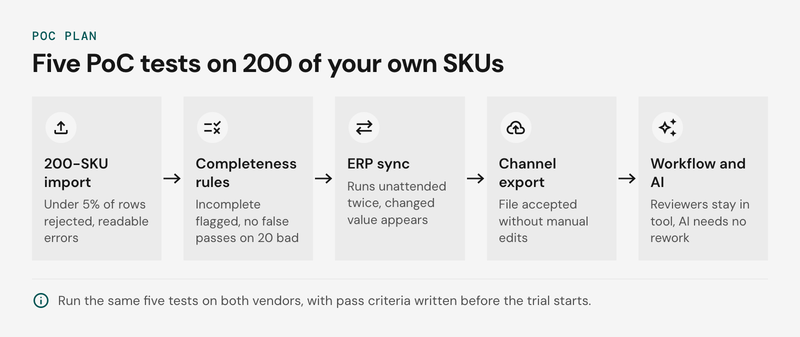
The tests and our proposed pass criteria (illustrative targets to adjust, not benchmarks):
| Test | What to run | Illustrative pass criterion |
|---|---|---|
| 200-SKU import | Load a CSV or XLSX export from your current source into your draft data model | Under 5% of rows rejected, and every rejection has a readable error |
| Completeness score and data quality rules | Encode your required attributes per locale and channel, then validate | Incomplete products are flagged correctly, with no false passes on a seeded set of 20 bad records |
| ERP sync | One inbound sync of price or stock from your ERP | Runs unattended twice, and a changed value appears in the PIM |
| Channel export | One real target: a distributor feed, a shop, or a printed catalog | The receiving system accepts the file without manual edits |
| Workflow and AI | Route a record through validation, comments and tasks, and try AI-assisted data validation or predictive mapping | Reviewers finish without leaving the tool, and AI suggestions are correct enough to accept without rework |
For the ERP test, run a vendor connector and a custom integration side by side if both exist. Record build hours and who owns the maintenance. Those hours feed your total cost of ownership model, so log the PoC effort as well.
Channel export tests are worth multiplying when one catalog feeds several outputs. A European home décor brand used Sales Layer to handle product details across printed catalogs, online shops, and mobile apps. Pick your hardest output, not your easiest.
Put four contract checks in writing before signing:
- Onboarding: who maps your data model, and is that effort in the quote?
- Migration: is bulk import tooling included or billed per project?
- Exit: can you export all products, assets, and history in an open format, and at what cost?
- Support SLA: what are the response times by severity, and which hours are covered?
Ask both vendors for the same answers, then compare the quotes line by line.
FAQ: Akeneo vs Bluestone PIM
Is Akeneo better than Bluestone PIM?
How much does a PIM cost?
Is a PIM worth it for 5,000 SKUs?
Which PIM should I choose for a B2B catalog?
What is an affordable PIM for mid-size B2B companies?
Bluestone PIM vs Akeneo pricing: Which is cheaper?
Next step: Shortlist and run the PoC
Shortlist Akeneo Product Cloud and Bluestone PIM, then run the same two-week PoC on both. Use your three most awkward attribute families, one ERP sync, and one channel export, and score each system on mapping effort and completeness rules.
A PIM development company can run that PoC if your team lacks capacity. It also exposes the custom integration work that drives total cost of ownership.
For storefront and ERP work around the PIM, see our commerce development services, or bring your shortlist to our engineers: Build your commerce platform. If you are still weighing vendors and delivery partners, our guide to choosing the right PIM services explains what to look for before you commit.


