
What does a product designer do? Role, skills & salary


Contents
Job listings for "product designer," "UX designer," and "UI designer" often describe the same job with three different titles, and that inconsistency is exactly why the role confuses both job seekers and hiring managers. A product designer owns the full arc from user research to shipped interface, working across product, engineering, and business goals rather than just visuals or flows in isolation.
This guide breaks down what that actually looks like day to day, how it differs from adjacent titles, and what it takes to do the job well. This same title confusion shows up elsewhere in tech, too, job seekers face similar ambiguity when comparing software developers and engineers.
Product designer: Quick answer
A product designer owns the end-to-end path from a user problem to a shipped interface: user research, wireframing, prototyping in Figma, and usability testing before an engineer writes a line of code.
The role sits between the product manager and engineering, translating business goals into flows a user can actually complete.
Research sits upstream of the visual work, not after it: early findings often reshape a feature's scope before a single screen gets built.
What is a product designer?
A product designer's ownership extends beyond UX design or UI design alone, the role decides which problem is worth solving before either discipline starts work.
UX design shapes how a flow feels; UI design shapes how it looks; the product designer decides which flows exist and defends that call in design critique.
Scope changes with company size, and it changes as a designer becomes more senior. At a 50-person startup, one product designer might run user research, build the design system, and ship UI across three product teams. At a 500-person business, a staff designer sets design system standards and mentors, while a senior or lead designer owns a single product area end-to-end.
Agency product designers work across several clients' goals in parallel, trading depth on one product for breadth across many, a different experience from the in-house track, where a designer sees a decision through to its usage data.
The design system is the clearest marker of ownership. Whoever writes and enforces the component library's rules in Figma is, functionally, accountable for UI consistency across a product line. On lean teams, that is usually one generalist product designer rather than separate UX and UI hires.
What does a product designer do day to day?
A product designer's day splits between three modes: research, making, and defending decisions in a room full of engineers and product managers. No single day looks like the others, but a working week usually cycles through all three as part of the broader design process.
That daily back-and-forth is usually with product managers, not project managers, since the two roles own very different parts of the process.
Mornings often start with user research synthesis: reviewing session recordings, tagging pain points, checking a hypothesis against what users actually did rather than what they said. The focus is learning what's broken in the current user experience before touching a single screen.
From there, the work moves into wireframing: low-fidelity flows sketched fast, in Figma, to test a structural idea before anyone invests in visual polish.
Once a flow holds up, the designer builds higher-fidelity screens with the right tools and books time for design critique: a peer review where the goal is to find the weakest assumption, not admire the layout.
That loop is what moves product metrics. When Netguru's product designers worked inside Otodom's team on its saved-search feature, the subscription rate to saved-search notifications grew by 116%, with 12,028 new saved searches in the two months after launch.
For teams without in-house design capacity, professional UX design services can run the same research-to-release loop.
Usability testing sits in between: five or six moderated sessions per round is standard practice, per Nielsen Norman Group's research on qualitative, which found that five users typically expose the majority of a flow's usability problems. Product designers run these sessions themselves more often than not, applying the same design principles round after round to keep findings comparable.
The rest of the week goes to cross-functional collaboration: standups with engineering, scope conversations with the product manager, and handoff documentation that spells out states, edge cases, and motion specs so nothing gets reinterpreted in build.
Designers who don't document these details well end up relitigating decisions mid-sprint.
Junior designers spend more hours in Figma production, learning tools and craft. Senior and lead designers spend more hours in critique, roadmap framing, and defending research findings to stakeholders who'd rather skip straight to build, and they gain influence by helping teams create alignment before code gets written.
Who a product designer works with day to day
A product designer's closest working relationship is with the product manager, not other designers. The two align on scope before a single wireframe exists, the PM owns the business case and success metrics, the designer owns how the product actually behaves for the user. That handoff, done badly, is where most feature scope creep starts.
Software engineers come next, and the relationship shifts as a project matures. Early on, designers pull engineers into critique sessions to flag technical constraints before they're baked into a Figma prototype. Closer to release, the conversation turns into implementation detail: spacing tokens, state transitions, edge cases nobody wireframed.
When usability testing shows a planned feature isn't worth building, cutting it is a joint call between the designer, the PM, and the engineering lead, not the designer's alone.
Stakeholder management fills the rest of the week: sales wants a demo-ready flow, support flags recurring complaints, leadership wants a roadmap slide. A staff or lead product designer spends real time translating between these groups; a junior designer rarely sits in that room yet.
Team size and company stage decide how much of the job is making versus negotiating. Understanding how product owners and managers collaborate can help designers navigate these same stakeholder dynamics more effectively.
Product designer vs. UX designer vs. UI designer
A product designer owns end-to-end problem framing across the whole design process: research, information architecture, interaction design, and visual polish. UX designer and UI designer are narrower slices of that same scope, usually assigned once a team grows past a handful of people.
| Role | Owns | Typical Deliverables | Usually Reports Into |
|---|---|---|---|
| Product Designer | User research, business goals, end-to-end flow | Wireframes, prototypes, test plans | Product manager or Head of Design |
| UX Designer | Information architecture, user flows, interaction design | Journey maps, flow diagrams, wireframes | Product designer or design lead |
| UI Designer | Visual design, component libraries | High-fidelity Figma files, style guides | Product designer or design lead |
The split is organizational, not a difference in skills.
At a 50-person startup, one product designer runs research, wireframing, and usability testing without a dedicated UX or UI hire, using whatever tools the team has already standardized on. Past roughly 300-500 employees, those responsibilities usually split: a staff or lead product designer sets direction and design principles across a pod, while UX and UI designers own their slice of the process day to day.
Agency work adds a third axis. An in-house product designer owns one product's roadmap for years and can focus deeply on a single user experience. An agency designer, which is the model Netguru's design teams work in, rotates across client engagements, going deep on interaction design and information architecture for a few months before handing off.
Neither path is more senior by default. Both let designers gain range and learn new domains fast, but the skills transfer while the context doesn't. Picking the right environment depends on whether you want to create one product deeply or many products broadly.
Why the title means something different at every company
A product designer at a 15-person startup and a product designer at a big tech company are doing different jobs under the same title.
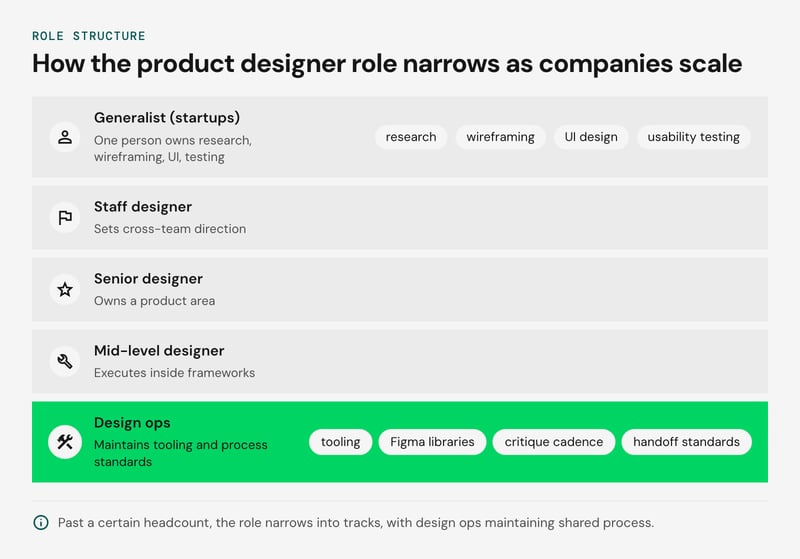
At small teams, one person often owns research, wireframing, UI design, and usability testing end to end, because there is no one else to hand it to.
Past a certain headcount, the role narrows and design ops appears: a function dedicated to tooling, Figma libraries, critique cadence, and handoff standards, so individual designers stop reinventing process on every project.
Larger design orgs typically split product design into staff, senior, and mid-level tracks with distinct scopes: staff designers set cross-team direction, senior designers own a product area, and mid-level designers execute inside frameworks that design ops maintains. Big product companies also add dedicated research and content design partners, work a startup product designer would cover alone.
In-house teams also differ from agency work. Agency product designers move between client contexts every few months and lean harder on process documentation to onboard fast, since there is no shared institutional context to fall back on.
Staff vs. senior vs. lead product designer: What changes?
A senior product designer owns a feature end to end; a staff product designer owns a problem space across multiple teams; a lead product designer owns people, usually three to eight designers, plus the roadmap they execute against.
The distinction is not about skill level, it is about surface area. Understanding how product managers operate helps clarify these boundaries, since much of a senior, staff, or lead designer's surface area is defined by where their responsibilities meet a product manager's.
Senior is where design critique becomes something you run, not just attend. You are expected to defend decisions to a product manager with research evidence, not opinion.
Staff sits one layer up: less Figma time, more stakeholder management, because your job is aligning three product managers on a shared user model before anyone wireframes anything.
Lead adds headcount and hiring to that mix, and in most orgs it forks away from hands-on design work entirely.
| Level | Primary output | Time in Figma | Reports to |
|---|---|---|---|
| Senior | Shipped features | High | Design manager |
| Staff | Cross-team frameworks | Medium | Design manager or director |
| Lead | Team goals, hiring | Low | Director or VP |
Companies also advertise "senior" roles that are actually staff-scoped work, which is why title alone tells you less than the actual deliverables listed in the req.
What skills does a product designer need?
A product designer needs two distinct skill sets: craft and collaboration. Craft skills produce the work; collaboration skills get it adopted. Junior portfolios often show only the first.
Hard skills center on Figma as the industry-standard tool for wireframing, prototyping, and design systems work.
Beyond the tool, a product designer needs interaction design fluency (state changes, transitions, error states), research synthesis, and enough data literacy to read an A/B test result without a data scientist translating it.
Running a design sprint, the five-day Google Ventures framework for scoping a problem before committing engineering time, is a skill many hiring managers ask about directly.
Soft skills determine whether that craft ships. A product designer works alongside a product manager daily, and the relationship only functions when the designer can defend a decision with user evidence rather than opinion. Design critique is where this gets tested: giving feedback that improves the work without becoming personal, and taking feedback on your own screens without getting defensive.
How much do product designers earn?
A product designer's salary depends more on seniority and company stage than on job title alone.
Two US data sets frame the range.
Glassdoor data puts the median product designer's total pay at $120,000, from $102,328 for a junior designer to $213,353 for a senior and $264,055 for a principal (Untitled UI, citing Glassdoor). Advertised salaries run higher: an analysis of 1,000 product designer job postings found a median of $180,000, with the middle half between $157,000 and $213,000 (Recruiting from Scratch).
Level matters more than the headline number. A staff or lead product designer working on core product strategy, running research synthesis, and mentoring a small team commands meaningfully more than someone doing junior wireframing and handoff support.
Big tech pays on a different scale again, with senior total compensation passing $300,000. Outside the US, salaries are substantially lower, so benchmark against local data before comparing offers.
In-house product designers at product companies typically earn more than agency designers doing comparable work, partly because in-house roles carry ongoing ownership of a product's design system and metrics, not just delivery of a project.
How to become a product designer
Most product designers get in through one of three doors: a design or HCI degree, a UX bootcamp that pivots into product work, or a lateral move from visual or UI design into full product ownership. The path matters less than what you can prove you have done.
Hiring managers want to see process, not polished mocks. A portfolio should walk through a real problem: the user research that defined it, the wireframing iterations that shifted based on findings, and the usability testing that killed or validated a direction before launch. Screens without that trail read as UI portfolios, not product design portfolios, no matter how clean the Figma files look.
A bootcamp gets you the vocabulary; the first role is usually won by a portfolio case study that shows research changing a decision, not just a before-and-after screenshot. Agency work can speed that up, because a designer ships several research-to-handoff cycles a year instead of one.
Hiring in-house vs. working with a design partner
A single in-house product designer works well when the scope is narrow and stable: one product, one roadmap, tight feedback loops with the same product manager every sprint. Once a company runs multiple products or needs research, wireframing, and usability testing on parallel tracks, a design partner fills the gaps faster than a hiring pipeline can.
The tradeoff is not just headcount. An in-house product designer builds context that compounds: they know the codebase constraints, the support tickets, the politics of cross-functional collaboration with engineering and sales. A partner team brings breadth instead: staff, senior, and lead designers who have solved similar problems elsewhere, plugged in through Figma and existing design ops rather than a six-week onboarding.
Most mid-market teams end up running both. Core product ownership stays in-house; a partner covers surge work, a new platform, or a redesign that needs fresh eyes.
The deciding question is rarely cost. It's whether the work needs institutional memory or outside pattern-matching.


