
Retail technology trends 2026: what to adopt, pilot, or watch


Contents
Retail leaders face more technology trends than budget, and most trend lists treat every item as equally urgent. The ones that deserve money in 2026 are AI for forecasting and pricing, a unified-commerce order management system, item-level RFID in apparel and footwear, and agentic commerce as a pilot.
Retail media and computer vision checkout fit only some retailers. Your verdict shifts with store format, inventory accuracy and team capacity.
Retail technology trends 2026 at a glance
Retail technology investment pays back first in demand forecasting and unified commerce. The Agentic Commerce Protocol and item-level RFID need narrower bets, scoped to a category or a single channel.
Every trend below depends on the same two feeds, accurate inventory and a reliable order-promising layer. Agent checkout fails when price and stock feeds lag, because the order cannot be fulfilled. RFID counts mean little if store pick capacity cannot fill ship-from-store orders.
We recommend fixing inventory accuracy and order promising in the order management system before funding any agent or media work, because every newer channel reads from those feeds.
That order comes from our retail software development work on commerce platforms, order management integrations and autonomous store technology, all of which read from the same inventory and order feeds.
The verdicts side by side:
| Trend | What changed | Verdict |
|---|---|---|
| Demand forecasting and AI pricing | Models forecast at store and SKU level from POS and inventory data, so forecast quality depends on feed hygiene. | Adopt |
| Unified commerce and OMS | One inventory and order-promising layer serves stores and online, which ship-from-store requires. | Adopt |
| Agentic Commerce Protocol and Agent Payments Protocol | OpenAI and Stripe, and Google Cloud, published open protocols for agent-initiated checkout and payments in September 2025. | Pilot |
| Item-level RFID | EPC Gen2 read rates drop on metal and liquids, and tag cost varies by category. | Adopt in apparel and footwear, pilot elsewhere |
| Retail media networks | Clean-room matching and measurement agreed with advertisers decide whether a network earns revenue. | Build at scale, partner below it |
| Computer vision checkout | Amazon scaled back Just Walk Out in grocery in 2024; camera install, calibration and shrink exceptions drive cost. | Pilot in narrow formats |
Retail technology by the numbers
Retail technology figures come in two grades, analyst estimates and government statistics on the market, and measured results from rollouts and trials, and each supports a different decision.
The figures below are labeled by grade, with publisher and year:
- Analyst estimate, eMarketer, 2025: US advertisers will spend more than $62 billion on retail media in 2025, up more than $10 billion year over year (EMARKETER, 2025).
- Government statistic, US Census Bureau, 2026: E-commerce sales accounted for 16.4 percent of total US retail sales in 2025, up from 16.1 percent in 2024 (US Census Bureau, Quarterly Retail E-Commerce Sales). The other 83.6 percent still runs through stores, which is why store inventory accuracy matters to every channel.
- Research result, Auburn University RFID Lab with GS1 US, 2018: item-level inventory accuracy rose from 63% with barcodes to 95% with RFID (Auburn University RFID Lab and GS1 US, 2018).
Analyst estimates are forecasts built on each publisher's own model, so two publishers can size retail media networks differently. Use them to scale a budget line, and quote the publisher when you do.
Rollout results are measured on real stores, but they rarely come with a control group and mostly from retailers that succeeded. We recommend treating them as an upper bound and setting your pilot target from your own baseline, such as forecast error or count accuracy.
How is AI used for merchandising, demand forecasting, and pricing?
AI for demand forecasting, dynamic pricing, and merchandising earns an adopt verdict for 2026, provided your stock and sales data are accurate and current. Models trained on bad inventory records forecast confidently and wrongly, and pricing engines repeat the error at every price change.
Three failure modes show up first:
- Phantom inventory and censored demand. A stockout records zero sales, so the demand forecasting model learns that the item is slow and under-orders it again.
- Lagging stock feeds. If store inventory reaches the order management system in nightly batches, dynamic pricing marks down or raises prices against yesterday's position.
- Unlogged promotions. When price changes and campaigns are missing from the training data, the model reads promo lift as baseline demand.
The data prerequisites, in the order we'd fix them:
- Location-level stock accuracy, verified by cycle counts or item-level RFID.
- Event-driven updates for sales, returns, and transfers that reach the OMS within minutes.
- A clean history with promo calendar, price changes, stockout flags, and store closures.
- One product and location hierarchy across stores and online.
- Price floors, ceilings, and approval rules before any auto-pricing goes live.
Generative AI adds a lighter layer on top: drafted product descriptions, conversational search, and assortment suggestions tailored to a shopper. It depends on the same catalog and stock quality as the forecasts, so it pays back only after the data work above.
A store associate copilot is the in-store version of this stack. It answers questions about stock, substitutes, and current price at the shelf, and it is only as trustworthy as the inventory feed behind it.
Lowe's rolled out Mylow Companion, an AI assistant, to thousands of store associates in May 2025 (Lowe's Corporate Newsroom, 2025).
Our recommendation is to start with demand forecasting on one category and a few stores, since the data gaps surface there before they affect customer-facing prices. The wider AI picture is in AI in retail.
Why does unified commerce need a modern OMS?
A modern order management system gives unified commerce one inventory promise across web, app, and stores. Without it, ship-from-store and click-and-collect oversell stock that stores cannot pick.
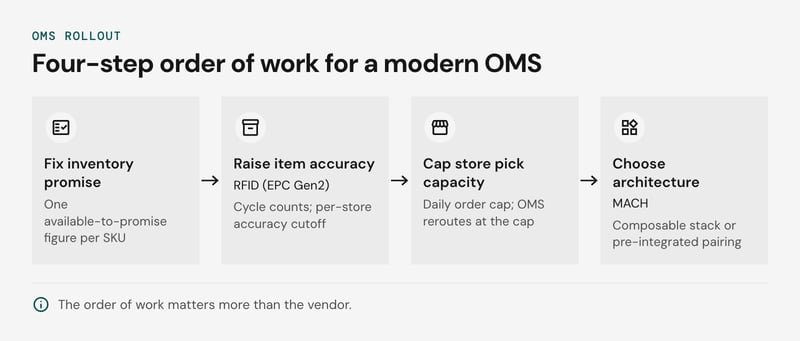
We recommend adopting a dedicated OMS in 2026 for any retailer whose stores and online channels still keep separate stock ledgers. Buy the engine and own the sourcing rules, because the rules are where your margin and service levels live. Get the order of work right before you pick a vendor:
- Fix the inventory promise first. The OMS needs one available-to-promise figure per SKU and location, net of safety stock and in-flight orders. Order promising built on a nightly stock file will oversell fast-turning items.
- Raise item accuracy second. The promise is only as good as the counts beneath it. Cycle counts or item-level RFID (EPC Gen2) improve them. Set a per-store accuracy cutoff, based on your own cancellation data, below which a store is excluded from ship-from-store sourcing.
- Cap store pick capacity third. Ship-from-store works only if a store can pick, pack, and hand off within the promised window. Model pick labor per store per hour, set a daily order cap, and let the OMS reroute when a store hits it. Otherwise online orders compete with the customers standing in the aisle.
- Choose the architecture last. A composable commerce (MACH) stack lets you swap the OMS, search, or checkout independently, and add a fulfillment node or channel without replatforming.
The cost of composable commerce is integration and ownership. You take on event contracts between services, an owner for the order state machine, and tracing across vendors. A retailer without its own platform team should start with a pre-integrated commerce and OMS pairing.
If you are weighing that trade-off, composable commerce consulting can help you judge whether your team is ready to own the integration layer.
The integration layer between OMS, storefront, and POS is the part to scope early with an in-house team or a retail software development partner. Single-channel retailers with a handful of stores can skip this: a commerce platform's built-in order handling is enough until a second fulfillment node appears.
What are AI agents and agentic commerce changing for retailers?
AI agents turn agentic commerce into a channel where software reads your catalog and submits the order, so agent-readable product data and live inventory become your storefront.
The Agentic Commerce Protocol, published by OpenAI and Stripe in September 2025, defines how an agent such as ChatGPT passes a cart to a merchant's checkout endpoint. The merchant stays merchant of record and keeps its own payment flow.
Stripe's shared payment token carries the buyer's credential without exposing card details. At launch on September 29, 2025, the protocol powered Instant Checkout in ChatGPT for US Etsy sellers, with over a million Shopify merchants announced to follow (Stripe Newsroom, 2025).
Google Cloud's Agent Payments Protocol (AP2) covers a different layer: proof that the user authorized the purchase.
It uses signed mandates, one for the user's intent and one for the final cart, so a merchant or issuer can verify what the agent was allowed to buy. AP2 is payment-method agnostic.
Google announced AP2 in September 2025 with more than 60 payments and technology organizations (Google Cloud Blog, 2025).
Retailers are also building their own agents. Walmart launched Sparky, an agentic shopping assistant in the Walmart app, in June 2025 (Walmart, 2025).
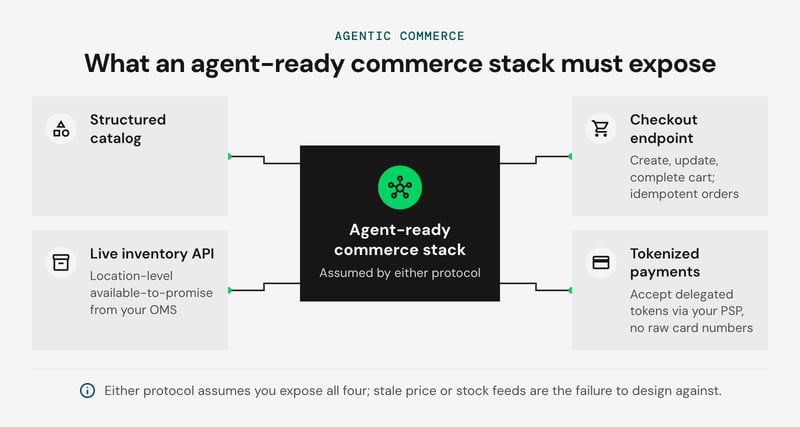
Either protocol assumes you expose four things:
- Structured catalog: GTIN, variants, price, currency, shipping and return terms as typed fields, not copy buried in descriptions or images.
- Live inventory API: location-level available-to-promise from your OMS, with a freshness timestamp on every response.
- Checkout endpoint: create, update and complete a cart, with tax and shipping calculated server-side and idempotent order creation.
- Tokenized payments: accept delegated tokens through your PSP, and never handle raw card numbers.
Stale price or stock feeds are the failure to design against. An agent that quotes yesterday's price or sells the last unit twice creates an order you must cancel or fulfill at a loss. Reservation logic in the OMS and feed refresh intervals deserve more attention than the choice between protocols.
Our verdict is pilot. Expose one category's catalog and inventory, cap agent order volume, and track the cancellation rate on agent orders before widening. Both specifications are still changing, so retailers whose stores and web keep separate stock ledgers should fix the OMS first.

Does item-level RFID fix inventory accuracy?
Item-level RFID fixes inventory accuracy in apparel and footwear, and it earns a pilot elsewhere. Shoppers expect the same stock truth online and in store, and ship-from-store, pickup and order promising all fail when the on-hand count is wrong.
The Auburn RFID Lab result in the numbers section above is the most cited benchmark for apparel.
EPC Gen2 UHF tags and the GS1 EPC Tag Data Standard make the data portable. Each item carries a serialized identifier that any reader, and any order management system, can interpret, and suppliers can tag at source.
The economics come down to tag cost against unit price. As an illustrative assumption, not a benchmark, a $0.05 tag adds under 0.1% to a $60 jacket and roughly 1.7% to a $3 item. Read-rate risk then decides whether the category is viable at all.
The trade-offs side by side:
| Category | Tag cost vs unit price | Read-rate risk | Verdict |
|---|---|---|---|
| Apparel and footwear | Small share of price | Low; fabric and cardboard read well | Adopt |
| Cosmetics, beverages, liquids | Larger share | Liquids absorb UHF signal | Pilot |
| Electronics, jewelry, metal fixtures | Varies | Metal detunes standard tags; on-metal tags cost more | Pilot |
| Low-price grocery | Largest share | Mix of liquids and metal cans | Pilot on high-value lines only |
Shrink and loss prevention is the second payback line. Exit readers can flag tagged items leaving unpaid, and serialized reads show which zone an item vanished from, so shrink analysis moves from period counts to event traces. Detection is not prevention, though: someone must act on the alert.
One caveat applies to every row. The accuracy gain depends on process: regular handheld counts, replenishment rules tied to the read data, and a clean feed into the OMS. Without those, tags add cost and the count stays wrong.
Are retail media networks worth building?
Retail media networks are worth building only when a retailer has a large base of logged-in shoppers and enough brand-supplier demand. Mid-market retailers should partner, and small retailers should skip.
The verdict by retailer size is our recommendation, not a benchmark:
| Retailer profile | Verdict | Why |
|---|---|---|
| Large omnichannel, loyalty ID attached to most transactions, many brand suppliers | Build | Owning the ad server and data keeps margin and the advertiser relationship |
| Mid-market, partial identity coverage, tens of brand suppliers | Partner | A managed platform covers ad serving, billing and clean-room matching; start with onsite sponsored products |
| Small or single-brand, mostly anonymous traffic | Skip | The audience is too thin for advertisers, and operating cost outweighs revenue |
Three conditions gate a build decision. We suggest checking them in this order:
- First-party identity coverage. Measure the share of sales you can tie to a known customer. Advertisers pay for audiences they can target and measure, and anonymous baskets give them neither.
- Clean-room matching. Brands will want to match their CRM lists against your purchase data in clean rooms such as Snowflake, AWS Clean Rooms or LiveRamp, with neither side exposing raw records. Budget for this as core infrastructure.
- Measurement agreed with advertisers. Get two or three anchor brands to sign off on the incrementality method and attribution windows before engineering starts, using the IAB and MRC retail media measurement guidelines as the baseline (IAB Retail Media Measurement Guidelines, 2024).
Without that sign-off, advertisers discount the results you report. Platform options and cost trade-offs are in our retail media platforms guide.
Is computer vision checkout still worth it?
Computer vision checkout is worth a pilot in narrow formats: small stores with a limited range, controlled entry, and small baskets.
In 2024, Amazon removed Just Walk Out from its US Amazon Fresh grocery stores in favor of Dash Carts, a signal that large-basket grocery is the hardest case for the technology (Wall Street Journal, 2024). Our comparison of self-checkout and grab-and-go formats covers the alternatives.
Amazon kept the technology in third-party venues such as stadiums and airports, where shoppers buy a few items under time pressure. That pattern is our basis for the recommendation: the fewer SKUs and shoppers per camera zone, the better the accuracy and the economics.
Three cost lines decide whether a pilot pays back:
| Cost line | What drives it | Early warning sign |
|---|---|---|
| Camera install | Ceiling height, fixture layout, retrofit versus new build, edge compute and network | Scope grows after the floor survey |
| Calibration | Planogram resets, lighting changes, moved fixtures | Accuracy drifts after each reset |
| Exception handling | Occluded items, similar packaging, groups shopping together, remote review staff | Receipt disputes and the review queue keep growing |
A store with a narrow range and few resets keeps all three lines low. A full-range supermarket with weekly promotions rebuilds calibration constantly, and exception handling becomes a permanent staffing line.
Shrink and loss prevention should be a pilot metric from day one. Removing the till does not remove theft; losses shift to disputed receipts, items taken without being charged, and entry gates left open. Compare shrink per store against a matched conventional control store before approving a second site.
Small formats are where the model scales. For Żabka's autonomous Nano stores, we built the architecture linking card-based entry, payments, third-party image recognition and store hardware; the system now runs in more than 50 locations.
The build decision is covered in our computer vision in retail guide. AR try-on in store, for size and color recommendations on fashion and footwear floors, is a smaller bet that suits the same pilot discipline.
Frequently asked questions about retail technology trends
What are the key technology trends for the retail industry in 2026?
How is AI used in retail?
What technology do retail stores use?
Conclusion: Adopt, pilot, watch
Adopt unified commerce and AI demand forecasting, adopt item-level RFID in apparel and footwear, pilot agentic commerce, and pilot computer vision checkout only in small, narrow-range formats. Retail media is a build decision for large retailers and a partner decision for the mid-market.
Unified commerce comes first because the other trends read from it. Agents need accurate availability, RFID produces it, and order promising consumes it. A pilot means one category or one store format, with a stop condition set before launch.
The first agentic commerce pilot can be a product feed and checkout endpoint for a single high-margin category. Outside apparel, start item-level RFID in the store format where inventory accuracy is the bottleneck, using GS1 EPC Gen2 tags, and keep computer vision checkout to small stores with a limited range, measuring shrink against a control store.
Each new channel, from agents to retail media, reads the same catalog and stock data, so the cost of a wrong count grows with every channel you add. For the broader picture, see our pieces on the future of retail technology, the future of retail, and ecommerce trends.
If you are deciding which of these to fund first, send us your current stack and goals and we will map where your inventory and order data stand against each verdict.


