
Trusted AI chatbot for 25,000+ dental professionals
98%
Answer accuracy
Measured against the evaluation framework written with ITI.
~0
Production hallucinations
Tracked live through Context Faithfulness scoring.
12
Countries in user testing
Covered by 24 user tests before launch.
The client

The International Team for Implantology (ITI) is a global association in implant dentistry, with more than 25,000 members in over 100 countries.
It advances the field through education and research, and has built decades of evidence-based clinical knowledge. Members access it through book series, journals, clinical guidelines, an online academy, conferences and study clubs.
The challengeWhat needed solving
ITI's content was trusted but hard to use. The goal was to put it within reach every day and keep members engaged between renewals.
Challenge 01Knowledge in silos
Each resource ran on its own platform and format, so finding an answer meant knowing which one to open first.
Challenge 02Too many steps to an answer
A complete answer often meant collecting partial information from several sources and putting it together.
Challenge 03Engagement tied to events
ITI reached members mostly at conferences and study clubs. Between events, it had little everyday presence.
What we did
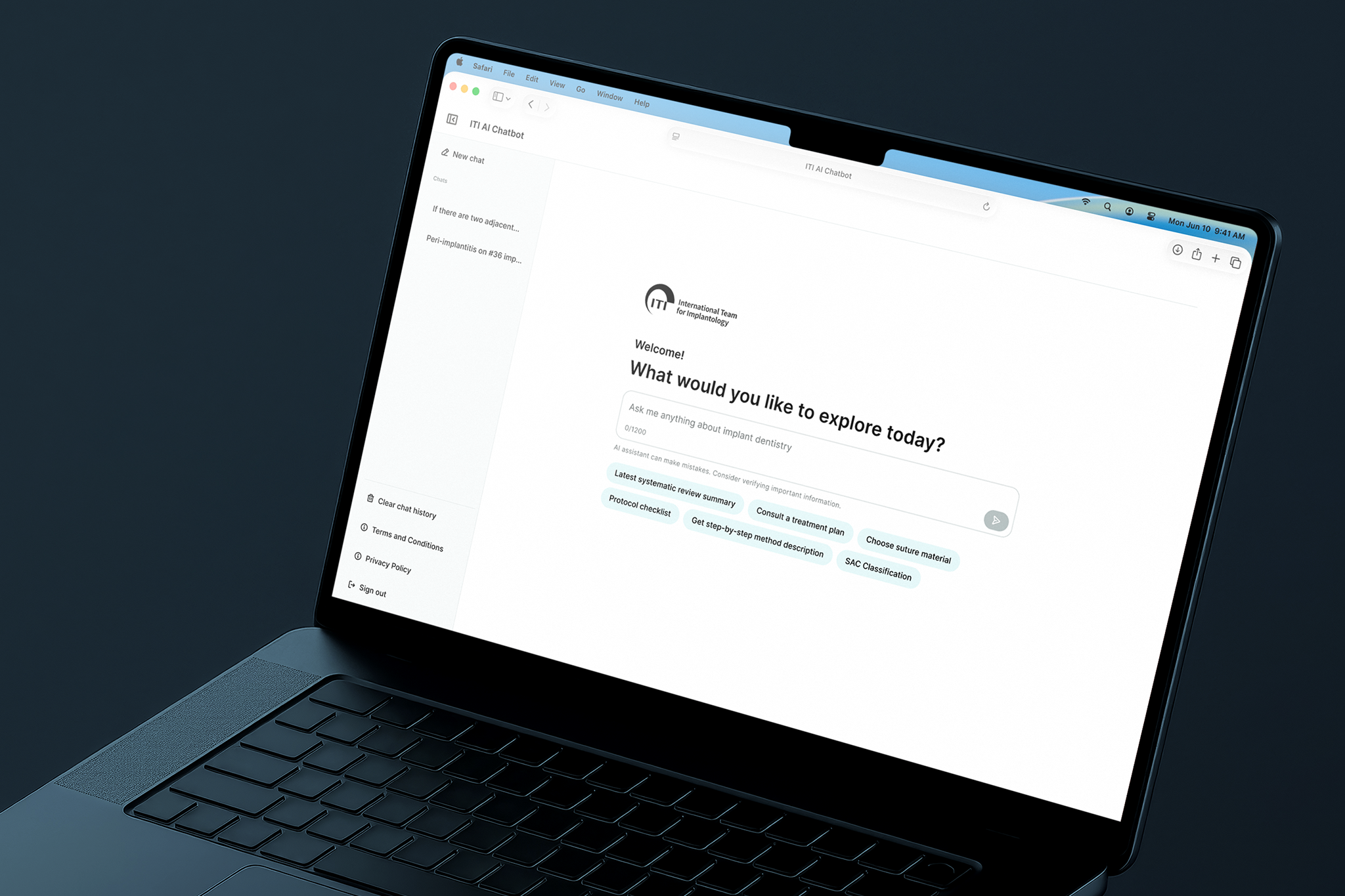
An AI concierge for ITI members
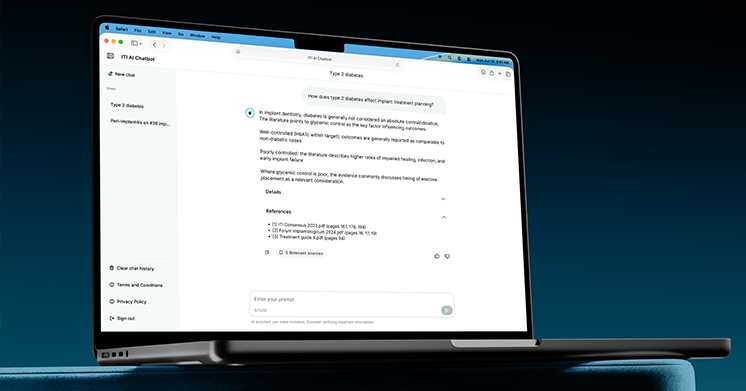
We built an educational AI concierge grounded only in ITI's own treatment guides and clinical guidelines. It uses Retrieval-Augmented Generation (RAG): for every question, it pulls the relevant passages from ITI's content and turns them into one complete, sourced answer.
Accuracy from preparation, not model size
The chatbot runs on GPT-5-mini. Clean text, tested chunking, retrieval per content type and a strict system prompt keep its answers inside ITI's content.
Quality made measurable
An evaluation framework written with ITI became an automated Promptfoo suite tracked in Langfuse. Load tests before launch caught a rate limit and a database bottleneck in time.
Two retrieval approaches, one winner
We ran a SQLite vector store side by side with graph-based LightRAG. SQLite proved faster, cheaper and enough for practitioners' questions, while LightRAG stays ready for a future advanced mode.
Built on Chatguru, launched in Istanbul
Chatguru, our open-source chatbot platform, saved about a month of groundwork. A one-month PoC and five MVP sprints later, the app launched to several hundred practitioners in Istanbul in May 2026.
Client testimonial
Netguru combined efficient delivery with a proactive, business-oriented mindset, consistently going beyond feature development to truly understand our objectives. Their transparent approach and continuous optimisation proposals contributed to a high-quality outcome.
Tech stackThe tools that made it possible
01
GPT-5-mini
A small model with low reasoning keeps costs and response times low. Careful data preparation keeps it accurate.
02
Azure
The whole system runs in ITI's own Azure environment, so member data never leaves their infrastructure.
03
SQLite vector store
We tested it side by side with graph-based LightRAG. SQLite proved faster, cheaper and enough for members' questions.
04
Promptfoo & Langfuse
Promptfoo scores every meaningful change and Langfuse tracks each run, so any quality drop is traceable in production.
05
Chatguru
Our open-source chatbot platform gave us a working foundation and saved about a month of groundwork.
More like thisOther places we scaled product teams for growth.
What’s next