





Build an ecommerce personalization platform that converts browsers into buyers

We design and integrate personalization layers — product recommendations, behavioral targeting, audience segmentation, and A/B experimentation — directly into your commerce stack, so every shopper sees an experience built around them.

Trusted by

Book a discovery call

Why generic recommendation tools leave conversion on the table

Most out-of-the-box recommendation widgets operate on the same shallow logic: surface what is popular, surface what others bought, repeat. That approach ignores the individual — the shopper who bought running shoes last month, browsed waterproof jackets twice this week, and abandoned a basket on mobile yesterday. Treating those signals as noise is a conversion problem you are paying for every day.

The gap between a generic tool and a purpose-built personalization layer is not cosmetic. Generic tools sit on top of your catalogue and pull from aggregated trends. A purpose-built layer ingests your own behavioral data — clicks, dwell time, purchase history, session context — and uses that signal to shape every touchpoint in real time. The result is an experience that reflects what a specific shopper actually wants, not what the average shopper once bought.

There is also a data ownership issue. SaaS recommendation tools typically hold your behavioral data inside their own infrastructure. When you build a personalization layer integrated with your own customer data platform, you control the data, the models, and the roadmap. That control matters when you want to test a new segmentation hypothesis, expand into a new market, or feed the same signals into your email and paid channels.

  • Generic tools optimise for catalogue coverage; purpose-built layers optimise for individual intent.
  • Aggregated popularity signals miss high-value micro-segments with distinct preferences.
  • Data locked in a SaaS vendor limits your ability to activate signals across other channels.
  • A personalization layer built on clean first-party data compounds in value as your customer base grows.

The five capabilities your personalization platform must have

Each capability below maps to a measurable outcome. Together they form a personalization layer that works across your entire customer journey.

Product recommendations

Serve individually relevant product suggestions on the homepage, PDP, basket, and post-purchase screen — driven by real-time behavioral signals rather than static merchandising rules.

Behavioral targeting

Trigger content, banners, and offers based on what a shopper is doing right now — browse depth, category affinity, device type, and session recency — not just who they are on paper.

Audience segmentation

Group shoppers dynamically by lifecycle stage, purchase frequency, category interest, or predicted churn risk, then deliver distinct experiences to each segment without manual rule maintenance.

A/B and multivariate experimentation

Run controlled tests on recommendation algorithms, page layouts, and offer logic so every personalization decision is grounded in evidence from your own traffic — not vendor case studies.

CDP integration

Connect your personalization layer to your customer data platform so behavioral, transactional, and CRM signals flow into a single unified profile — and feed back out to email, paid, and on-site simultaneously.

Helping Ledbury unite online and offline retail seamlessly

Ledbury is a premium menswear retailer with a growing presence across both physical stores and e-commerce. The business faced a pressing challenge: merging their online Spree Commerce platform with in-store point-of-sale systems within a very tight timeline, so that customers could take measurements in person and complete their purchases online without friction.

Netguru embedded experienced Ruby on Rails and Spree Commerce developers into the project, building new functionality that linked the retail POS system directly to the existing e-commerce platform. The integration opened entirely new sales channels by bridging in-store consultations with online ordering — enabling Ledbury to scale with confidence, plan new locations in Richmond and Washington D.C., and acquire a historic shirt workshop, all underpinned by the robust platform Netguru helped deliver.

You guys have been excellent to work with; we really appreciate how well the projects are managed and run.

Paul Watson

Ledbury Co-founder

Read case study
Ledbury case study

Bringing always-on autonomous shopping to Żabka at scale

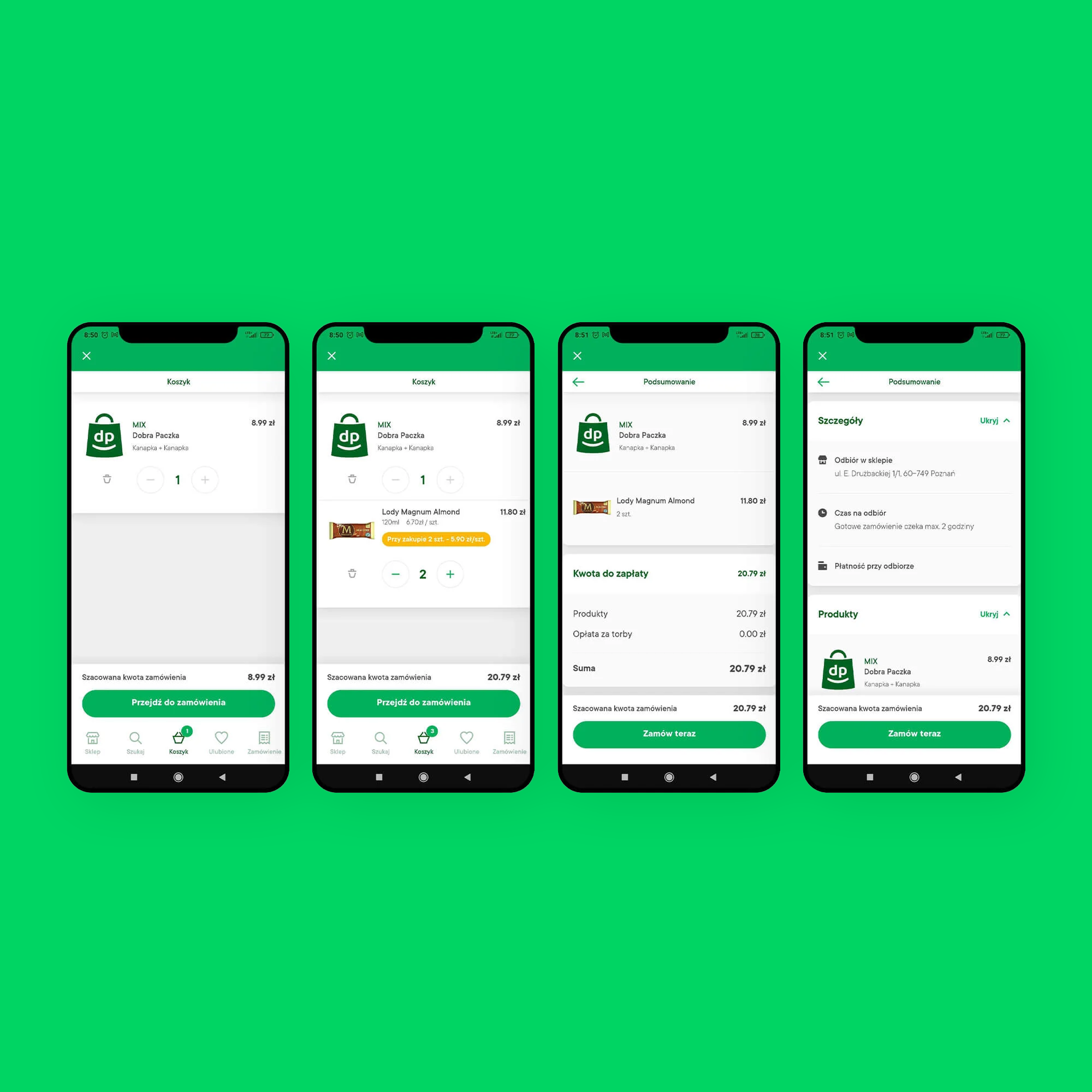
Żabka is one of Poland's largest retail chains, operating thousands of convenience stores across the country. As the business looked to pioneer a new era of autonomous retail, it needed a trusted technology partner capable of planning, designing, implementing, and maintaining the complex architecture that would power its next generation of stores.

Netguru took ownership of the full system architecture for Żabka's autonomous stores — from initial design through to implementation and ongoing maintenance. The result is a seamlessly integrated solution that enables customers to shop around the clock, delivering a genuine 24/7 experience at scale.

Read case study
Zabka Dobra Paczka green square preview

What our clients say

Netguru's work has resulted in an improved average order value, increased basket size, and higher number of monthly active users. They're proactive, caring, and highly experienced.

Ayman Kaheel

CTO, Breadfast

They leave no stone unturned when it comes to understanding the business context. Thanks to their unique approach, we were able to reduce the workload on our operations team whilst improving the user experience.

Tiago Goncalves Cabaço

VP of Design, Careem

The new Flutter-based application created by Netguru gave us the flexibility, performance, and user engagement we were looking for. It not only aligned with our platform's design but also significantly boosted user retention and sales.

Joseph Raphael

CTO, METRO BRAZIL

Build, buy, or integrate: choosing the right approach for your business

Off-the-shelf personalization platforms — Dynamic Yield, Bloomreach, Nosto — are genuinely capable products. For a mid-market retailer with a standard catalogue and a lean engineering team, they can get you to a working recommendation layer faster than a custom build. The trade-off is that you pay a recurring licence fee, accept the vendor's data model, and work within their roadmap rather than your own.

The economics shift when your catalogue is large and complex, your data model is non-standard, or you need tight integration with proprietary systems. Licence costs for enterprise-tier SaaS personalization scale with usage and revenue, and the total cost over three to five years frequently exceeds what a well-scoped custom integration would cost — without the flexibility that comes with owning the layer yourself.

A third path — and the one most of our clients end up on — is a composable approach: build the personalization logic and data pipeline as a custom layer, but integrate it with best-of-breed components (a CDP, a feature flagging tool, an experimentation framework) rather than building every piece from scratch. This gives you control where it matters and speed where it does not.

  • Off-the-shelf SaaS: fast to deploy, predictable feature set, vendor-controlled roadmap, usage-based pricing that scales with revenue.
  • Fully custom build: maximum control and flexibility, higher upfront investment, requires ongoing engineering ownership.
  • Composable integration (Netguru's typical approach): custom personalization logic on top of your existing stack, integrating CDP, experimentation, and commerce platform connectors — without reinventing infrastructure you already have.

The right answer depends on your catalogue complexity, your engineering capacity, and how differentiated your personalization needs to be. We typically run a two-week scoping engagement to map your current stack, identify the gaps, and recommend the architecture that fits your constraints — before any build begins.

Frequently asked questions about building a personalization platform

How long does it take to build and deploy a personalization layer?

A focused first phase — covering product recommendations, basic segmentation, and integration with your existing data sources — typically takes eight to twelve weeks from kick-off to production. That timeline assumes your behavioral data pipeline is already in reasonable shape. If data collection needs work first, add two to four weeks for that groundwork. We prioritise shipping a working recommendation layer early so you can start measuring lift while the broader build continues.

Does this work with Shopify Plus, Salesforce Commerce Cloud, or a headless setup?

Yes to all three. We have built personalization integrations on Shopify Plus using its Storefront API, on Salesforce Commerce Cloud via the Open Commerce API, and on fully headless and composable stacks using Next.js or similar frontends. The personalization layer itself is platform-agnostic — it sits between your data sources and your frontend, so the commerce platform underneath is largely irrelevant to the core logic. What matters is that your behavioral events are being captured cleanly, which we audit during scoping.

What is the cold-start problem and how do you handle it for new visitors or new products?

The cold-start problem describes the situation where a recommendation model has no prior data on a specific user or product, so it cannot make an individualised suggestion. For new visitors, we use contextual signals — referral source, device type, geo, landing page — to assign them to a behaviorally similar segment and serve recommendations appropriate to that group. For new products with no purchase or view history, we use content-based signals: category, attributes, price point, and catalogue relationships. As the user or product accumulates behavioral data, the model transitions from contextual to individual signals automatically.

How quickly can we expect to see measurable lift in conversion or AOV?

In our experience, the first statistically significant signals appear within four to six weeks of going live, provided you have sufficient traffic to reach significance in your A/B tests. The exact timeline depends on your monthly session volume and how narrowly you define your test segments. We set up experimentation infrastructure from day one so that every recommendation change is measured against a control group — you are not waiting for a quarterly review to know whether something is working.

Do we need a CDP already in place before starting?

No, but having one accelerates the work. If you already use a CDP — Segment, mParticle, Rudderstack — we connect the personalization layer directly to your existing unified profiles. If you do not have a CDP yet, we can build a lightweight behavioral data pipeline that serves the personalization use cases first, then expand into a fuller CDP architecture as a second phase. We will not tell you to pause personalization work until a CDP is in place; we scope what is achievable with your current data infrastructure and build toward the fuller picture in parallel.

What AI and machine learning techniques power the recommendations?

The core technique for returning visitors with sufficient history is collaborative filtering — identifying shoppers with similar behavioral patterns and using their collective actions to predict what a given individual is likely to engage with next. On top of that, we apply predictive affinity scoring to rank products by the probability a specific user will purchase, rather than just view. For segments where individual data is sparse, we layer in content-based filtering using product attributes. The specific combination we recommend depends on your catalogue size, session volume, and the use cases you want to prioritise first.

Ready to build a personalization layer that works for your specific catalogue and customers?

We run a focused scoping call to understand your current stack, your data maturity, and the personalization use cases most likely to move the needle for your business. No generic pitch — a direct conversation about your situation.

Book a scoping call