
Legacy modernization case studies: 14 projects by trigger


Contents
A legacy platform is like a house with a failing part: a leaking roof calls for a roofer, a cracked foundation for a rebuild, and sometimes the house is fine and only needs an extension. Modernization works the same way.
The trigger tells you which repair you need, and the whole house is rarely the answer. The 14 Netguru projects below, grouped by approach, show how each trigger led to a different decision, and why the first question is whether the problem sits in the platform or in how it was implemented.
What do 14 legacy modernization projects show?
They show that the trigger decided the approach in each project, and that not every project needed a migration. The table below gives each case's starting point, approach and published result, and the sections after it walk through each group.
Two of the 14 projects changed no platform at all and still met the business goal. For that reason, Netguru's application modernization services start with a diagnosis of the existing system, before anyone picks a target architecture.
Legacy modernization case studies at a glance: All 14 projects
The 14 projects span five approaches: rehosting, refactoring, rewriting or rebuilding, replacing with a new product, and extending or upgrading in place. The 7 Rs and the strangler fig pattern are defined in our modernization framework article.
The cases are grouped, not ranked. The published results measure different things (tickets, traffic, users, orders, delivery time), so no row should be compared with another on a shared metric.
| Client | Starting point | Approach | What changed | Time or scope | Published result |
|---|---|---|---|---|---|
| Nodus Medical | Voice-controlled surgical assistant used in hospitals across Europe | Rehost | Infrastructure migrated to AWS by Netguru's DevOps team | Infrastructure | Platform ready to grow securely |
| Evvnt | Ruby on Rails and Angular codebase costing more to maintain each year | Refactor | Code refactored, test coverage raised substantially | 1,137 hours, team of three | 60% fewer issue tickets |
| Odin Company | Codebase that had to be refactored before it could be extended | Audit, then refactor | Audit before any change; Teamcasting module redesigned | Codebase and one module | No metric published |
| Anime Digital Network | PHP and Joomla platform that went down under high traffic | Rewrite | Cloud video streaming platform on AWS with autoscaling and CI/CD | Platform and delivery pipeline | Client returned for multiprofiles, a Zendesk integration and Smart TV purchasing |
| senseFly | Typo3 server-side CMS | Rewrite | Vue.js and TypeScript client-side app over a new microservice cluster | 14 weeks | 50K+ monthly visits, 16K+ subscribers |
| Tourlane | PHP codebase | Rewrite | Codebase rewritten in Ruby on Rails | Stage one in four months | Site fully converted |
| US-based edtech SaaS | 20-year-old ASP, .NET and MSSQL product | Rewrite | Moved to Node.js and Vue, interface redesigned | 5 months research and design, MVP in 6 months | MVP on time and on budget, helped secure a state contract |
| Raqib50 | Existing app for a mobile-dominated, Arabic-speaking audience | Rebuild | App re-engineered mobile-first | Released 3 weeks before an early election | 1,400 visitors a day |
| Avalon Foundation | Microsoft Dynamics 365 setup with cumbersome UX and frequent downtime | Replace | Mendix low-code CRM, website and database migration | 7 months, 10+ years of data migrated | Two departments on the new CRM; Netguru estimates the build at 3x faster than conventional development |
| Keto-Mojo | Legacy React Native app | Replace, with a controlled sunset | Legacy app stabilised while native iOS and Android apps took over | Native apps from 2021 | Users moved across in a controlled sunset; the stabilised legacy app is still in use |
| METRO BRAZIL | Native apps that were costly to keep updated | Replace | One Flutter app reusing the web screens through WebViews | First three months after launch | +70% daily active users, +50% customer satisfaction, +40% international and GCC orders |
| UBS | Hybrid Cordova mobile banking app | Replace, supported | Netguru supported the move to native iOS and Android alongside a redesign | App and design system | No metric published |
| Ledbury | In-house Spree Commerce store | Extend in place | New module merged in-store selling with the online shop | Tight timeline | Customers measured in store can order online |
| Artemest | Italian artisan marketplace with fast growth | Upgrade in place | Netguru took over, reviewed the whole system and upgraded the code | Without interrupting sales | Platform keeps pace with four to five new artisans a week |
Four projects replaced the product outright, five rewrote or rebuilt it, two refactored, one moved the infrastructure, and two kept the platform. Ledbury and Artemest show that a sound platform can take on a new channel or fast growth without a migration.
What triggers a modernization project, and which approach fits?
The cases map triggers to approaches fairly consistently. The table shows the pattern and the point where each approach stops paying off.
| Trigger | Approach | Example from the cases | Where it stops working |
|---|---|---|---|
| Maintenance cost grows each year | Refactor, with tests first | Evvnt's Ruby on Rails and Angular codebase | Leaves an unsupported framework in place |
| Framework or CMS is the limit | Rewrite or rebuild | ADN on PHP and Joomla; senseFly on Typo3 | Feature freeze, plus data and parity to prove |
| Infrastructure limits growth | Rehost | Nodus Medical moved to AWS | Design flaws move to the new host intact |
| Product the business has outgrown | Replace | Avalon's Dynamics 365 setup | Data migration becomes the hard part |
| Channel gap or growth on a sound platform | Extend or upgrade in place | Ledbury's Spree Commerce store | Inherits the platform's constraints |
Triggers overlap, so order them. Let a dead framework decide first: moving code on an unsupported framework to a new host only moves the problem, and refactoring cannot restore vendor support.
When does rehosting fit?
Rehosting fits when the application's design can carry the load and the constraint sits in the infrastructure it runs on.
Nodus Medical builds a digital assistant that surgical teams control by voice during an operation, used in hospitals across Europe. Netguru's DevOps team migrated its infrastructure to AWS.
The case puts the weight on preparation: an AWS migration involves many decisions that are awkward to reverse later, and for software used during surgery the bar for security and reliability is higher than usual (Nodus Medical case study).
None of the 14 projects was a pure replatform, where an application moves to a new runtime or commerce platform with minimal code changes. For that route in commerce, see our legacy ecommerce modernization guide.
Before choosing a rehost, check whether the failure survives a change of host. If outages come from how the code is built, the move is a stopgap, and the trigger points to refactoring or a rewrite.
When does refactoring fit?
Refactoring fits when the framework still works and the cost sits in the codebase.
At Evvnt, maintaining the Ruby on Rails and Angular application cost more each year. Netguru refactored the codebase, connected the Lead Machine integration and raised test coverage substantially. The result was 60% fewer issue tickets, for 1,137 hours of work by a team of three (Evvnt case study).
Test coverage is the entry condition. Without it, nobody can tell a behavior-preserving change from a regression, so each cleanup adds the risk it was meant to remove.
Odin Company shows a different order. The team audited the existing codebase before changing anything, then refactored it and redesigned the Teamcasting module (Odin case study). Evvnt's sequence suits a team that already knows where the pain is and can count it in tickets. An audit-first sequence suits a codebase whose weak points are still unmapped.
When is a rewrite or rebuild the answer?
A rewrite is the answer when the framework or CMS itself is the limit and refactoring cannot lift it. Five projects show what each rewrite had to carry across.
Anime Digital Network, PHP and Joomla to a cloud platform. High traffic caused downtime, and the legacy PHP and Joomla setup stopped the platform from scaling. Netguru rewrote it as a cloud video streaming platform on AWS. Autoscaling absorbs traffic peaks, and CI/CD pipelines cover integration, build, test and deploy, with a place to test before each release.
The client came back for multiprofiles, a Zendesk integration and purchasing in the app and on Smart TV (ADN case study).
senseFly, Typo3 to Vue.js. The Typo3 server-side CMS gave way to a Vue.js client-side application in TypeScript over a new microservice cluster, delivered in 14 weeks. The application has 50K+ monthly visits and 16K+ subscribers (senseFly case study). A CMS replacement has to carry content and URLs across, so a content and redirect inventory should come before any new front end is designed.
Tourlane, PHP to Ruby on Rails. The codebase was rewritten from PHP to Ruby on Rails. Stage one finished in four months with the site fully converted, which left the company able to keep building new tools on it (Tourlane case study).
US-based edtech SaaS, ASP and .NET to Node.js and Vue. The 20-year-old product needed a top-tier SQL licence and more maintenance than anything else in the portfolio, which pushed net profit per user down, and a competitor with a better interface had already taken business.
After five months of research and design, a working MVP arrived in six months, on time and on budget, and helped the client secure an important state contract. The redesign met WCAG 2.1 level AA (edtech SaaS case study).
Raqib50, a mobile-first rebuild against a fixed date. The app had to be re-engineered for a market dominated by mobile use, in Arabic, and parliamentary elections arrived earlier than planned. The new version shipped three weeks before the vote and drew 1,400 visitors a day (Raqib50 case study). A fixed external date forces staging: scope is prioritized against the date, and the rest ships after.
Where the framework still works and the cost sits in the code, refactoring is the cheaper test. The rewrite-versus-refactor decision is covered in depth in a separate guide.
When does replacing with a new product work?
Replacing a legacy system works when the business has outgrown it and its data and users can be moved across.
Avalon Foundation, Dynamics 365 to Mendix. A Microsoft Dynamics 365 setup with cumbersome UX, manual reporting and frequent downtime was replaced by a Mendix low-code CRM in seven months, including the website and database migration.
More than 10 years of data were migrated, which the case calls the hardest part. Netguru estimates the build at 3x faster than conventional development (Avalon Foundation case study). Low-code speeds up the build but leaves the data work as long as it was, so that migration needs its own owner, schedule and test cycle.
METRO BRAZIL, native apps to Flutter. The native apps were costly to keep updated, out of step with the web platform and had no multilingual or multi-currency support. One Flutter app now reuses the existing e-commerce screens through WebViews. In the first three months, daily active users grew 70%, customer satisfaction improved 50%, and international and GCC orders grew 40% (METRO BRAZIL case study).
UBS, Cordova to native. Netguru supported the bank's own designers in moving the mobile banking app off the hybrid Cordova framework onto native iOS and Android, alongside a redesign of payments, login and the home screen and work on a reusable component library (UBS case study).
METRO BRAZIL consolidated native apps into one codebase, and UBS went from hybrid to native: the direction of the replacement follows the cost driver.
Sunsetting the old app at Keto-Mojo
Keto-Mojo's legacy React Native app limited performance and further development. Netguru first improved Bluetooth sync, performance and UX on the legacy app, which lifted its store ratings, while a controlled sunsetting strategy moved users to native iOS and Android apps that replaced it from 2021 (Keto-Mojo case study).
The risk in a replacement is the overlap. Two versions are live at once, and the old one keeps collecting bug reports until the last user leaves. Set the retirement condition before the new app ships, and fund fixes on the old app until it is met.
Can you modernize without migrating?
Yes. Ledbury and Artemest each met their goal without changing platform, because the existing system could carry what the business needed next.
Ledbury wanted its online and in-store sales merged into one process on a very tight timeline. Netguru built a module on the in-house Spree Commerce store, so a customer can walk into a shop, be measured and order online (Ledbury case study).
Artemest, an Italian marketplace for artisan design, was growing fast. Netguru took over development of the existing platform, reviewed the whole system and upgraded the code without interrupting sales. In the client's words, the marketplace adds roughly four to five new artisans each week and needs reliable infrastructure to serve that growth (Artemest case study).
Extending or upgrading in place works when three conditions hold: the new requirement fits the current data model and release process, changes ship without downtime, and the cost of each change is not rising. When all three hold, a migration adds cutover risk without removing a constraint.
The opposite sign is a requirement the architecture rules out, or a team that has to touch more of the system for each change than for the last. Before approving an extension, list the next two planned requirements and test whether each fits the platform without a workaround.
What do the cases have in common?
Three practices recur across the projects.
Audit or map the existing system first. Odin's codebase was audited before any refactoring, the edtech SaaS team mapped the features and every type of user of a 20-year-old product before redesigning it, and Avalon's discovery mapped the old system's information architecture into a new structure.
Keep the old system in service while users move. Keto-Mojo kept the legacy app running and improved it during the sunset, and Artemest kept selling throughout its upgrade.
Treat data as its own workstream. Avalon's decade of records was the hardest part of its CRM move. Give the migration an owner, a schedule and a rehearsal against a copy of production data, so the largest risk does not stay hidden until the end.
Do you need a migration at all?
A system needs a migration only if the problem sits in the platform. If it sits in the implementation, fixing that is cheaper.
Netguru's engineers use a simple test to tell the two apart. As Maciej Kiner, Engineering Manager at Netguru, puts it: "If the problem can be fixed by improving the code, the configuration or the infrastructure, it's the implementation. If it keeps coming back despite good practices, or working around it means fighting the core of the system, it's the platform."
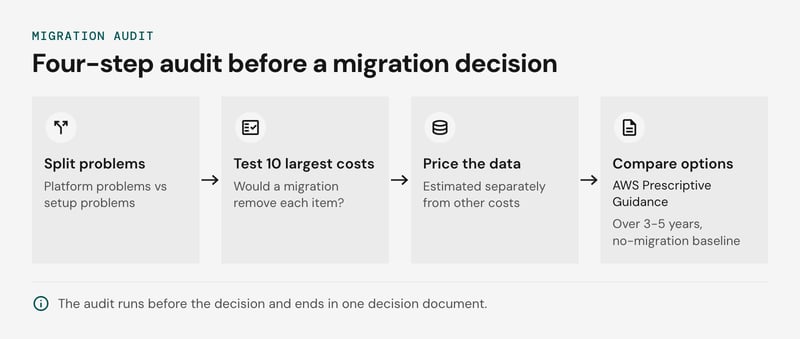
The audit behind that decision has four steps:
- Split platform problems from implementation problems. A platform problem survives a clean, well-run setup of the current supported version. An implementation problem comes from custom code, hosting configuration, integrations or data quality.
- Test the 10 largest cost items. Marcin Fuja, Engineering Manager at Netguru, describes the exercise: "We take the 10 biggest cost items from the last year and check whether those problems would exist on the target platform. If most of them disappear, we have a clear argument for migration. If they stay, we start with optimization."
- Price the data separately. Data migration is rarely the visible part of the estimate, and in Avalon's case it was the hardest.
- Compare options over 3-5 years, with the no-migration option as the baseline. Cost further optimization, a partial rebuild and a full migration against each other, including licences, hosting, maintenance, the cost of each change, a transition period with double running costs and the risk of a conversion dip after launch.
In Netguru's e-commerce platform audits this work typically takes two to four weeks, depending on the scale of the system. The baseline stops holding when the framework or CMS no longer receives security patches: then the audit mainly decides which approach to take.
Legacy modernization FAQ
What is legacy system modernization?
What are examples of legacy modernization?
How long does legacy system modernization take?
Do you always need to migrate a legacy system?
What to do next
Start with the trigger you can name, then match the approach to it: rising maintenance cost points to refactoring, a framework or CMS that has become the limit to a rewrite, an outgrown product to a replacement, and a channel gap on a sound platform to an extension.
Before committing budget, check whether the fault sits in the platform or in how it was implemented. Several of these projects needed no migration at all. If you want that diagnosis for your own system, you can talk to our team.


