
Retail software development: Netguru's approach and retail case studies


Contents
Retail software development is the discipline of connecting every shopper touchpoint — POS, mobile commerce, inventory management, fulfillment, and AI personalisation — into one coherent stack. It spans custom builds on Ruby on Rails, React Native and Flutter apps, Shopify Plus migrations, and MACH architecture rollouts. This article covers how Netguru approaches these decisions, illustrated through ten named retail builds and the architectural choices behind each.
Getting this foundational architecture right requires an experienced software development partner who understands both the business and technical stakes involved.
For retailers, these custom web builds must integrate seamlessly with POS, inventory, and personalisation layers rather than functioning as standalone storefronts.
The discipline has shifted from building ecommerce sites to orchestrating omnichannel commerce across stores, mobile, and autonomous retail formats — and the engineering decisions that enable that shift happen at the start of a project, not at go-live.
Retail software development in 2025: What's actually changed
Three years ago retail software development meant building an ecommerce site that could survive a Black Friday traffic spike. Today it means engineering a platform that can orchestrate omnichannel commerce across physical stores, mobile apps, and autonomous retail formats — simultaneously, in real time, with customer state persisting across every touchpoint.
The shift is architectural, not cosmetic. The decisions that determine whether a retail platform can support this — stack choice, data layer design, integration boundaries — happen in the first two weeks of a project, not at go-live. That's where most retail software development projects succeed or fail.
Retail market trends shaping software decisions
Four forces are rewriting retail software development priorities in 2026. Each one carries a specific architectural implication, ignore any of them at the planning stage and you'll be retrofitting within a relatively short timeframe.
Autonomous retail: From pilot to multi-site infrastructure
Autonomous retail has crossed the threshold from novelty to operating format. The Żabka Nano rollout in Poland, a frictionless grab-and-go store network using computer vision pipelines and edge inference, required IoT sensor fusion, on-device ML model serving, and a real-time inventory management system that legacy POS-centric stacks simply cannot support. The architectural implication is clear: autonomous store software needs edge compute with local inference latency under 200ms, plus a reconciliation layer that syncs transaction data back to central systems asynchronously, improving in-store efficiency and tightening supply chain visibility across regions.
Adoption is no longer experimental. The global retail automation market was valued at USD 24.12 billion in 2023 and is projected to reach USD 44.84 billion by 2030, a 9.1% CAGR from 2024 to 2030 (Grand View Research, Retail Automation Market Size & Share Analysis Report, 2030, 2024). Amazon Go, Aldi Shop&Go, Tesco GetGo, and AiFi-powered formats now operate across thousands of locations world-wide, signaling that custom retail software development services targeting autonomous formats have moved from differentiator to table stakes (see also 7 Proven Composable Commerce Companies That Deliver Results).
Mobile commerce: The primary channel, not a secondary one
Mobile commerce now drives the majority of e-commerce transactions in most retail categories, with smartphone purchases accounting for over 60% of global digital retail sales and continuing to grow at double-digit rates in emerging markets. When the METRO Brazil team wanted to modernize their B2B wholesale purchasing experience, the mobile app we shipped on React Native delivered a 70% DAU increase within the first three months of launch: evidence that meeting wholesale buyers on mobile, with fast catalog search and reorder flows, changes behavior measurably.
The competitive landscape is unforgiving. Shopify, Amazon, Mercado Libre, and Shein have set the latency and UX bar that mid-market retailers now have to match. The retail software development implication: mobile-first means designing APIs for low-latency, high-concurrency reads, not adapting a desktop web backend. React Native and Flutter each remain strong choices here, but the data retrieval layer, how Product data, pricing, and inventory reads are served, matters more than the framework decision.
Personalisation
Personalisation at scale requires a unified customer data platform feeding a recommendation engine. Fragmented systems, a legacy OMS here, a separate e-commerce database there, cannot support real-time personalisation because there is no single read surface for the ML layer to query, and the resulting insights stay shallow. Retailers planning personalisation investment should front-load the data exchange and unified profile work, or the AI layer will operate on stale, incomplete signals. The connected retail experience customers expect depends on data readiness that most mid-market businesses underestimate by at least one engineering quarter.
Omnichannel commerce: Closing the fulfillment gap
Omnichannel commerce has moved past click-and-collect basics into complex fulfillment orchestration, ship-from-store, locker delivery, same-day routing. Vinted Go's locker fulfillment software required event-driven architecture to coordinate locker availability, carrier handoffs, and buyer notification in near-real time. Legacy systems that rely on batch processing cannot support this. MACH architecture, Microservices, API-first, Cloud-native, Headless: is the dominant architectural pattern enabling omnichannel unification, because it decouples the order management layer from the customer experience layer, allowing each to evolve independently and improve supply chain responsiveness.
Footwear retailer Clarks achieved a 19% increase in conversion rate after moving to a composable commerce architecture, as highlighted by MACH Alliance member commercetools in an omnichannel retail context (Akeneo press release referencing MACH Alliance members at Retail Technology Show 2025). We saw this in practice with Lunching.pl: created a beautiful, pixel-perfect food ordering app with native-like experience, smooth micro-interactions, restaurant filtering by hours, ingredient lists, and integrated Firebase backend without custom development.
What retail tech challenges look like at scale
Integration debt is the most common reason retail software development projects stall: not unclear requirements, not budget overruns. The typical 200-store chain runs a POS platform that hasn't changed since 2014, a WMS bolted onto a 2019 ERP migration, and an OMS added during the COVID e-commerce surge. None of these systems share a unified data model. The result is fragmented inventory counts, split customer records, and order routing logic scattered across three platforms that were never designed to connect.
Three failure modes repeat across nearly every engagement we take on:
Inventory phantom stock. When the OMS reads availability from a cached WMS feed rather than a live one, overselling is inevitable. We've seen this cause 8-12% order cancellation rates in peak trading windows, a number that compounds hard when same-day fulfillment SLAs are in the contract.
Replatforming risk underestimation. Moving from a legacy monolith to headless commerce or Shopify Plus feels like a modernize-everything moment. In practice, the business logic embedded in the old POS and OMS rarely maps cleanly to the new data model. Teams discover this in UAT, not discovery, at which point the timeline has already slipped. Our replatforming risk model flags these mismatches at the architecture review stage, before a line of code is written.
Mobile retention engineering treated as an afterthought. Retailers build the e-commerce app, then ask why 60-day retention is under 20%. The answer is almost always that push notification segmentation, cart recovery, and loyalty state are reading from different data sources. Fixing this post-launch costs three times what it costs to design the unified data exchange layer upfront.
The systems problem is structural, not technical. Legacy platforms rely on batch synchronization, nightly inventory feeds, hourly loyalty point reconciliation, in an operating environment that now expects sub-second reads. Autonomous retail deployments using IoT shelf sensors make this worse: sensor events fire thousands of times per hour, and a fragmented backend has no decision-making path to act on them in real time. We saw this in practice with Żabka Polska: over 50 autonomous store locations launched.
The patterns above aren't edge cases. Salesforce State of Commerce (2024) found that 54% of retailers identify fragmented data as their top barrier to delivering unified commerce experiences Retail software development at scale is fundamentally an integration problem dressed up as a feature request.
Types of retail software teams build (and when each matters)
Not every retail software problem has the same shape. A Point of Sale (POS) rebuild, an inventory management system overhaul, and an omnichannel commerce platform are three completely different engineering investments, with different make-vs-buy thresholds, different integration surfaces, and different consequences when they fail. Here is how we read each category in practice, including the triggers that should push a team from buy to build.
| Software type | What it does | Build when | Buy (or extend) when |
|---|---|---|---|
| Point of Sale (POS) | Transaction processing, receipt generation, payment gateway integration, offline mode | Deep custom hardware integration (autonomous checkout, frictionless entry), or a legacy POS is strangling throughput at >200 transactions/hour/lane | Standard retail flow, no unusual peripherals, Stripe Terminal or Square covers 90% of the workflow |
| Inventory management system | Stock-level tracking, replenishment triggers, warehouse-to-shelf synchronization | Multi-node fulfillment with complex allocation rules, or IoT shelf sensors feeding a decision engine for real-time supply visibility | Single-warehouse, predictable SKU count under ~10k, Cin7 or similar handles it |
| Order Management System (OMS) | Cross-channel order routing, split shipments, returns orchestration | You operate across 3+ fulfillment nodes (stores, DCs, third-party lockers) and need custom routing logic tied to supply chain SLAs | Low order volume (<500/day), single channel, most e-commerce platforms include a serviceable OMS |
| Warehouse Management System (WMS) | Pick-pack-ship workflows, labor management, slotting optimization | You run your own DC and need to connect RF scanning, conveyors, or robotics to improve pick efficiency | 3PL fulfillment, their WMS is part of the service |
| CRM + loyalty | Customer data unification, segmentation, points and tier management | Real-time personalization at checkout, or loyalty rules too complex for off-the-shelf earn-and-burn models | Standard program, Salesforce Loyalty or open-source like Open Loyalty works |
| Omnichannel commerce platform | Unified cart, inventory visibility, customer experience across web, mobile, and physical channels | Decoupling from a monolith toward MACH architecture, or React Native / Flutter mobile apps tied to a headless backend | Pre-product-market-fit, Shopify Plus buys 18-24 months before you hit its ceiling |
| Mobile retail apps | Native or cross-platform shopping, scan-and-go, store-mode associate tools | You need offline-capable store-associate apps, scan-and-go in-aisle, or push-driven clienteling tied to CRM events | Catalog-browse and checkout only, a PWA or Shopify mobile SDK is enough |
| Retail analytics and data platform | Sales forecasting, demand sensing, unified customer insights, loss-prevention dashboards | Fragmented systems that can't connect and need a purpose-built data exchange layer for digital decisioning | You already have a cloud data warehouse and just need BI tooling on top |
| Autonomous retail / computer vision | Frictionless checkout, shelf-out-of-stock detection, edge inference at the camera layer | Unmanned format or high-throughput store where checkout queues are a documented revenue leak | Proof of concept only, production CV pipelines require significant MLOps investment |
| Virtual try-on / AR commerce | 3D product visualization, fit simulation, live AR overlays on mobile | Return rate is driven by fit uncertainty (apparel, eyewear, furniture) | Product catalog is commodity or size-standardized |
The make-vs-buy decision in custom retail software development often comes down to one question: Is the workflow a differentiator or a commodity? A grocery chain running an autonomous store format, as Żabka Nano does with its computer vision pipeline for frictionless checkout, cannot buy that capability off the shelf. The edge inference architecture, the product recognition model, and the anti-fraud logic are the product. Standard WMS software, by contrast, is a commodity; building it from Ruby on Rails when a mature SaaS option exists wastes investment that belongs in the customer experience layer.
A practical decision tree we apply: (1) Does the workflow touch a competitive moat or a unique supply chain constraint? If yes, build. (2) Does an off-the-shelf system cover 80%+ of requirements with stable APIs? If yes, buy and extend. (3) Will volume or node count double in 24 months? If yes, prefer headless or composable so you can swap components without a full rebuild.
In our experience, the categories teams most often get wrong are OMS and Omnichannel commerce. Both look like integrations until the business adds a fourth fulfillment node or a new sales channel, at which point a lightly customized platform collapses under routing complexity. Vinted Go's locker fulfillment software is a clear example: the locker-network orchestration logic had no viable off-the-shelf analogue, so the software development services engagement had to be custom from the ground up. Getting that call right at the start avoids a costly rebuild 18 months later.
For context, Omnichannel shoppers spend 13% more per transaction and purchase 250% more frequently than single-channel shoppers (Netguru research, How Commerce Engines Enable True Omnichannel Ecommerce Experiences). Case in point: Avalon Foundation hit a fully functional CRM in under 7 months with Netguru.
Custom build vs Shopify Plus, SAP, or Salesforce: how to decide
The decision is rarely about technology preference. It is about where your business rules sit on a spectrum from standard to genuinely proprietary, and whether your team can run what you choose.
Shopify Plus wins when your GMV is under $50M, your catalog is standard, and your team has fewer than three backend engineers. Above that threshold, or the moment you need pricing logic that Shopify's API cannot express, a custom loyalty tier that sits outside the reward catalog model, or deep ERP and supply chain integration, the platform starts costing more in workarounds than a custom build would cost to develop and run.
Here is the decision matrix we use in practice:
| Signal | Shopify Plus | SAP / Salesforce | Custom (MACH architecture) |
|---|---|---|---|
| Annual GMV | <$50M | $100M+ enterprise | $20M to $500M with complex rules |
| Catalog complexity | Standard SKUs, <100k products | Regulated, complex pricing | High variant count, custom attributes |
| Integration count | <8 systems | 20+ legacy systems | 8-25, mostly modern APIs |
| Team maturity | Small; prefers managed ops | Large IT org, SI partner | Mid-size eng team, microservices experience |
| Customization depth | Theme-level; checkout extensions | Deep ERP/WMS coupling | Full control over domain logic |
| Time to first revenue | 6-12 weeks | 12-24 months | 3-9 months |
| Year-one TCO range | $150k-$600k | $2M-$8M | $800k-$3M |
| Replatform risk at 24 months | High if GMV grows past ceiling | Low, but sunk-cost lock-in | Low if team retention holds |
SAP Commerce Cloud and Salesforce Commerce Cloud make sense when you are already deep in that vendor's data and identity layer, or when the alternative is building 40 integration adapters from scratch to connect fragmented legacy systems that were never designed to talk to each other. In those situations, the pre-built connectors justify the license cost. Where they break down is speed and efficiency: a mid-market retailer we worked with spent 14 months in a Salesforce implementation before a single customer-facing feature went live.
MACH architecture, meaning microservices, API-first, cloud-native, and headless, is the right foundation when your business rules are genuinely proprietary. Autonomous checkout logic, locker-based fulfillment routing, or a B2B wholesale ordering experience cannot be expressed in a SaaS platform's configuration layer. You build it, or you do not have it. This is the differentiation 40% of retailers cite as their biggest challenge (Netguru research, How to Build a Retail Media Platform? From Marketplace to Revenue Engine).
The honest version of this decision has three gates:
- Differentiation test: does this software capability differentiate you competitively, or is it table stakes? Inventory management is table stakes; buy it. A proprietary customer experience tied to your physical store network is differentiation; build it.
- Integration surface test: count your required integrations across commerce, supply, and identity systems. If more than a third connect to systems the platform does not have a certified connector for, your total cost of ownership on a SaaS platform climbs fast.
- Team readiness test: a MACH-based custom retail software development services investment requires engineers who understand event-driven patterns and idempotent API design. If that is not your current team, either hire before you build or use a managed platform while you grow into it.
That played out at Żabka Polska, where Netguru helped launch over 50 autonomous store locations, the kind of digital store format no SaaS platform in the world ships out of the box.
The most expensive mistake we see is choosing Shopify Plus for its speed, hitting its ceiling at month 18, then funding a full replatform. The second most expensive is choosing SAP for enterprise credibility and spending two years modernizing a system that a focused custom build would have delivered in nine months. Both mistakes share a root cause: the decision was made before the differentiation, integration, and team-readiness gates were honestly answered.
Case Study 1: Żabka Nano — autonomous store architecture
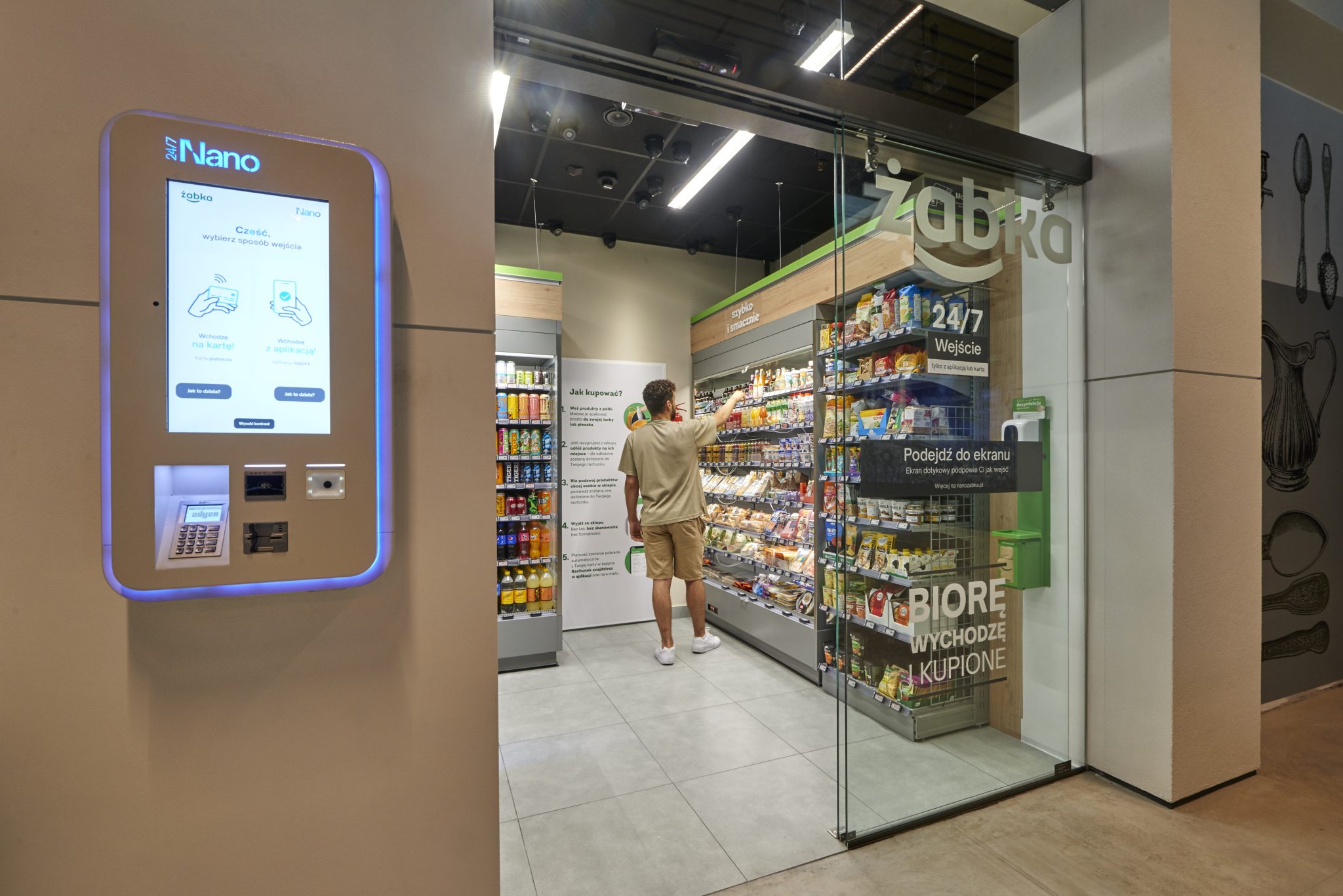
Żabka is Poland's largest convenience chain, with thousands of locations across Central Europe. When the business set out to launch Nano, an unmanned store format where customers walk in, take products, and walk out — with computer vision and IoT sensor fusion replacing the cashier — they needed a software partner who could build the entire operational and customer-facing layer from scratch.
Objectives
- Build a mobile entry and checkout experience that authenticates shoppers, opens the store, and reconciles their basket without a cashier in the loop
- Integrate the application layer with the in-store IoT mesh (cameras, shelf sensors, door controls) and the AI inference services responsible for item recognition
- Build a back-office and remote operations console so a small central team could monitor dozens of distributed stores in real time
- Design architecture capable of rapid expansion across numerous locations without per-site engineering effort
Outcomes
- 50+ Żabka Nano stores live across Poland, one of the largest autonomous retail deployments in Europe
- Mobile-first purchase flow that compresses entry, shopping, and payment into a single session — receipt arrives in-app within seconds of leaving the store
- A modular store-as-a-service backend that decouples the customer app, the IoT layer, and the recognition pipeline, so each can evolve independently
- Operational tooling enabling a remote team to handle stock alerts, hardware faults, and customer support across the entire estate from one dashboard
"Cooperation with Netguru allowed us to efficiently deliver our vision — the team brought valuable competencies in system architecture, backend development and cloud solutions that supported our business goals." — Paweł Grabowski, Head of Digital B2B at Żabka Future
Case Study 2: Delivery Hero — scaling engineering teams for global Q-commerce

Delivery Hero is one of the world's largest food delivery and Q-commerce platforms, operating across 70+ countries. Scaling engineering capacity to match aggressive product roadmaps — without sacrificing quality or onboarding speed — was the persistent challenge as the business grew.
Objectives
- Access flexible engineering talent capable of scaling up or down based on business cycles and seasonal peaks
- Cover expertise across multiple technology stacks — backend, frontend, data engineering, and design — from a single partner
- Achieve fast onboarding and seamless integration with Delivery Hero's internal teams and ways of working
Outcomes
- 150+ Netguru engineers and specialists engaged since 2019
- Teams scaled to 30+ professionals at peak demand; currently a dozen embedded specialists
- Coverage across 10+ technology areas including backend, frontend, data engineering, and product design
- Reduced onboarding time through Netguru's mature sourcing and vetting processes
"Netguru has helped us accelerate product development roadmap progress, speeding up time to market and impact." — Ulf Kirsten, VP at Delivery Hero
Case Study 3: METRO BRAZIL — mobile commerce on React Native
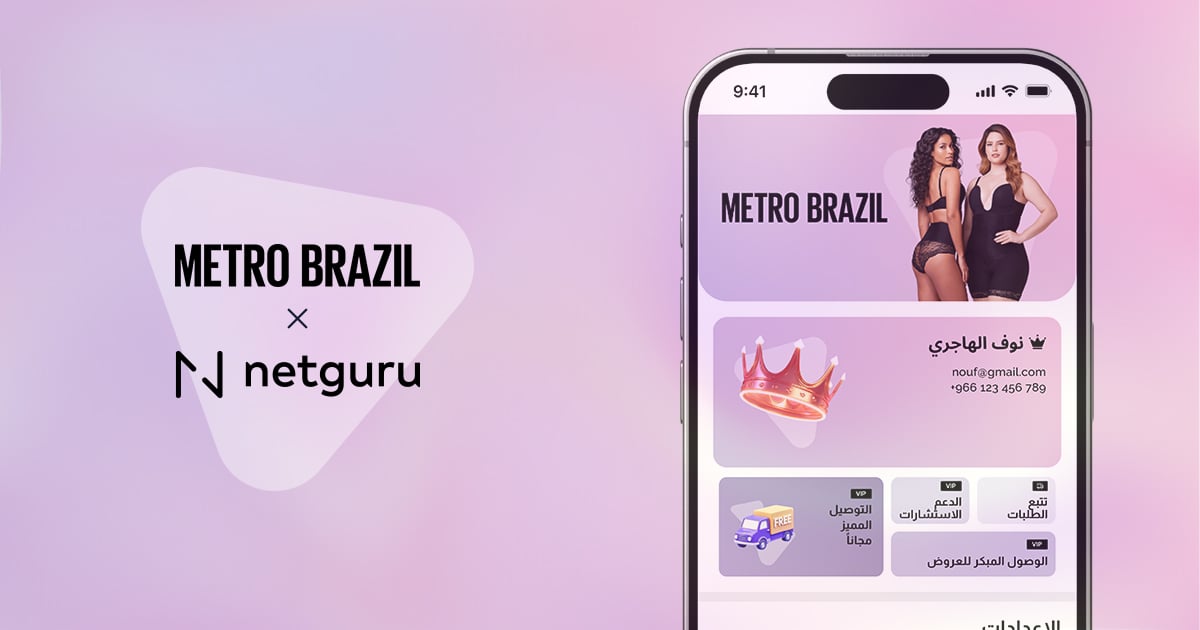
METRO Brazil serves both B2B wholesale customers and B2C shoppers across the Middle East and GCC markets. The existing native iOS and Android codebases were diverging in feature parity, slowing release cycles, and making it impossible to ship promotions, loyalty mechanics, and personalized catalogs at the cadence the market demanded.
Netguru rebuilt the mobile commerce stack on React Native, with a Ruby on Rails backend exposing product, order, and customer APIs to the app, the web storefront, and internal tools.
Objectives
- Replace diverging native iOS and Android apps with a single React Native codebase, with feature parity and a unified release pipeline
- Rebuild backend services to support B2B and B2C catalogs, pricing rules, and order workflows from a single API layer
- Add multi-language and multi-currency support for Middle East and GCC markets
- Deliver an exclusive VIP program for GCC customers with tier-based benefits
- Improve app performance, onboarding, and product discovery to drive daily active users
Outcomes
- +70% increase in daily active users within the first three months post-launch
- +50% improvement in customer satisfaction scores across B2B and B2C segments
- +40% growth in international and GCC orders driven by multi-currency support
- Single React Native codebase for iOS and Android, eliminating platform drift
- METRO BRAZIL VIP Program launched for GCC customers
- Seamless UI/UX parity with the web platform across all mobile flows
"The new application created by Netguru gave us the flexibility, performance, and user engagement we were looking for. It not only aligned with our platform's design but also significantly boosted user retention and sales." — Joseph Raphael, CTO at METRO BRAZIL
Case Study 4: Ledbury — merging online and offline sales
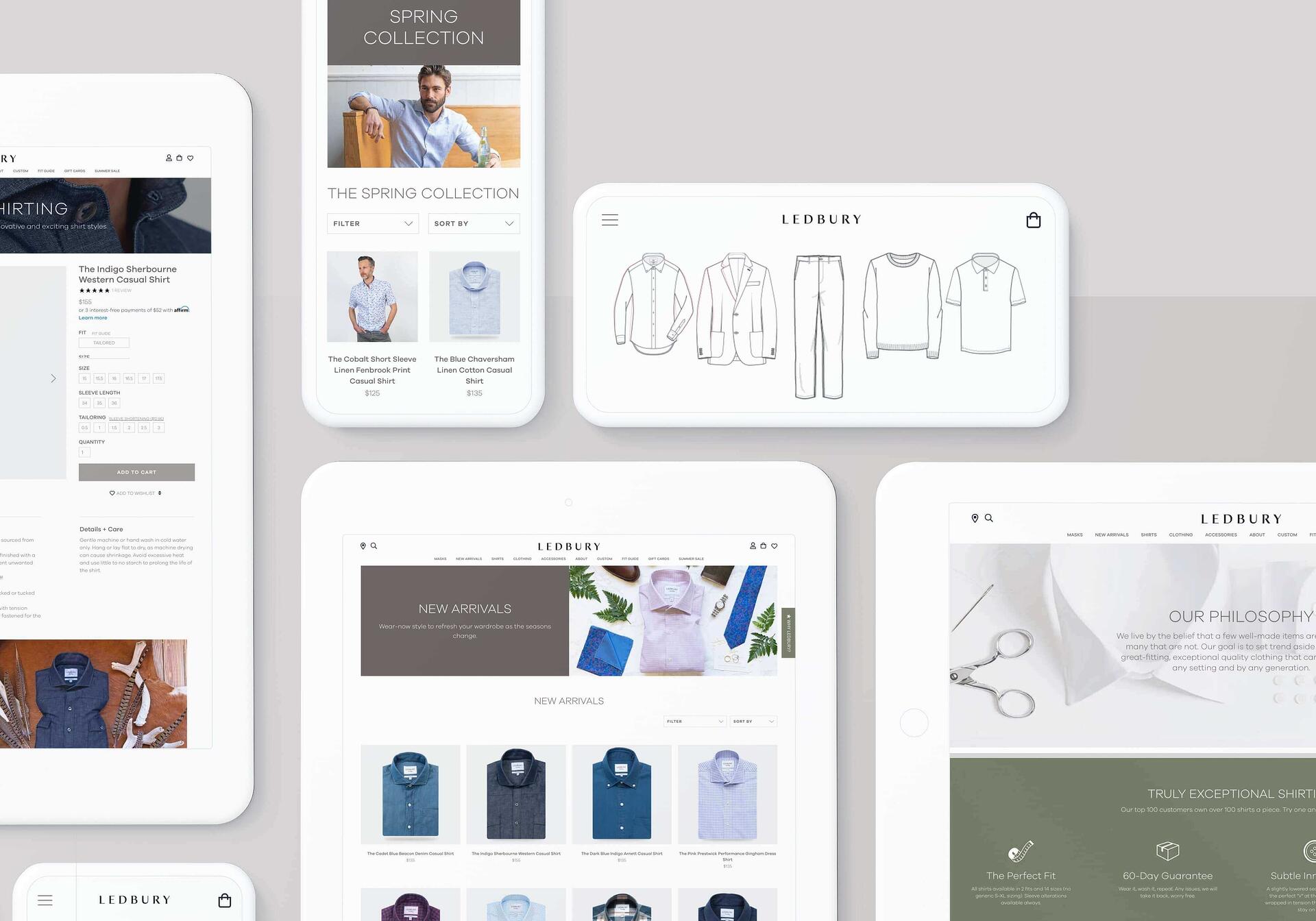
Ledbury is a premium menswear brand built on exceptional shirt quality. Its e-commerce platform and physical stores ran as parallel systems with no shared inventory truth or unified customer state — shoppers who browsed online could not reliably reserve stock at a store, associates had no visibility into web carts, and fulfillment defaulted to the warehouse even when a nearby store held the SKU.
Objectives
- Build a unified commerce layer connecting POS, e-commerce, and warehouse stock into a single inventory management backbone
- Enable BOPIS (buy online, pick up in-store) so customers could reserve shirts online and collect same-day at any retail location
- Give store associates a clienteling view of online purchase history, sizing preferences, and abandoned carts
- Reduce split shipments and warehouse-only fulfillment by routing orders to the closest location with stock
Outcomes
- 100,000+ shirts sold through the merged online and offline channel in the first year
- Omnichannel commerce flows live: customers move between web, mobile, and stores without losing cart state, sizing data, or loyalty context
- Inventory accuracy improved materially across all channels, reducing overselling and manual reconciliation
- BOPIS became a meaningful share of online orders, lifting store foot traffic and creating upsell opportunities at pickup
Case Study 5: Sportano — sports commerce app on React Native
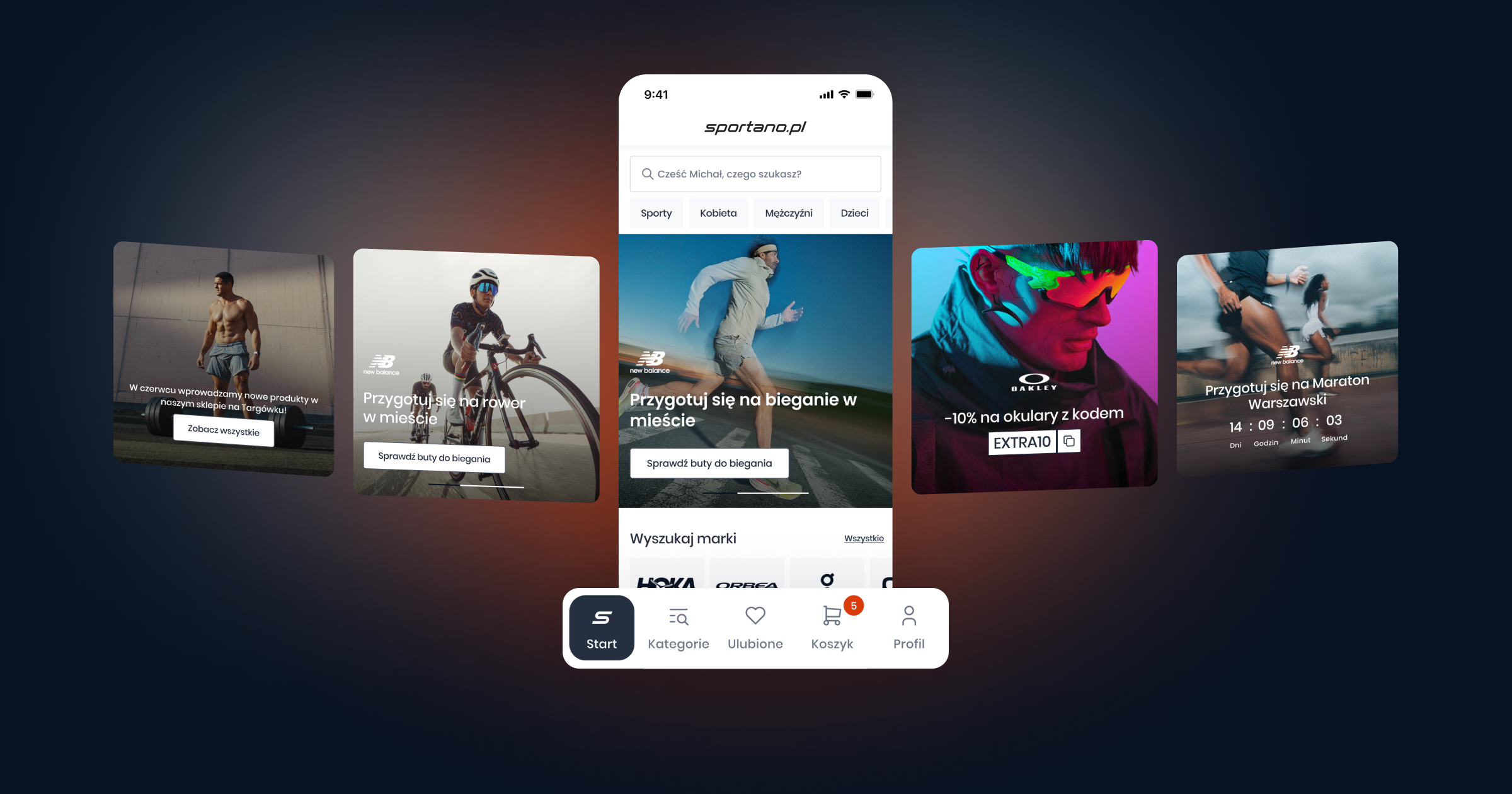
Sportano is a fast-growing sports and outdoor retail marketplace serving Central and Eastern Europe. The business was web-only, limiting spontaneous mobile shopping and the ability to compete on convenience with mobile-first sports retailers. Sportano needed a partner to own native-like mobile app development end-to-end, including complex integrations with third-party logistics and proprietary systems.
Objectives
- Build a cross-platform iOS and Android app using React Native that achieves native-like performance and UX
- Achieve full feature parity with the existing web application across catalog, checkout, loyalty, and account management
- Integrate with Sportano's third-party logistics, CRM, and product catalog systems
- Reduce website maintenance costs through a single shared codebase
- Lay a technical foundation for enhanced logistics capabilities and future personalization
Outcomes
- Dual-platform app deployed on iOS and Android within project timeline
- ~5,000 downloads in the first week of launch
- Full feature parity with the web application at launch
- 5.0-star rating on the App Store
- Net Promoter Score of 8 for the engagement
"Their mobile experience and React Native expertise, combined with close coordination on integrations, produced a robust solution that fully meets our objectives." — Grzegorz Kupidura, CTO at Sportano
Case Study 6: Vinted Go — carrier integration at European scale

Vinted Go operates one of Europe's largest peer-to-peer resale marketplaces across 22 markets. Scaling shipping across borders — each with different carrier contracts, label formats, and tracking APIs — without burning out internal engineering capacity was the core challenge.
Objectives
- Extend market reach across Europe without proportionally growing the internal engineering team
- Reduce dependence on individual carriers for better operational flexibility and cost efficiency
- Scale shipping operations to handle higher volumes at lower per-shipment cost
- Integrate new carrier services without creating integration bottlenecks
Outcomes
- New carrier integrations released on schedule, enabling new market entries
- 32.8M app downloads in 2023, supported by reliable shipping infrastructure
- 100% on-time delivery performance maintained during rapid expansion
- Net Promoter Score of 10 for the engagement
"I'm especially happy that the IT support teams, both ours and Netguru's, collaborate so smoothly that it feels like a single team." — Kasparas Kralikas, Engineering Manager at Vinted GO
Case Study 7: Otodom — product design driving user engagement metrics
-3.jpg)
Otodom (part of OLX Group) is Poland's largest property portal. The product team's design capacity couldn't keep pace with the roadmap — they needed senior designers who understood OKRs and could independently move metrics, not just execute on briefs.
Objectives
- Address talent scarcity that was blocking product development velocity
- Enable rapid project transitions while maintaining design consistency and quality
- Bridge collaboration across product, development, and strategy stakeholders
- Support infrastructure modernization including a Sketch-to-Figma migration
- Drive measurable improvements in user engagement and notification performance
Outcomes
- Subscription rate to saved search notifications: +116%
- Conversion from email to reply: +21%
- Share of logged-in users: +14%
- Subscription acquisition improved from -89/month to +6,488/month over five months
- 12,028 new saved searches created within two months of feature launch
Case Study 8: NEONAIL (COSMO Group) — AR virtual try-on for beauty retail
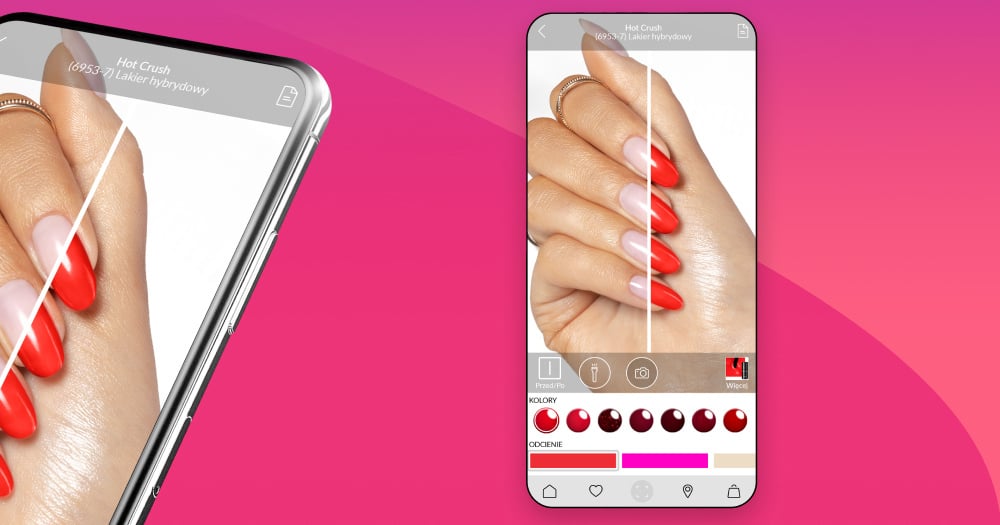
NEONAIL, part of COSMO Group, wanted to solve the core problem in online beauty retail: customers can't try before they buy. The solution required real-time 3D computer vision running on a mobile camera — a technically demanding engineering problem with a direct commercial outcome.
Objectives
- Develop a virtual try-on app enabling realistic 3D nail color testing in real time
- Create ML models that deliver natural appearance across devices with varying camera hardware
- Ensure seamless ecommerce integration for direct purchasing from within the app
- Achieve nail pattern stabilization, accurate color transfer, and realistic skin-nail boundary rendering
- Maintain performance across iOS and Android despite hardware fragmentation
Outcomes
- Color Match NEONAIL app launched on both iOS and Android
- Realistic 3D color transfer effect delivered with flawless pattern application at scale
- Cross-device compatibility achieved despite significant hardware variation
- Measurably increased customer purchase confidence — virtual testing reduces return rates in beauty retail
"Creating natural-looking, three-dimensional, colored nails in real time was challenging, so we took on Netguru because of their expertise in cutting edge technology." — Magdalena Bednarkiewicz, Senior Project Manager at COSMO Group
Case Study 9: Artemest — scaling a luxury ecommerce marketplace
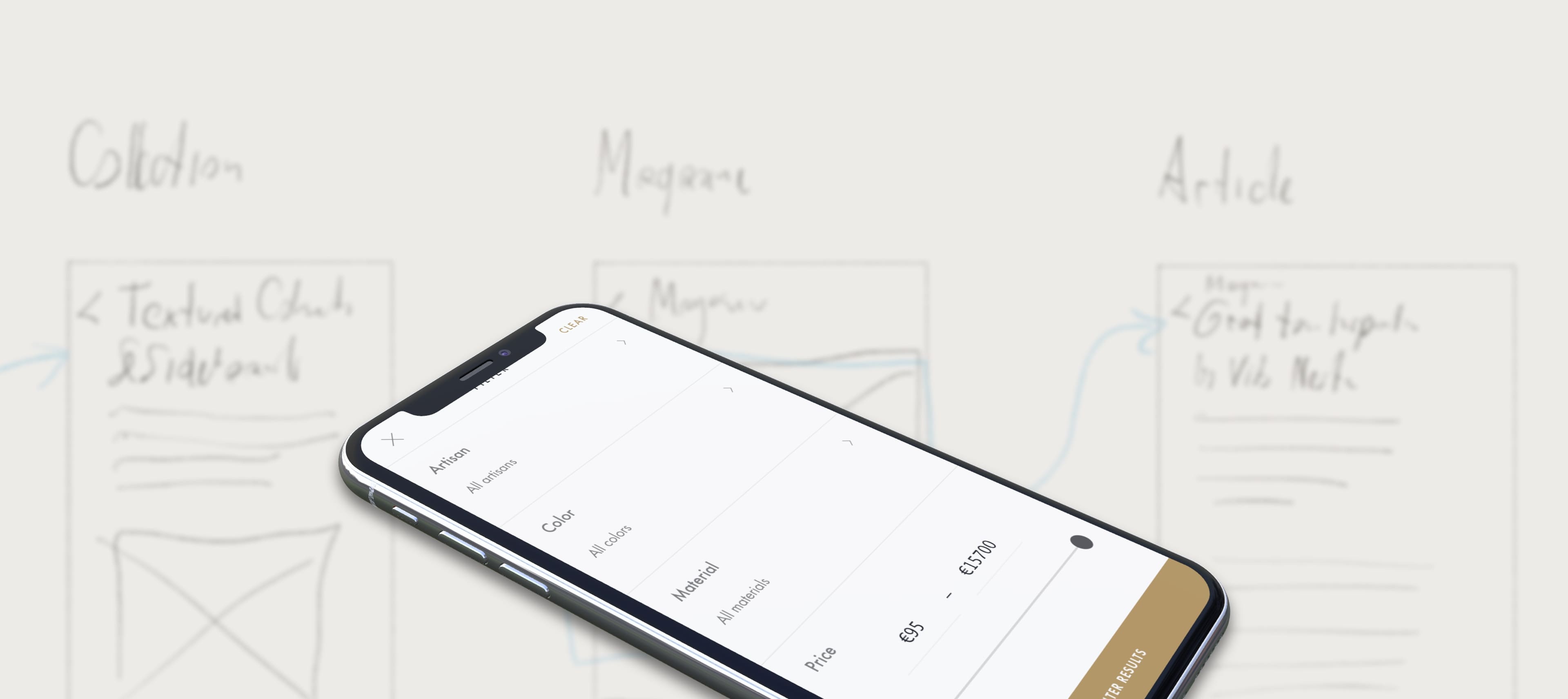
Artemest is a curated marketplace connecting collectors with independent Italian artisans and design studios. With 350+ vendors and a rapidly expanding catalog, the platform infrastructure needed a full renovation — without pausing the business.
Objectives
- Renovate platform infrastructure to support exponential vendor and catalog growth
- Execute comprehensive code review and architectural upgrade without disrupting live operations
- Build intuitive vendor tooling so artisans could manage their storefronts without technical complexity
- Expand into a new B2B trade channel alongside the existing consumer marketplace
Outcomes
- Full-stack renovation with DevOps optimization and enhanced platform scalability delivered
- Web and mobile applications relaunched to positive vendor and buyer community response
- Onboarding velocity sustained at 4–5 new artisans per week during and after renovation
- B2B trade channel launched, diversifying Artemest's revenue model
"Working with the Netguru Team was an amazing experience. They have been very responsive and flexible. We definitely increased the pace of development." — Marco Deseri, Chief Digital Officer at Artemest
Case Study 10: parcelLab — post-purchase experience as a conversion driver
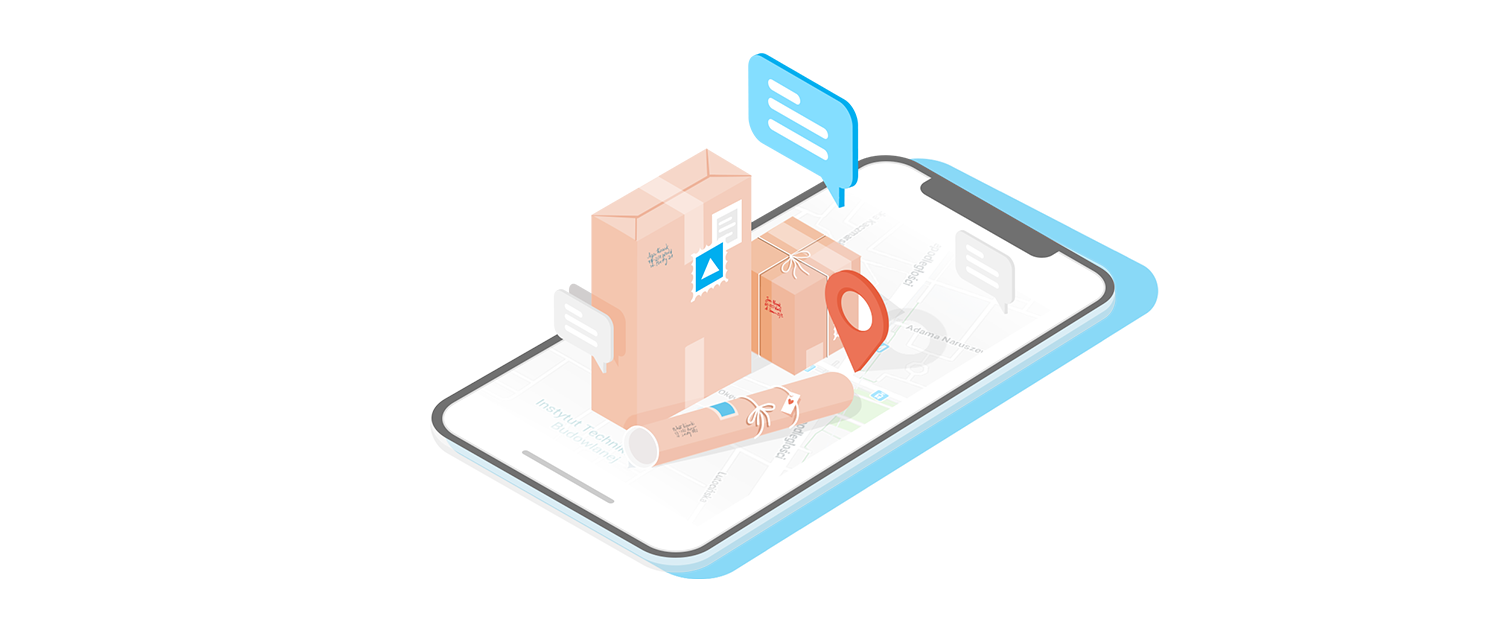
ParcelLab is a post-purchase experience platform that turns shipment tracking notifications — historically ignored transactional emails — into a revenue channel. Netguru helped parcelLab build the product and go-to-market presence that proved the concept in Germany's top retailers.
Objectives
- Demonstrate to retailers that delivery notifications represent an unexplored marketing and conversion opportunity
- Build landing page and product surfaces that could communicate the value proposition clearly across retail verticals
- Establish brand recognition and create product demand in the German ecommerce market
Outcomes
- 70%+ open rates and 30%+ click rates for delivery notifications — significantly above transactional email benchmarks
- Marc O'Polo generated 65,000 additional customer interactions with a 0.4% repurchase uplift
- 11teamsports achieved 19% revenue growth within two years of implementation
- Weltbild reduced returns by 5% after deployment
- Nearly one-third of Germany's top 100 online retailers adopted the solution
How Netguru approaches retail software development
Our retail software development process runs six phases, each producing a concrete artefact that the next phase builds on. The goal is to eliminate the ambiguity that turns a sensible roadmap into an expensive rework cycle.
Phase 1, Discovery (weeks 1-2). We map your existing systems, POS, inventory management system, OMS, CRM, against your growth objectives. The output is a decision log: which components to keep, which to replace, and where MACH architecture principles apply. This is where we decide whether you need a full headless replatform or targeted service extraction. Skipping this phase is how teams end up bolting a mobile commerce layer onto a monolith that can't support idempotent order writes at peak load.
Phase 2, Architecture (weeks 2-4). We produce a reference architecture with explicit service boundaries, event-driven integration patterns, and data ownership rules. For autonomous retail builds, this includes the edge inference topology, how computer vision pipelines connect to your inventory management system without saturating your core API gateway. For Omnichannel commerce projects, we define the unified data layer before any frontend work starts, because personalization and unified cart state both depend on it.
Phase 3, MVP (weeks 4-10). We ship a working vertical slice, enough to validate the riskiest assumption, whether that's checkout throughput, React Native or Flutter performance on target devices, or IoT message throughput on connected shelf hardware. Our METRO Brazil engagement went from initial architecture to a live B2B wholesale mobile app, and active users grew 70% within three months of launch. "The app gave us flexibility and performance, and boosted user retention and sales," said Joseph Raphael, CTO at METRO Brazil.
Phase 4, Integration (weeks 8-14). Payment gateways, ERP connectors, Shopify Plus extensions, loyalty engines, and third-party fulfillment APIs come in here. We treat integration as an engineering concern, not a configuration task, each connector is built with retry logic, dead-letter queues, and observable failure states. For Żabka Nano's autonomous store network, this phase covered the edge-to-cloud pipeline that coordinates computer vision output with real-time inventory reconciliation across 50+ live locations.
Phase 5, Rollout (weeks 12-20). We manage phased traffic migration, feature flag governance, and rollback procedures. For multi-site retail, rollout is environment-specific: a Vinted Go locker fulfillment software release has different blast-radius concerns than a Shopify Plus storefront update. Our engineers stay on the critical path through go-live, not just until handoff.
Phase 6, Support and iteration. Post-launch, we provide SLA-backed engineering support and run regular architecture reviews. Teams that modernize on this cadence consistently see 40-60% faster release cycles within the first year compared to their legacy monolith baseline, a pattern we've read across multiple client engagements.
Across all phases, we bring 18+ years of retail software development experience, 400+ engineers, and a 4.9/5 client rating on Clutch. The process is calibrated for the complexity CTOs actually face: fragmented legacy systems, aggressive go-live timelines, and a business that cannot afford a full-stop migration.
AI use cases in retail software
AI in retail software is only as good as the data infrastructure underneath it. Each of the four use cases below has a distinct integration prerequisite, ship those first, or the AI layer will underperform regardless of model quality.
Demand forecasting
AI-driven demand forecasting reads historical sales, supplier lead times, seasonal signals, and external variables (weather, local events) to generate SKU-level replenishment recommendations. The prerequisite is a unified inventory management system with at least 18 months of clean transaction history and a reliable data exchange path to your OMS, warehouse management system, and upstream supply chain partners. Without that, models train on noise. In practice, retailers running fragmented legacy systems that rely on manual stock counts see forecast accuracy degrade by 15-25 percentage points compared to peers with integrated supply chain data, and the efficiency gains on inventory carrying costs disappear with them.
AI-based forecasting improves forecast accuracy by 10-20% over conventional methods (AWS Architecture Blog summarizing a McKinsey study, 2023). For more on this, see The Future of Order Management Systems: Trends Shaping Commerce in 2026..
Personalisation
Personalisation in omnichannel commerce spans product recommendations, dynamic pricing, and triggered lifecycle messaging. The integration prerequisite is a unified customer identity, a single profile that connects e-commerce sessions, mobile commerce events, in-store POS transactions, and loyalty data. Without cross-channel identity resolution, recommendation models optimise for one touchpoint while ignoring the others, which produces the familiar failure mode: a customer buys a product in-store, then sees ads for it online for two weeks. The insights a clean identity graph unlocks (lifetime value scoring, churn signals, segment-level price elasticity) are what separate a working personalisation layer from a marketing dashboard.
Computer vision, autonomous checkout and loss prevention
Autonomous retail represents the highest-complexity AI deployment in the retail software development stack. The Żabka Nano autonomous store project, where our software development services team built the computer vision pipeline for Poland's first cashierless convenience store, required edge inference running on in-store hardware, a real-time product recognition model trained on thousands of SKU images, and an event-driven architecture to reconcile basket state as customers moved through the store. The data prerequisite is substantial: structured planogram data, high-resolution shelf imagery per SKU, and integration between the vision pipeline and the inventory management system for real-time stock delta updates.
That same project showed how tightly the computer vision layer has to couple to the rest of the digital stack. For loss prevention specifically, the vision infrastructure connects to shrinkage detection models that share the recognition backbone. The key architectural decision is where inference runs: cloud round-trips add 200–400ms of latency that breaks the real-time requirement, so edge inference is the only viable path for production autonomous retail anywhere in the world.
Self-checkout friction and queue management
Self-checkout AI addresses two distinct problems: item recognition errors (the "unexpected item in bagging area" failure that drives customer abandonment) and queue-length prediction for dynamic lane management. The prerequisite for recognition is a product image dataset maintained in sync with your catalogue, stale training data is the main reason self-checkout accuracy degrades over months after launch. Queue management requires foot-traffic sensor data feeding a decision-making layer that can trigger staff alerts or open additional lanes to improve throughput at peak hours. Both connect back to the POS layer; ensure your POS exposes a real-time event stream rather than batch exports, or the feedback loop has too much lag to be useful.
Retail solutions we build and the stack behind them
React Native and Flutter power our mobile commerce builds; Ruby on Rails underpins our API layers and back-office services; Shopify Plus handles mid-market e-commerce where GMV sits below the threshold where custom makes economic sense. In our experience, above roughly $50M annual GMV, the total cost of Shopify Plus constraints, rigid checkout extensions, limited data model control, restricted B2B pricing logic, typically exceeds the cost of a headless commerce architecture. That's when we recommend decoupling the storefront from the commerce engine entirely.
Here is how our retail software development practice maps to the problems retailers actually bring us:
| Problem | What we build | Primary stack |
|---|---|---|
| Fragmented mobile experience | Cross-platform commerce apps | React Native, Flutter |
| Shopify Plus hitting GMV ceiling | Headless commerce replatform | Next.js + custom API layer |
| Siloed inventory and order data | Omnichannel commerce middleware | Ruby on Rails, event-driven microservices |
| Checkout friction in physical stores | Modern POS and self-checkout systems | IoT sensors, edge compute, Node.js |
| Autonomous store operations | Computer vision + access control | IoT, edge processing, cloud ML |
| Weak personalisation at scale | AI recommendation and search layer | Python ML services, embeddings |
Mobile commerce. React Native works well when a retailer needs a single codebase across iOS and Android with near-native performance. Flutter is our choice when animation fidelity or offline-first behaviour matters more, typically for loyalty or clienteling apps where the customer experience is the product.
Replatforming. Our Shopify Plus migration playbook starts with a data readiness audit: unified product taxonomy, clean customer records, and idempotent order APIs before a single storefront line moves. Skipping that step is where replatforming projects stall at month four.
Autonomous retail. IoT sensor integration, weight cells, RFID, computer vision, connects physical inventory to a unified data layer in real time.
EMarketer forecasts that in 2025, global retail mcommerce sales will account for roughly 70% of total retail ecommerce sales (EMarketer (Mcommerce: Reports, Statistics & Marketing Trends), 2025). For more on this, see 47 Ecommerce Statistics for Online Store Owners in 2025.
In practice, no retailer needs all six tracks at once. We run a two-week discovery to identify which systems are the binding constraint on revenue, then sequence development investment accordingly.
When headless or MACH architecture actually makes sense
MACH architecture earns its complexity premium at specific scale thresholds, not by default. Below $50M GMV, the operational overhead of managing five independently deployed services (API gateway, product catalog, cart, checkout, order management) routinely exceeds the flexibility gains. Above that threshold, the calculus flips.
The decision gate we use in practice has three conditions. If your team answers yes to all three, MACH is the right investment:
- Release velocity is bottlenecked by your monolith. If a POS change blocks a checkout deploy, you're paying the microservices tax anyway, without the benefit.
- You need data sovereignty across channels. Headless commerce decouples your storefront from your backend, letting you read unified customer data into a CDP without extracting it through a vendor's API rate limits.
- Your GMV or order volume is outgrowing managed SaaS guardrails. Adobe Commerce (Magento) and Salesforce Commerce Cloud both offer headless front-end support, but their data models still constrain B2B pricing logic and multi-warehouse inventory management at scale.
Where this breaks down: teams that modernize to MACH without staffing a platform engineering function. The architecture requires someone owning the service mesh, deployment pipelines, and schema contracts. On one recent engagement, a 120-person retailer adopted headless commerce with no dedicated platform engineer, within nine months, catalog latency had degraded by 40% due to unmanaged cache invalidation across three systems.
45% of headless commerce adopters cite integration challenges and implementation complexity as their top barrier to adoption (Gitnux, Headless Commerce Statistics: Market Data Report 2026 (compiled from recent retailer surveys), 2024). For more on this, see Headless Commerce 101: Why Decoupling Your Storefront Is the Future of Retail.
Shopify Plus remains the right default for direct-to-consumer brands under the GMV threshold. The moment custom checkout logic, multi-entity inventory, or connected IoT in-store systems enter the picture, a composable build with a focused services layer outperforms any managed platform.
Frequently asked questions
How long does a retail software development project take?
Based on our delivery experience, most retail software development engagements run 3-9 months from discovery to production, depending on integration complexity and the digital capabilities in scope. A greenfield mobile commerce app typically ships in 12-16 weeks. A focused loyalty or analytics module lands in 8-14 weeks. A full replatforming of legacy systems that connect POS, ERP, e-commerce, and supply chain telemetry runs 6-12 months, with enterprise omnichannel programs stretching to 18 months when warehouse and store operations are in scope. The biggest schedule risk is fragmented data contracts between third-party systems: resolve those in week one.
What does custom retail software development cost?
Custom retail software development typically ranges from $80,000 for a focused mobile or loyalty application to $500,000-$2M for a full omnichannel commerce platform build with supply chain and analytics integrations, based on industry project data. According to client reviews, the average cost for an e-commerce development project is $51,943.13 (Clutch, E-Commerce Website Development Pricing Guide, 2026). Research indicates that integration work, connecting inventory management, POS, and fulfillment APIs, usually accounts for 30-40% of total investment. Scope the integrations first; they drive the budget more than the front-end.
Can you work with our existing Shopify plus or SAP stack?
Yes, Netguru builds on top of existing Shopify Plus and SAP environments rather than replacing them. For Shopify Plus clients, we extend via Custom apps, the Storefront API, and headless front-ends where the standard theme layer hits its limits. For SAP estates, we layer commerce, analytics, and customer-facing capabilities around the core to improve operational efficiency without disrupting finance or supply chain modules. Ripping out a working stack mid-growth is the highest-risk move in retail replatforming; we plan integrations to modernize around your core, not discard it.
Do you handle in-store iot and computer vision builds?
Netguru engineers IoT sensor networks, edge compute pipelines, and computer vision systems for autonomous retail applications. Our work on Żabka Nano, , involved designing the data exchange layer between shelf sensors and the central inventory management system across 50+ stores, generating real-time insights for replenishment and supply chain decisions. If your autonomous retail plans require real-time stock monitoring or frictionless checkout, that infrastructure is within our delivery scope.
How do you measure success on a retail software project?
We agree on KPIs before the first line of code: conversion rate, mobile retention (D30), average order value, and fulfillment error rate are the four metrics that matter in most retail engagements. For omnichannel commerce builds, we also track cross-channel attribution, unified customer profile completeness, and analytics adoption rates inside the merchandising team. A project without pre-agreed KPIs has no honest definition of done; we treat that agreement as a project prerequisite, not an afterthought.
What's the difference between retail software development services and a product agency?
A product agency owns the roadmap; a retail software development services partner executes against yours while contributing engineering judgment on trade-offs. Netguru sits closer to the second category: we embed with your team, challenge architectural decisions where future plans warrant it, and hand over systems your engineers can maintain. The practical difference shows up at handoff: you own the code, the infrastructure, and the documentation.
How to evaluate a retail software development partner
The right retail software development partner is not the one with the longest client list — it is the one who asks the right questions before writing a line of code. When evaluating vendors for retail and commerce builds, these are the signals that separate partners from contractors.
They scope integrations before estimating. Retail projects overrun budgets almost exclusively because of integration complexity — POS, ERP, OMS, and loyalty systems that were never designed to communicate. Any partner who quotes a fixed price without first auditing your integration surface has not done this before. Expect a two-week discovery sprint before any financial commitment.
They have shipped at your traffic tier. A React Native app for a 50,000-SKU sports retailer is a different engineering problem from a mobile app for a 200-person SaaS. Ask for references from clients with similar transaction volumes, not just similar industry tags.
They own the architectural decisions. Staff augmentation fills seats. A genuine development partner pushes back on wrong stack choices, flags integration risks that will surface at go-live, and owns the Architecture Decision Record — not just the sprint velocity.
They can show post-launch retention. The worst retail builds look fine at handoff and collapse under Black Friday load. Ask what percentage of their retail clients remained with them for 12+ months post-launch. Netguru's average engagement length is 18+ months; for retail builds specifically, post-launch retainers are the norm, not the exception.
They work within your compliance constraints from day one. PCI DSS, GDPR, HIPAA for health-adjacent retail, and emerging autonomous store regulations are not retrofittable. If a partner treats compliance as a final-stage checklist rather than an architectural input, your go-live date will slip.
If you are evaluating Netguru as a partner, the fastest path is a Scoping call where we map your integration surface, flag the three most common failure points for your project type, and give you a realistic timeline — before any engagement begins.


